Arbitrage — What It Means and Where the Edge Went
Arbitrage means capturing a price gap across two venues at once. What it really is, the main risks, and why the edge is thin from a retail seat.
Arbitrage is the practice of buying and selling the same asset, or its close equivalent, across two venues at the same time to capture a price gap that should not exist. The trade does not predict direction. It locks in the difference between a low price in one market and a higher price in another, then closes both legs before the gap disappears.
That definition sounds clean. From a retail seat it is harder. Most gaps worth taking are gone in milliseconds, and the firms that take them sit next to the exchange with hardware you do not have. Understanding arbitrage still matters, because the same logic — fair value and execution over prediction — runs underneath almost every disciplined trade you place.
What arbitrage actually means
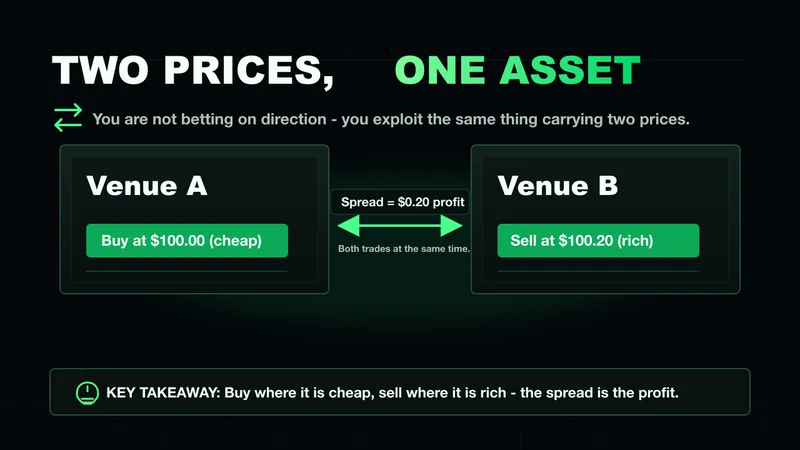
The arbitrage meaning is narrow on purpose. You are not betting that an asset goes up. You are exploiting the fact that the same thing carries two prices at once. Buy where it is cheap, sell where it is rich, and the spread is the profit. In a perfectly efficient market that spread is zero. Arbitrage exists only because markets are not perfectly efficient in every moment.
A few recognized forms:
- Spatial arbitrage takes the same asset listed on two exchanges.
- Triangular arbitrage works three currency pairs until the cross rate disagrees with the implied rate.
- Merger arbitrage buys a target company below the announced deal price and waits for the deal to close.
The mechanics differ, but the principle holds: price out of line with fair value, corrected by your trade. What makes arbitrage distinct from speculation is the risk shape. A directional trade is wrong when price moves against you. A clean arbitrage trade is supposed to be wrong only when execution fails.
How does arbitrage work in practice
In theory both legs fire at once and the spread is yours. In practice, work backward from where it breaks.
The gap has to be wider than your total cost to act on it: commissions, exchange fees, the bid-ask spread on both legs, financing if you hold overnight, and slippage. A two-cent dislocation looks like free money until you add a one-cent spread on each side and a fee on top. Then it is a loss. This is why most visible arbitrage is taken by institutions; their cost per trade is low enough that thin gaps still clear a profit, and their systems are fast enough to fill both legs first.
Speed is the other constraint. The gap signals that the market has not finished pricing something. The moment it does, the gap collapses. If your second leg fills a half-second late, you are no longer arbitraging — you are holding a naked directional position you never intended, at a price you did not choose. So the real work is not finding the gap. It is confirming the gap survives your own costs and your own fill speed. Most of the time it does not.
A simple arbitrage example for new traders
Take one stock dual-listed on two exchanges. On the first it trades at 100.00. On the second, briefly, at 100.08. The arbitrage example writes itself: buy at 100.00, sell at 100.08, pocket eight cents per share, repeat at size.
Now price it honestly. Say each leg costs a penny of spread and a small per-share fee. The eight-cent gap is closer to five cents after costs, before slippage. If the second exchange moves while you are still working the first leg, those five cents can become zero, or negative. The trade that looked risk-free carried execution risk the whole time. The headline number is the gross gap; the number that pays you is what survives costs and both fills. New traders see the first and miss the second.
The main risks of arbitrage
The phrase risk-free arbitrage is the most expensive idea a new trader can hold. Real arbitrage carries risk; it is just shaped differently from a directional bet. The main risks of arbitrage are concrete:
- Execution risk. One leg fills, the other does not, and you are exposed to the direction you were trying to avoid.
- Cost risk. Fees, spreads, financing, and slippage eat the gap. A gap narrower than your all-in cost is a loss disguised as an opportunity.
- Settlement risk. The two venues settle on different terms; a failed transfer or a halted exchange leaves you holding one side.
- Model risk. In merger or statistical arbitrage, your fair value is an estimate. If the deal breaks, the convergence you waited for never comes.
Gold is a useful reminder. GC can trade technically for hours, then invalidate an entire structure within minutes when a macro headline hits. A relationship you treated as stable enough to arbitrage breaks the same way. The gap you were harvesting was never a law; it was a condition.
Arbitrage vs market making
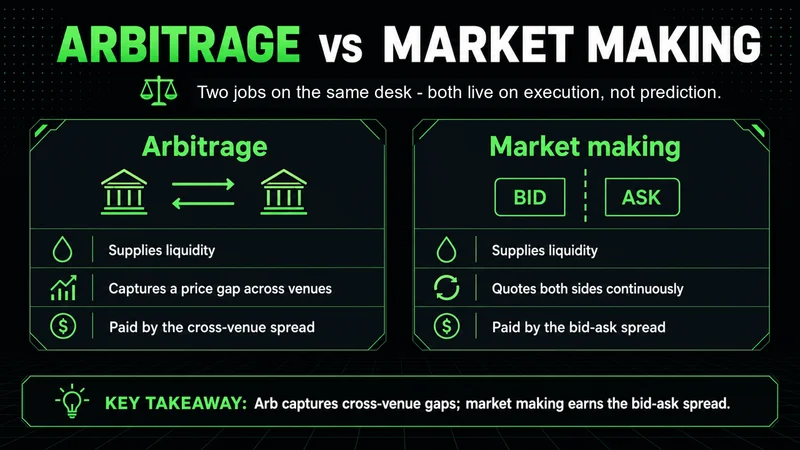
People treat arbitrage vs market making as a rivalry. They are closer to two jobs on the same desk. Both supply liquidity, both profit from small repeatable edges, and both live or die on execution quality rather than prediction.
The difference is what they are paid for. A market maker quotes both sides of one instrument and earns the bid-ask spread for standing ready to trade; the risk is inventory, getting filled on one side and stuck holding it while price moves. An arbitrageur holds offsetting positions across two instruments or venues and earns their convergence; the risk is that the two legs stop being two faces of the same thing.
For a retail trader, both are dominated by participants faster and better-capitalized than you. That does not make the concepts useless. The discipline underneath — define your edge, your cost, and what makes you wrong — survives in any strategy you can run.
Rules and a checklist before you call it arbitrage
The edge in arbitrage is thin and the costs are fixed, so a broken rule shows up in the numbers faster than it would in a directional trade. That makes the rules worth stating plainly. A few hold across every form:
- Price the trade fully before you act — commissions, both spreads, financing, slippage. If the gap does not clear all of it with room left, it is not a trade.
- Never leave a leg naked. If you cannot fill both sides nearly at once, you are not arbitraging.
- Define the invalidation. Know in advance what tells you the relationship has broken, and act on it.
The common arbitrage mistakes beginners make follow from skipping those: treating the gross gap as profit, assuming risk-free means no risk, holding a half-filled trade and hoping the second leg returns, and competing on speed against systems built for it.
This is the arbitrage checklist worth keeping at the desk:
- Is the gap real and live, not stale data?
- Does it survive my full cost?
- Can I fill both legs nearly at once?
- Do I know exactly what invalidates the trade?
If any answer is no, there is no trade.
And here is where it stops working. This framework holds while the two prices stay tethered to the same underlying value. The moment that link breaks — a halted venue, a failed deal, a regime shift that re-rates one leg and not the other — the position you thought was hedged becomes two separate directional bets, and the arbitrage you sized as low-risk is suddenly the largest exposure on your book.
FAQs
What is arbitrage in simple terms? It is buying and selling the same asset, or its equivalent, in two markets at once to capture a price difference that should not exist. The trade profits from the gap closing, not from direction.
Is arbitrage good for beginners? Rarely, in its pure form. The gaps are small, they close in milliseconds, and the participants taking them have lower costs and faster systems than a retail trader. The concept is worth learning; competing head-on for the edge is not.
Is arbitrage risk-free? No. The risk shifts from direction to execution. If one leg fills and the other does not, or if costs exceed the gap, you lose. Treating it as risk-free is the most common and expensive mistake.
When should traders use arbitrage thinking? Use the logic even when you cannot run the pure trade. Pricing an edge against its full cost, refusing to hold a half-finished position, and defining invalidation in advance improve any strategy.
What is the difference between arbitrage and market making? A market maker quotes both sides of one instrument and earns the spread, carrying inventory risk. An arbitrageur holds offsetting positions across two venues and earns their convergence, carrying the risk that the two stop tracking each other.
Worth the read?