Fiscal Policy — What It Means and How Traders Read It
Fiscal policy is how a government uses spending and taxation to steer the economy. Here is what it means and how traders read it as market context.
Fiscal policy is how a government uses spending and taxation to influence the economy: more spending or lower taxes to support demand, less spending or higher taxes to cool it down. That is the textbook definition, and it is correct. What the textbook leaves out is the part that matters at the screen. By the time a fiscal decision reaches the tape, the market has usually already taken a position on it.
Most explainers treat fiscal policy as an input that moves price in a straight line. Spending goes up, stocks go up. Taxes go up, stocks go down. Real markets do not behave that cleanly. The headline is rarely the trade. The positioning around the headline is.
What fiscal policy actually means
Fiscal policy lives with the legislative and executive branches, not the central bank. In the United States, that means Congress sets spending levels and tax law, and the Treasury manages the cash. The two levers are direct. One is how much the government spends. The other is how much it takes back through taxes. The gap between them is the deficit or the surplus, and that gap is funded by issuing debt.
This is the cleanest way to understand the fiscal policy meaning without getting lost in theory. The framework reduces to a short list:
Spending — what the government injects into the economy through programs, transfers, and public investment.
Taxation — what it withdraws from households and firms.
The balance — the deficit or surplus that results, funded by issuing debt.
Spending and taxes are the inputs. Aggregate demand, employment, and inflation are the outputs the policy is trying to steer. Everything else is detail layered on top of those two levers.
Expansionary and contractionary, and why the label matters less than the timing
Fiscal policy comes in two stances. Expansionary policy increases spending or cuts taxes to lift demand, typically during a slowdown. Contractionary policy does the reverse to slow an overheating economy. Stimulus checks and infrastructure programs sit on the expansionary side. Tax increases and spending cuts sit on the contractionary side.
The labels are simple. The timing is not. Fiscal action moves slowly. A spending bill is debated for months, passed, and then disbursed over quarters or years. By the time the money reaches the real economy, the conditions that justified it may have changed. This lag is the single most underappreciated feature of fiscal policy, and it is exactly where traders who treat the announcement as the event get caught.
There are also automatic stabilizers that work without any new vote. Unemployment benefits rise in a downturn and fall in a recovery. Progressive tax revenue does the opposite. These mechanisms cushion the cycle quietly, and they are part of why a single headline tells you less than it appears to.
Fiscal policy versus monetary policy
The fiscal policy vs monetary policy distinction is the one most traders blur, and it costs them context. Fiscal policy is spending and taxation, controlled by the government. Monetary policy is interest rates and money supply, controlled by the central bank. Both aim at growth, employment, and price stability, but they pull different levers and move on different clocks.
Dimension | Fiscal policy | Monetary policy |
|---|---|---|
Controlled by | Government and legislature | Central bank |
Main tools | Spending, taxation, transfers | Interest rates, money supply |
Speed of impact | Slow, with long implementation lags | Faster, though it still works with a lag |
Direct market read | Debt issuance, deficit path | Rate decisions, forward guidance |
The practical takeaway is that monetary policy usually reprices markets faster because a rate decision is a single, scheduled, binary event. Fiscal policy reprices the economy more directly through actual cash, but the market reaction is spread out and harder to isolate. When the two move in the same direction, the effect compounds. When they conflict, the central bank's clock tends to dominate the near-term tape.
Fiscal policy as an economic indicator
Treating fiscal policy as an economic indicator is more useful than treating any single bill as a catalyst. What you are reading is the trajectory of the deficit, the size and composition of spending, and the supply of new government debt that funds it. Heavy debt issuance, for example, can pressure yields, and yields feed directly into how equities are valued.
This is why the fiscal picture matters even when no headline is breaking. A widening deficit financed by a flood of new Treasury supply changes the backdrop that every other asset trades against. You do not need a vote on a given day for the fiscal stance to be exerting pressure on the curve.
How traders actually use fiscal policy data
Here is the part the top results skip. A trader does not buy stocks because a spending bill passed. A trader reads how the market is positioned into the event and how price behaves after the information is out.
The sequence I watch is straightforward:
Context — is the fiscal news already expected, or is it a genuine surprise? An expected bill is largely priced in before the ink dries.
Reaction — does price accept the move in the direction the headline implies, or does it reject and reverse?
Structure — once the first reaction resolves, is there a level to define risk against, or is the move just noise?
Acceptance after a fiscal surprise tells you positioning agreed with the narrative. Rejection tells you the move was already in the book and the headline was an exit, not an entry.
Liquidity drives markets more than opinions do. The headline tells you what happened; the positioning around it tells you what the market was already prepared to do.
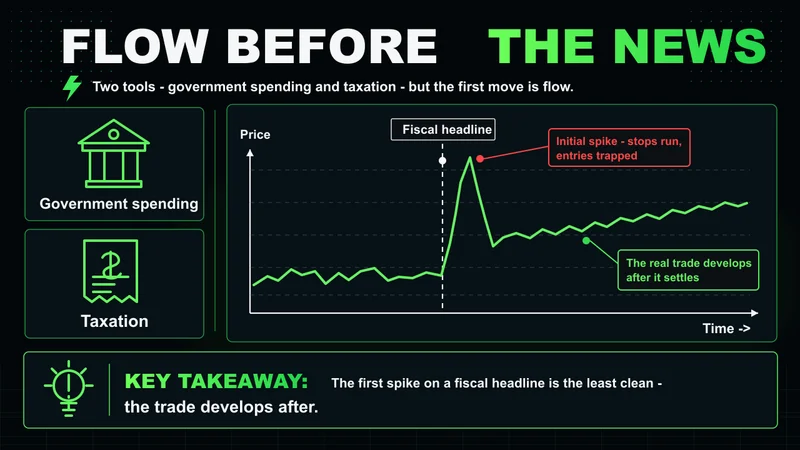
In practice, the first move is driven by flow more than by the announcement. The initial spike after a major fiscal headline is often the least clean opportunity of the session, because it is where stops are run and emotional entries get trapped. The trade, when there is one, usually develops after that first reaction resolves into a structure you can define risk against.
Where this framework breaks down
This approach works while fiscal news is the dominant variable in the room. It stops working the moment something larger takes over. If the central bank is actively repricing rate expectations the same week, monetary policy will override the fiscal read, and a clean reaction to a spending headline can be erased by a single line in a policy statement. The fiscal signal is still there; it is just no longer in control of the tape.
It also breaks down when the policy is fully anticipated. A telegraphed tax change that the market has discussed for months carries almost no surprise, so the reaction you are waiting for never arrives. Reading fiscal policy as a trading signal only works when there is genuine information left to be priced. Without that, you are trading your own expectation, not the market's.
The limitations of fiscal policy
The limitations of fiscal policy are real, and they shape how much weight the read deserves:
Implementation lag — the policy often lands out of sync with the cycle it was meant to address.
Political constraints — the decision is rarely the clean economic choice an economist would make.
Debt cost — debt-financed spending carries a price that shows up later in higher interest expense and tighter future flexibility.
For a trader, the honest version is this: fiscal policy is a slow, powerful input that is frequently already discounted by the time you can act on it. Respect it as part of the context, not as a same-day catalyst. The market rewards reading positioning far more than reacting to announcements.
FAQs
What is fiscal policy in simple terms? It is the government's use of spending and taxation to influence the economy. More spending or lower taxes supports demand; less spending or higher taxes restrains it. The gap between spending and revenue is funded by issuing debt.
How is fiscal policy different from monetary policy? Fiscal policy is controlled by the government and works through spending and taxes. Monetary policy is controlled by the central bank and works through interest rates and the money supply. Monetary policy usually reprices markets faster because a rate decision is a single scheduled event.
How does fiscal policy affect the stock market? It works mostly through expectations and the path of government debt rather than a direct, same-day move. Heavy debt issuance can lift yields, which weighs on equity valuations, while spending can support corporate revenue over time. The market typically prices the expectation well before the policy lands.
How do traders use fiscal policy data? They read it as context, not as a same-day trigger. The questions that matter are whether the news is already expected and whether price accepts or rejects the move after the information is out. The reaction to the headline carries more information than the headline itself.
The bottom line
Fiscal policy is the government's two-lever tool for steering the economy through spending and taxation, and it matters to anyone reading markets. But it matters as slow-moving context, not as a clean catalyst you can trade on announcement. The lag is real, the surprise is often already priced, and liquidity drives the first move more than the policy does. Read the positioning, wait for price to accept or reject the move, and define your risk against the structure that develops afterward. That is the difference between trading the fiscal narrative and trading the market's reaction to it.
Worth the read?