Trading Journal — How to Keep One That Works
A trading journal records the reasoning behind every trade, not just the wins. Here is what to log, a simple example template, and the mistakes to avoid.
A trading journal is a structured record of every decision around a trade: the setup, the entry, the risk, the exit, and the reasoning behind each one. It is not a diary of wins and losses. It is the tool that turns scattered screen time into pattern recognition you can actually act on. Most traders keep score. Few keep a record of why they did what they did, and that gap is usually where consistency stalls.
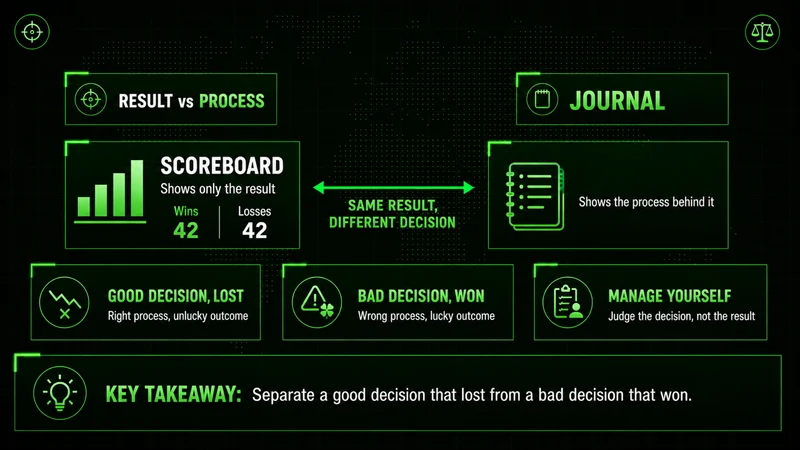
The difference matters more than it sounds. A scoreboard tells you the result. A trading journal tells you the process that produced it. When you can separate a good decision that lost from a bad decision that won, you start managing yourself the way a professional manages risk. That is the whole point.
What a trading journal actually is
A trading journal is a written log of each trade and the context around it. The trading journal meaning that gets lost online is simple: it is a record of decisions, not just outcomes. The outcome is the easy part. The market hands you that for free. The decision behind it, the part you control, is what most traders never write down.
Think of it as the audit trail for your own process. Every entry breaks into three moments:
Before the trade: what you saw, the thesis, and what would make the idea wrong.
During the trade: how price actually behaved relative to your plan.
After the trade: what you did, why you did it, and how it felt.
Over weeks, those entries stop being notes and start being data. You begin to see which conditions you read well, which setups you force, and where your discipline tends to break.
This is also the honest answer to what is a trading journal in trading: it is the bridge between having a strategy and following it. Strategy lives in your head. Execution lives in the journal. The gap between the two is where accounts quietly bleed.
Why a trading journal matters more than another setup
Most traders believe they need more setups. Most actually need fewer trades and better risk management. A trading journal is how you find that out about yourself, because it exposes the trades you take when conditions are unclear.
Here is why trading journal matters in risk management specifically. Risk is not just the stop you set on a single trade. It is the pattern of behavior across many trades: how you size when you are frustrated, how you move stops when a position turns against you, how often you trade out of boredom instead of opportunity. None of that shows up on an equity curve alone. It shows up in the journal, where the reasoning is written next to the result.
A few things the journal surfaces that nothing else will:
The setups where your win rate is real versus the ones you keep forcing.
The sessions and conditions where your execution falls apart.
The trades you took with no defined invalidation, which are usually the expensive ones.
The gap between the size you planned and the size you actually used.
When you can see these patterns in writing, capital preservation stops being a slogan and becomes a set of specific rules you give yourself. That is a more durable edge than any single entry trigger.
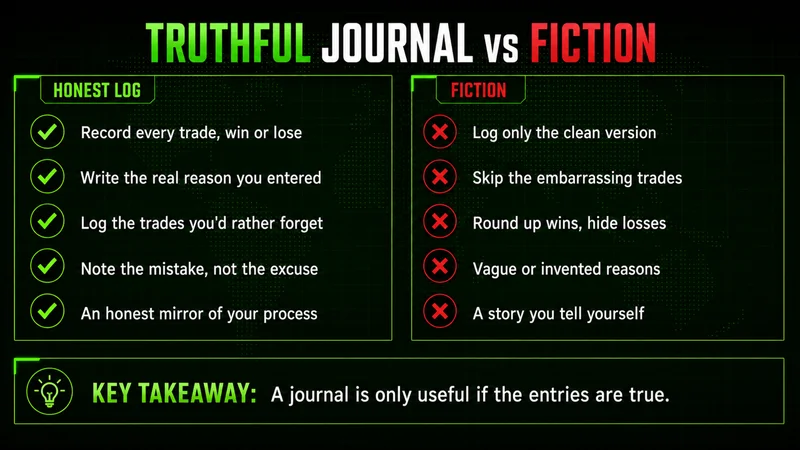
There is one honest limit here. A journal only helps if the entries are truthful. If you log the clean version of events, or skip the trades you are embarrassed about, the data turns into fiction and the whole exercise inverts. The journal becomes a story you tell yourself instead of a mirror. The discipline is in recording the trades you would rather forget.
What to record in your trading journal
The fields matter less than the habit, but a good structure makes the habit easier to keep. Split each entry into three stages: before, during, and after. That sequence forces you to commit to a plan first, then judge yourself against it.
Record these for every trade:
Date, time, and instrument traded.
The setup or thesis, in one sentence, written before entry.
Entry price, stop, and target, with the defined invalidation that makes the idea wrong.
Position size and the dollar risk that size represents.
Market context: trend, key levels, liquidity, and session.
The outcome, in R-multiples rather than raw dollars.
A short note on execution quality and your emotional state.
The emotional note is the field most traders skip, and it is often the most useful one. The trades you take to get back at the market rarely show up cleanly in your PnL. They show up in your notes, where the same phrase keeps appearing right before your worst entries. Writing the state down is how you catch the pattern before it costs you a third time.
Logging outcomes in R-multiples instead of dollars is a small change with a large effect. It strips the emotion out of the number. A loss of one R is an operational cost, the same whether the account is small or large. That framing keeps you focused on process over outcome, which is exactly what the journal is for.
Trading journal vs trade plan, and why both exist
These two documents get confused constantly, so it is worth being precise. The trading journal vs trade plan explained simply: the plan is what you intend to do; the journal is what you actually did. One looks forward, the other looks back.
A trade plan defines the rules in advance. Which setups you take, how you size, where your invalidation sits, what conditions keep you flat. It is written when you are calm, away from the heat of a live position. The trading journal is the feedback loop that tells you whether you followed the plan and whether the plan is working.
You need both because each one checks the other. The split is clean once you see it:
The trade plan is written before, away from a live position, and defines the rules.
The trading journal is written after, and records whether you followed them.
The plan sets the standard; the journal measures you against it.
Without a plan, the journal records improvisation, and improvisation is hard to improve. Without a journal, the plan is just intention, and intention drifts the moment a position moves against you. Over time, the journal is what tells you which parts of the plan to keep, tighten, or throw out.
A simple trading journal example and template
You do not need software to start. A spreadsheet with one row per trade does the job, and a trading journal template is just a set of columns you commit to filling in honestly. Here is a trading journal example for beginner traders, with the fields that carry the most weight.
Field | Example entry | Why it matters |
|---|---|---|
Date / instrument | 2026-05-28, NQ | Anchors the trade to its session and conditions |
Setup | Failed breakout above prior high | Forces a thesis before entry |
Entry / stop / target | 18,420 / 18,395 / 18,470 | Defines risk and invalidation up front |
Position size / risk | 2 contracts, 0.5R of account | Ties size to a fixed risk unit |
Context | Range day, thin liquidity into close | Records the conditions, not just the chart |
Outcome (R) | minus 1R | Keeps score in risk units, not dollars |
Note | Entered before confirmation, impatient | Captures the decision, not just the result |
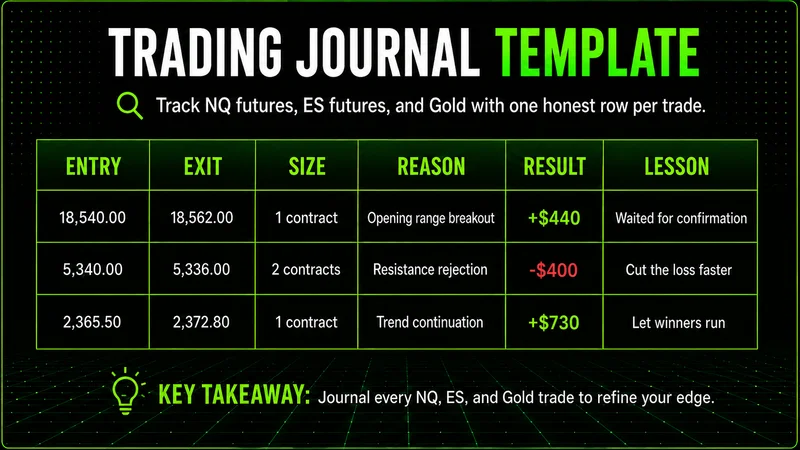
The template is not the edge. The honesty in the last column is. A beginner who fills in seven fields truthfully will learn faster than an advanced trader running expensive software who logs only the trades that flatter them. Start simple. Add columns when you find a question your current fields cannot answer.
One caution on tooling. A spreadsheet works cleanly while your sample is small and your strategy is stable. The moment you trade multiple instruments across different session types, manual entry starts to lag and you skip rows when you are busy, which is exactly when the data matters most. That is the point where a dedicated tool earns its place, not before.
How to improve your trading journal over time
A journal you never review is just storage. The value comes from the read-back. Set a fixed time each week to go through your entries and ask specific questions instead of vague ones.
Here is how to improve your trading journal over time, in order of impact:
Review on a schedule, weekly at minimum, so patterns surface before they cost you.
Group trades by setup and compare win rate and average R across each group.
Flag every trade taken without a defined invalidation, and track whether that count is falling.
Note the conditions tied to your worst entries, then add a rule that keeps you flat in them.
Revisit the journal's own fields each month and cut any column you never actually use.
The goal of this review is not to feel productive. It is to convert observation into rules. The review is also where steadiness comes from, because it ties how you feel about your trading to a documented process rather than to last week's result. A strong week and a difficult week both pass. The patterns in the journal are what stay.
Improvement also means letting the journal get more precise as you do. Early on, a single note about emotion is enough. Later, you may split that into pre-trade state and in-trade behavior, because you have noticed they diverge. The journal should evolve with your read of the market, not stay frozen as the template you started with.
Common trading journal mistakes beginners make
Most journals fail for the same handful of reasons. The common trading journal mistakes beginners make are rarely about formatting and almost always about honesty and consistency.
The mistakes that do the most damage:
Logging only winning trades, which turns the journal into a highlight reel.
Recording the result but not the reasoning, so there is nothing to learn from.
Writing entries days later from memory, when the actual decision has already faded.
Skipping the emotional note, which hides the trades driven by tilt.
Treating the journal as a chore to complete rather than a tool to read.
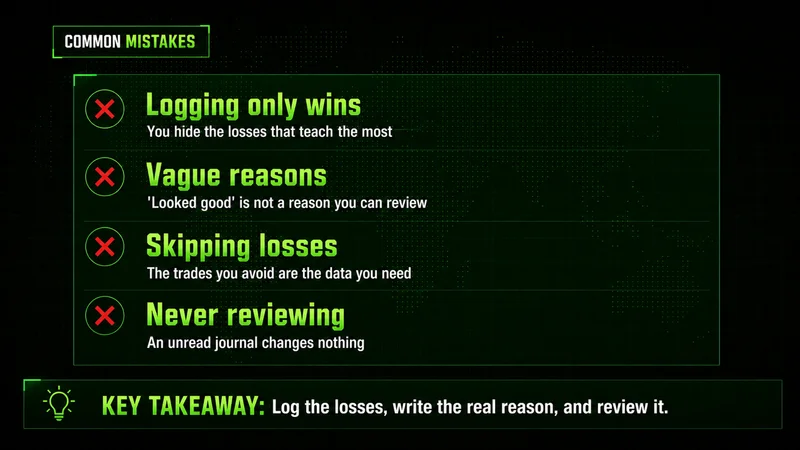
Notice that none of these are technical problems. They are discipline problems, and the journal is where a slipping discipline shows up first, usually weeks before it shows up in the account. The fix is not a better template. It is the decision to record the uncomfortable trades with the same care as the clean ones.
FAQs
What is a trading journal in simple terms? It is a written record of each trade and the reasoning behind it, covering the setup, entry, risk, and outcome. It tracks your decisions, not just your wins and losses, so you can see which parts of your process actually work.
What is a good trading journal for new traders? A simple spreadsheet with one row per trade is enough to start. The best journal for a new trader is the one they fill in honestly and review every week, not the one with the most features.
How do I calculate results in a trading journal? Log each outcome in R-multiples by dividing the profit or loss by the dollar amount you risked on that trade. A trade that risked one unit and lost it is minus one R, which keeps your scoring consistent regardless of account size.
How is a trading journal different from a trade plan? A trade plan is written in advance and defines your rules for setups, sizing, and invalidation. A trading journal is written after the fact and records whether you followed those rules and how the trade behaved, so the two together form a feedback loop.
Start logging your next trade
The fastest way to learn from a trading journal is to keep one for the next ten trades without skipping a single entry. For each one, commit to three things:
Write the thesis and the defined invalidation before you enter.
Size to a fixed risk unit before you click, not after.
Log the honest note the moment you exit, while it is still fresh.
Subscribe to the MRPNL newsletter for breakdowns of how disciplined journaling sharpens risk management and execution over a full trading season.
Worth the read?