Entry Price in Trading — What It Really Means
Entry price is the level your trade opens at and the anchor every profit, loss, and risk figure is measured from. Here is what it really means.
Your entry price is the level at which a position is opened — the exact price you buy or sell, and the fixed reference every profit, loss, and risk calculation is measured against until the trade is closed. It sounds simple, and the definition is. What beginners miss is that the number itself matters far less than where it sits relative to your stop, your invalidation, and the structure around it.
Most traders treat the entry price as the decision. It is not. It is one input into a single risk-defined decision that also includes where you are wrong and how much you are risking. Get that relationship right and a mediocre entry survives. Get it wrong and a perfect entry still bleeds the account over time.
What entry price means in plain terms
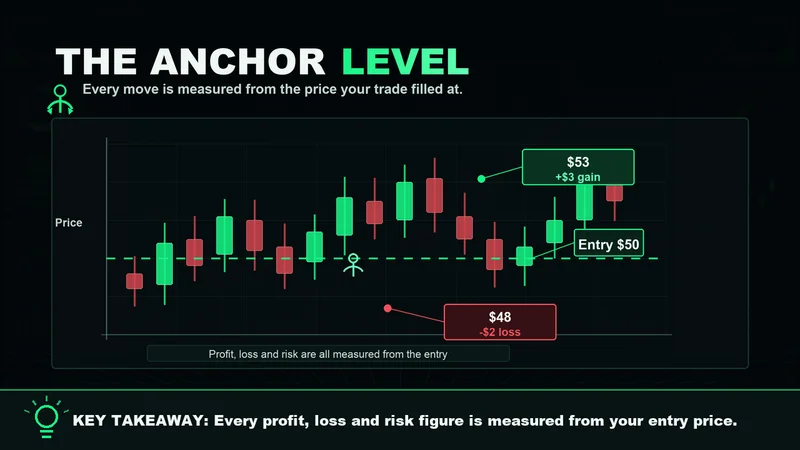
When you open a trade, the price at which it fills becomes your entry price. If you buy a stock at 50, your entry price is 50. From that point on, every move is measured from that level. Price at 53 means a 3-point gain. Price at 48 means a 2-point loss. The entry price does not change while the position is open; it is the anchor.
This is why the term shows up everywhere in a trading platform. Your unrealized profit and loss, your percentage return, and the distance to your stop are all calculated from the entry. Change the entry by even a small amount and every one of those numbers shifts with it.
Entry price vs exit price
The entry price opens the position. The exit price closes it. The difference between the two, adjusted for size and any commission, is your realized result.
Beginners often obsess over the entry and treat the exit as an afterthought. In practice the two are not equal in difficulty. A reasonable entry is usually available on most setups. A disciplined exit — taking the loss when structure breaks, or holding through noise when it does not — is where most accounts are actually won or lost. The entry gets you into the trade. The exit decides what the trade was worth.
How entry price affects your risk
Here is the part that turns a definition into something useful. Your entry price sets the distance to your stop, and that distance sets your risk per unit. If you enter at 50 and your invalidation sits at 48, you are risking 2 points per share. Enter the same idea at 49 with the same stop and you are risking 1 point — half the exposure for the same target.
That is the real reason a better entry matters. It is not about feeling clever for buying lower. It is that a tighter, structurally sound entry lets you size the position correctly while keeping the loss small if you are wrong. Trading without that context is gambling with better vocabulary. The entry only means something when it is aligned with structure, a defined invalidation, and a position size you can hold without flinching.
This is also where chasing breaks down. When price has already run and you enter late, your stop is either too far away, which forces you to size down to almost nothing, or too close, which gets you shaken out on normal noise. The entry was the problem, but the damage shows up in the risk.
Planned entry price vs average entry price
There are two numbers worth separating. The planned entry price is the level you intend to act on before the trade — the price your setup points to. The average entry price is what you actually end up holding after fills, especially if you scale in.
If you buy 100 shares at 50 and another 100 at 48, your average entry price is 49, even though neither fill happened there. Every platform recalculates this automatically as you add. It matters because your stop, your target, and your risk are now measured from 49, not from your original 50. Adding to a position moves the reference level, and traders who forget this often think they are risking less than they actually are.
When focusing on entry price stops helping
A precise entry is an advantage in clean, range-bound or structured conditions where levels hold and reactions are readable. It stops helping the moment volatility expands past the structure you based it on. During major news or a fast macro-driven move, the level you planned around can be gapped through or sliced in seconds, and the entry you optimized for becomes irrelevant. In those conditions the edge is not a better fill — it is sizing down, widening your expectations, or standing aside until structure returns. Optimizing the entry price in a regime that ignores structure is effort spent in the wrong place.
FAQs
What is entry price in trading? It is the price at which a position is opened — the level you buy or sell at. It becomes the fixed reference point that every profit, loss, and risk figure is measured from until the trade is closed.
Is entry price important for beginners? Yes, but mainly because of how it sets your risk. A sound entry lets you place a logical stop and size the trade correctly. On its own, in isolation from your stop and size, the entry number means very little.
What is the difference between entry price and average entry price? The entry price is the level of a single fill. The average entry price is the blended price across multiple fills when you scale into a position, and it becomes the new reference level for your stop and risk.
The short version
Entry price is the level your trade opens at and the anchor every result is measured from. The number alone is not the edge. What matters is where that entry sits relative to your invalidation and your size, because that relationship is what defines your risk. Treat the entry as one part of a complete decision — entry, stop, and size together — and the rest of the trade becomes far easier to manage.
Worth the read?