Trading Instruments — A Practical Guide for Traders
Trading instruments are the assets and contracts you trade — stocks, futures, options, forex. Learn what they are, how they differ, and how to choose them.
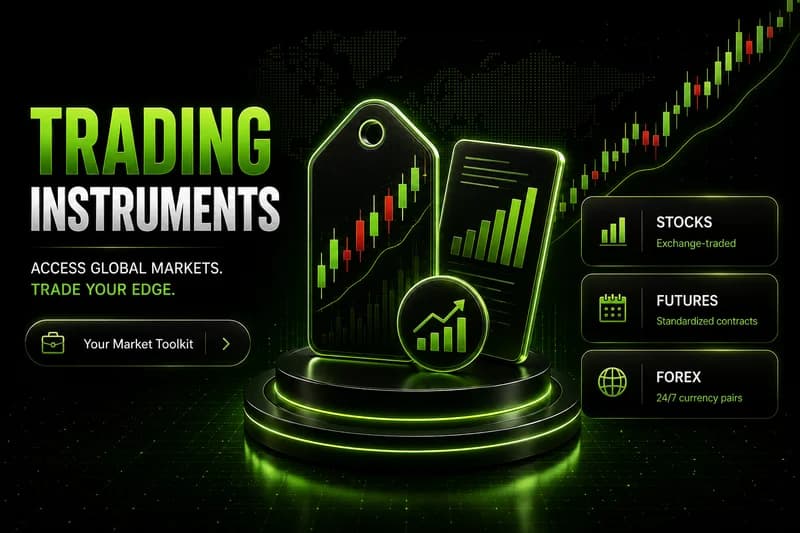
Trading instruments are the specific assets and contracts you actually buy and sell in the market: stocks, futures, options, forex pairs, and the derivatives built on top of them. Each one carries its own liquidity, volatility, and risk profile. The instrument you choose shapes your results as much as the strategy you run on it, and most newer traders underestimate that.
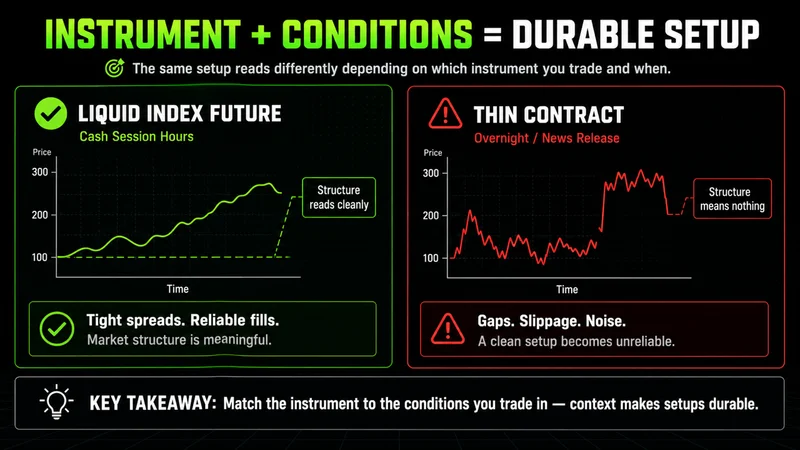
A strategy that reads market structure cleanly on the S&P 500 futures can fall apart on a thinly traded contract that gaps overnight. Same logic, different instrument, different outcome. Before you think about entries, you need to understand what you are trading and how it behaves.
Trading instruments meaning, in plain terms
A trading instrument is any tradable financial asset or contract that has a price and a market to trade it in. When someone asks for the trading instruments meaning, the simplest answer is this: it is the thing you take a position in.
That covers a wide range. A share of stock is an instrument. A futures contract on crude oil is an instrument. A call option, a currency pair, a bond, a contract for difference: all instruments. What unites them is that each has a quoted price, a counterparty on the other side, and a defined way to enter and exit.
The reason the term matters is that the instrument defines your playing field. It sets the hours you can trade, the size you can take, the leverage available, and how violently the price can move against you. Two traders running the identical setup on different instruments are not running the same trade.
How trading instruments work in financial markets
Every trading instrument exists inside a market structure that determines how orders are matched and filled. Understanding how trading instruments work in financial markets starts with where they trade.
Some instruments trade on centralized exchanges. Stocks, listed futures, and exchange-traded options all clear through a central venue with a visible order book. Price is set by buyers and sellers meeting at a common point, and the exchange guarantees the trade settles.
Other instruments trade over the counter. Spot forex and many CFDs are decentralized. There is no single exchange; instead, a network of brokers and liquidity providers quotes prices. That structure is why the trading instruments market for currencies runs almost around the clock and why the same pair can show slightly different quotes across brokers.
This difference is not academic. On an exchange-traded instrument, you can usually see the depth of the book and gauge real liquidity. On an over-the-counter instrument, you depend on your broker's pricing and execution quality. When you size a position, you are also making a bet on how well that instrument fills under pressure.
Trading instruments examples a beginner can picture
The category is broad, so concrete trading instruments examples help more than definitions. Here are the ones most active traders encounter:
- Stocks (equities): Ownership shares in a company, traded on stock exchanges. Liquidity ranges from deep, in large-cap names, to thin and erratic, in small caps.
- Futures: Standardized contracts to buy or sell an asset at a set date. Index futures like the S&P 500 and Nasdaq contracts are popular for their liquidity and nearly continuous hours.
- Options: Contracts giving the right, not the obligation, to buy or sell at a set price. They add a layer of complexity through time decay and implied volatility.
- Forex pairs: Currency exchange rates such as EUR/USD, traded in a decentralized, high-volume market.
- Commodities: Physical goods like gold, oil, and silver, usually traded through futures or CFDs rather than the physical asset.
- Bonds and money market instruments: Debt securities that pay interest, generally lower volatility than the instruments above.
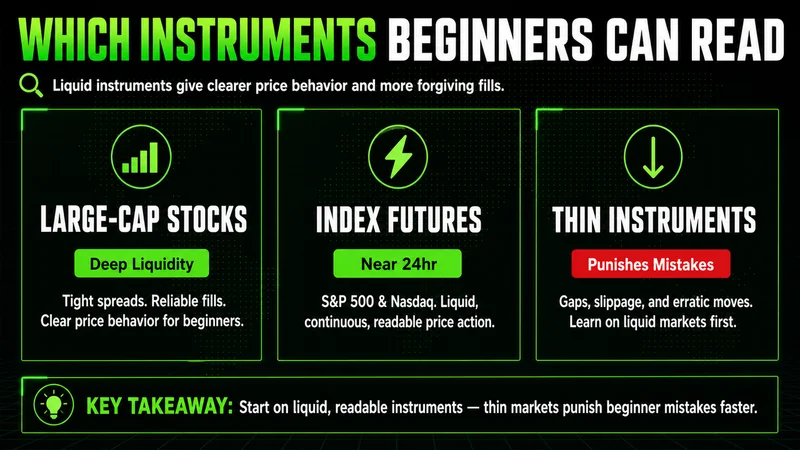
For trading instruments examples for beginner traders, the index futures and large-cap stocks tend to be the most readable, because their liquidity makes price behavior more reliable. Thin instruments punish mistakes faster.
Trading instruments vs asset classes, explained
People use these two terms as if they mean the same thing, and they do not. Sorting out trading instruments vs asset classes removes a lot of confusion.
An asset class is a broad family of investments with similar characteristics: equities, fixed income, commodities, currencies, and derivatives. A trading instrument is the specific, tradable contract that belongs to one of those families.
Put simply, the asset class is the category and the instrument is the item inside it. Equities are an asset class; a single share of a company is the instrument. Commodities are an asset class; a gold futures contract is the instrument you actually trade.
Why does the distinction matter for execution? Because risk often correlates within an asset class. If you hold three different equity instruments, you are not as diversified as the count suggests; they tend to move together when the broader market turns. Knowing the asset class behind each instrument tells you where your real exposure sits.
How to choose trading instruments for a trading plan
This is where the top guides usually stop short. They list categories without telling you how to pick. Knowing how to choose trading instruments for a trading plan comes down to matching the instrument to how you actually trade.
Start with three properties of any instrument: liquidity, volatility, and session behavior.
- Liquidity determines how cleanly you can enter and exit. Deep liquidity means tighter spreads and reliable fills. Thin liquidity means slippage, which quietly erodes results.
- Volatility determines how much the price moves and how wide your stops need to be. Higher volatility offers larger moves but demands smaller size to keep risk defined.
- Session behavior determines when the instrument is worth trading. Index futures behave very differently during the U.S. cash session than they do overnight on light volume.
The best traders react well to conditions; they do not predict them perfectly. Choosing an instrument is part of that reaction. You match the instrument to your available screen time, your risk tolerance, and the kind of price behavior you read well. A momentum trader and a slow swing trader should not be in the same instrument by default.
This is also where the framework breaks down if you ignore context. Market structure reads cleanly on a liquid index future during cash hours. Take that same approach to a thin contract overnight, or into a major news release, and the structure means almost nothing. The instrument behaves like a different animal, and a setup that looked clean an hour earlier becomes noise. The choice of instrument is only durable when it fits the conditions you trade in.
Main risks of trading instruments
Every instrument carries risk, but the shape of that risk changes from one to the next. Understanding the main risks of trading instruments keeps the trading instruments risk from surprising you mid-position.
- Market risk: The price moves against you. This is universal, but the speed varies. Leveraged futures and volatile small caps can move against a position faster than slower instruments.
- Liquidity risk: You cannot exit at a fair price because there are not enough buyers or sellers. Thin instruments and off-hours sessions make this worse.
- Leverage risk: Many instruments, including futures, forex, and CFDs, let you control a large position with a small deposit. Leverage amplifies gains and losses equally, and it is where most accounts get into trouble.
- Overnight and gap risk: Some instruments can gap sharply between sessions, jumping past your stop. Holding overnight is a different risk than holding intraday.
Account damage rarely comes from a single dramatic trade. More often it comes from sizing a position for the instrument you wish you were trading rather than the one in front of you. The instrument did not change; the position size relative to its volatility was wrong from the start.
Trading instruments for beginners, and account requirements
Newer traders should weigh trading instruments for beginners by readability and cost of mistakes, not by potential reward. Large-cap stocks and liquid index instruments give clearer price behavior and more forgiving spreads than exotic or thin markets.
There are practical trading instruments account requirements to understand before you trade certain instruments:
- Stocks: A standard brokerage account. Margin accounts allow leverage, but a cash account is the lower-risk starting point.
- Futures: A futures-enabled account, often with a higher minimum and margin requirements set per contract.
- Options: Brokers require an options-approval level, since the risk profile is more complex.
- Forex and CFDs: A specialized broker account, frequently with high available leverage that beginners should treat with caution.
Are trading instruments good for beginner traders? Some are, and some are not. The question is poorly framed. A liquid stock or index future, traded at small size with defined risk, is a reasonable place to learn. A highly leveraged, fast-moving instrument is where beginners most often blow up. The instrument is not the problem; mismatching it to your experience is.
Trading instruments trading basics, step by step
Bringing it together, here are the trading instruments trading basics, step by step, before you take a position. Treat it as a trading instruments checklist for new traders.
- Identify the asset class. Know whether you are trading an equity, a derivative, a currency, or a commodity, and what that implies for correlation and behavior.
- Check liquidity. Confirm the instrument trades enough volume that you can enter and exit without large slippage.
- Measure volatility. Know the instrument's typical range so you can size the position and place stops with defined risk.
- Confirm the session. Trade the instrument when it is liquid and active, not during dead hours.
- Define your risk first. Decide your invalidation level and position size before the entry, never after.
- Match it to your plan. The instrument should fit your strategy, your screen time, and your tolerance for movement.
This sequence is deliberately about preparation, not prediction. The instrument and its conditions are decided before the entry, which is exactly where most failed trades are actually lost.
FAQs
What are trading instruments in trading? They are the specific assets and contracts you buy and sell, such as stocks, futures, options, forex pairs, and commodities. Each instrument has its own price, market, liquidity, and risk profile, and the one you choose shapes how your strategy performs.
What is the difference between trading instruments and asset classes? An asset class is a broad family, such as equities, commodities, or currencies. A trading instrument is the specific tradable item inside that family, like a single share or a gold futures contract. The asset class is the category; the instrument is the item.
What are the main risks of trading instruments? The core risks are market risk, liquidity risk, leverage risk, and overnight gap risk. The shape of each risk changes by instrument, so a position sized correctly for one instrument can be far too large for another with higher volatility.
Which trading instruments are best for beginners? Liquid, readable instruments like large-cap stocks and major index futures are generally easier to learn on, because their liquidity makes price behavior more reliable. Highly leveraged or thin instruments tend to punish mistakes faster and are riskier for new traders.
Related concepts worth studying next
Trading instruments are the foundation, but they connect to a few topics worth understanding next. Asset classes give you the map of how instruments group and how their risks correlate. Liquidity and market structure explain why the same instrument behaves differently across sessions. Risk management ties it together, because position size is only meaningful relative to the volatility of the instrument in front of you.
Start with one liquid instrument, learn how it actually moves across a full session, and build from there. Depth in one instrument beats shallow exposure across many.
Worth the read?