Risk Management in Trading — What Keeps You Solvent
Risk management in trading is the framework that sizes positions, caps total exposure, and defines invalidation so no single trade ends your account.
Risk management in trading is the process of deciding, before you enter, how much you can lose and under what conditions you are wrong. It is not a stop-loss setting or a single number. It is the full framework that controls position size, defines invalidation, and caps total exposure so that no individual trade and no run of losing trades can end your account. Get that framework right and a mediocre strategy survives. Get it wrong and the best entries in the world eventually fail you.
Most traders treat risk management as an afterthought to the entry. That ordering is backward. The entry decides whether a single trade works. Risk management decides whether you are still trading in two years. The market does not care about your conviction, your effort, or how clean the setup looked. Risk exists whether you acknowledge it or not, and the only question that matters is how much of it you accepted before price moved.
What risk management in trading actually means
The simplest definition is the most useful one. Risk management means knowing the exact dollar amount you are willing to lose on a trade before you take it, and structuring the position so that losing that amount is the worst realistic outcome.
That definition does a lot of work. It forces a defined invalidation, because you cannot size a position without knowing where the idea is wrong. It forces a stop, because an undefined loss is an unlimited loss. And it forces honesty, because the number you write down is the number you have to live with when the trade goes against you.
The meaning gets distorted online. Risk management is often presented as a list of tools: stop-losses, trailing stops, hedges. Those are instruments. They are not the discipline. The discipline is the decision-making that happens before the order is placed, when you are calm and the position is still hypothetical. Once you are in the trade and watching it move, your capacity for clear decisions drops sharply. The framework exists to make those decisions for you in advance.
Why most accounts die slowly, not suddenly
Accounts rarely blow up on one trade. They erode. A trader risks a little more than planned on a setup that feels certain, recovers, and learns the wrong lesson. The next time, the oversized bet is the default. Rule-breaking compounds quietly long before the damage becomes obvious.
This is where risk management earns its place. It is not there to make winning trades bigger. It is there to keep any single decision from being fatal. If a single losing trade changes how you place the next one, the size was too big for your tolerance, and that is overleverage hiding in plain sight.
Protecting capital is the first objective, ahead of growing it. You cannot compound an account you no longer have. Survival through difficult stretches is what separates traders who are still active after several years from the ones who flamed out in a strong quarter and never recovered from the one that followed.
Position sizing: the formula that does the real work
If risk management has a single calculation, this is it. Position size is derived, not chosen. You start from how much you are willing to lose, and the size falls out of the math.
The risk management formula most professionals use is straightforward:
- Risk per trade = account size multiplied by your risk percentage (commonly 1%).
- Stop distance = the difference between your entry and your invalidation level.
- Position size = risk per trade divided by stop distance.
That third line is the part beginners skip. They pick a position size first, then place a stop wherever it fits the chart, and the actual dollar risk becomes whatever it happens to be. The calculation runs the other way. The dollar risk is fixed. The stop distance is dictated by structure. Position size is the output, and it changes on every trade.
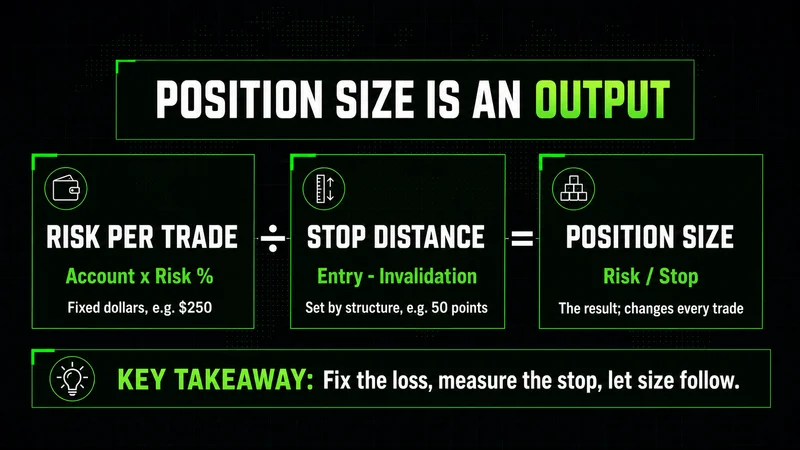
This is also why a wider stop forces a smaller position. The two move together. A trader who insists on the same size regardless of stop distance is not managing risk; he is managing nothing and hoping the volatility cooperates.
A worked example: risking 1% the right way
Numbers make the framework concrete. Take a $25,000 account and a 1% risk rule. The most you are willing to lose on the trade is $250.
You find a setup. Your entry is at a defined level, and structure says the idea is wrong if price trades through a swing low 50 points below. That 50-point stop distance is not negotiable; it is where your thesis breaks. To risk exactly $250 across a 50-point stop, you size the position so that each point is worth $5. If price hits your stop, you lose $250 and the trade is closed. Nothing about that outcome surprises you, because you accepted it before you clicked.
Now change one variable. The same setup appears, but the only valid invalidation sits 100 points away. The stop is twice as wide, so the position has to be half the size to keep the loss at $250. Same risk, smaller position. Beginners often do the opposite, holding size constant and quietly doubling their exposure whenever structure demands a wider stop. That is how a controlled 1% risk turns into a 2% loss without anyone deciding to take it.
The example scales to any account and any risk percentage. The mechanics never change. Define the loss, measure the stop, let the size follow.
Risk-reward is not risk management
These two get conflated constantly, and the confusion costs people money. The risk-reward ratio compares what you stand to lose against what you stand to gain on a single trade. A 1:3 ratio means risking one unit to make three. It is a useful filter for trade selection.
But a good ratio tells you nothing about whether your overall risk is controlled. You can take a string of 1:3 setups and still drain an account if each position is sized too large, or if you have five correlated trades open at once. Risk-reward governs the quality of one decision. Risk management governs your exposure across all of them.
The practical distinction: risk-reward asks whether this trade is worth taking. Risk management asks whether you can survive being wrong about it, and about the next several after it. You need both, but only one keeps you solvent when a sequence of high-quality setups all fail in the same week, which happens more often than the win-rate math suggests.
Portfolio heat: the risk nobody counts
Here is the gap in most risk education. Almost every guide stops at per-trade sizing, as if trades exist in isolation. They do not. The risk that actually ends accounts is the sum of correlated exposure across positions held at the same time.
The 1% you risked on each of four trades is not 1% of risk. If those instruments move together, it is closer to 4% on a single bet wearing four costumes.
Call it portfolio heat: the total open risk across everything you hold, weighted by how correlated those positions are. Three long index futures positions are not three independent ideas. NQ, ES, and a tech-heavy equity basket tend to move as one when volatility expands. Sizing each at 1% feels disciplined and is actually a 3% directional bet that all reveals itself at once on a bad print.
The fix is to cap aggregate risk, not just per-trade risk. Decide the maximum total exposure you will carry across all open positions, treat correlated trades as a single position for that purpose, and stop adding when you hit the ceiling. This only holds while correlations stay stable; in a genuine macro shock, assets that normally diverge can snap into lockstep, and the heat you measured an hour ago understates what you actually carry. That is precisely when capped exposure matters most, because it limits the damage from the correlation you did not see coming.
The mistakes that quietly compound
Most risk management mistakes are not exotic. They are small, repeated, and invisible until they aren't. The common ones beginners make share a root cause: letting the trade dictate the risk instead of the other way around.
- Moving the stop. The stop marks where the idea is wrong. Sliding it to avoid the loss does not make the idea right; it just makes the loss bigger.
- Sizing up after losses. Increasing position size to recover a drawdown quickly is the fastest way to turn a manageable losing streak into a fatal one.
- Trading without a defined invalidation. If you cannot say where you are wrong, you cannot size the trade, and you are guessing.
- Ignoring correlation. Four open positions that move together are one position, sized four times too large.
- Treating a green day as mandatory. Forcing trades to end the session positive is an emotional decision, not a process one, and it usually costs more than the original red.
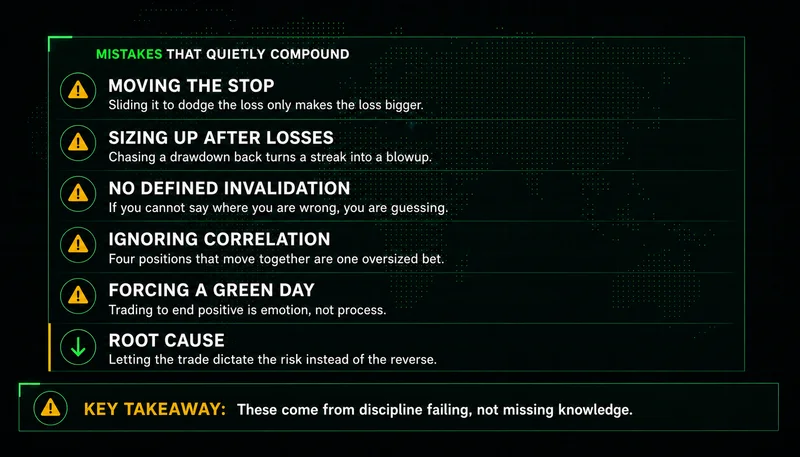
None of these come from a lack of knowledge. Every trader who makes them already knows the rule. They come from discipline failing under pressure, which is a different problem and the one that actually decides outcomes.
How risk management breaks during a drawdown, and how to rebuild it
Most traders do not have a strategy problem. They have a discipline problem, and it shows up at the worst time. A risk framework that looks solid in a spreadsheet quietly comes apart during a losing stretch, because that is exactly when the temptation to break it is strongest.
The sequence is predictable. Two or three losses in a row dent confidence. The next setup looks like a chance to recover, so the size creeps up. The stop gets a little wider to avoid getting tagged. A trade gets taken in conditions that would normally be skipped. Each step feels reasonable in isolation. Together they dismantle the plan that was working.
Improving risk management over time is less about learning new techniques and more about closing the gap between the rules you wrote and the rules you actually follow when it hurts. A few things move the needle:
- Keep the risk percentage fixed regardless of recent results. The size should be identical after three wins and after three losses. The moment it varies with your mood, the framework is gone.
- Review against the plan, not the outcome. Confidence should come from process, not recent profit and loss. A losing trade taken correctly is a good trade. A winning trade taken with double the planned size is a problem you got paid for.
- Step away when judgment degrades. Fatigue and frustration distort execution faster than most traders realize. Closing the platform after a rough session is sometimes the highest-quality decision available.
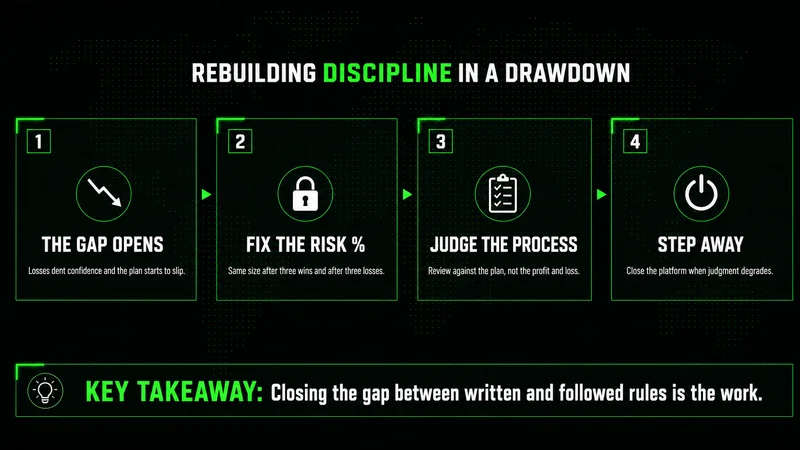
A simple way to make this concrete is a short post-session checklist: did I risk a fixed percentage, was every stop placed at a real invalidation, did I respect my total exposure cap, and did I take any trade outside my plan. Answered honestly over weeks, that record shows you where the discipline leaks before the account does.
FAQs
What is risk management in trading in simple terms? It is deciding, before you enter, the exact amount you can lose on a trade and structuring the position so that losing that amount is the worst realistic outcome. It controls position size, defines where you are wrong, and caps total exposure so no single trade or losing streak ends the account.
How do you calculate risk management for a trade? Multiply your account size by your risk percentage to get the dollar risk per trade, measure the stop distance from your entry to your invalidation level, then divide the risk by the stop distance to get position size. The dollar risk stays fixed; position size changes on every trade as the stop distance changes.
How much should a beginner risk per trade? A fixed 1% of account capital is a sound starting point, and exceeding it early is rarely worth the cost. Good risk management for new traders is less about the exact percentage and more about keeping it constant, especially during a losing stretch when the urge to size up is strongest.
What is the difference between risk management and the risk-reward ratio? The risk-reward ratio measures potential loss against potential gain on a single trade and helps with trade selection. Risk management governs your total exposure across every position and over time. A good ratio does not protect an account that is oversized or stacked with correlated trades.
What are the most common risk management mistakes beginners make? Moving stops to avoid a loss, increasing size after losses to recover faster, trading without a defined invalidation, ignoring correlation across open positions, and forcing trades to end the day green. Each one comes from letting the trade dictate the risk instead of the reverse.
How can you improve risk management over time? Keep the risk percentage fixed regardless of recent results, review trades against your plan rather than the outcome, and step away when fatigue degrades your judgment. A short post-session checklist that records whether you followed each rule exposes discipline leaks before they reach the account.
Worth the read?