Leveraged Trading — What It Is and How It Works
Leveraged trading lets you control a larger position with borrowed funds. Here is how it works, a clear example, the real risks, and when to use it.
Leveraged trading means controlling a position larger than your cash by borrowing the difference from your broker. You post a fraction of the trade's value, called margin, and the broker covers the rest. The mechanics are simple. The part that decides whether you survive it is not the leverage number on the label, it is how much of your account each trade actually risks.
Most beginners read leverage as a way to make more money. It is more accurate to read it as a way to make every decision matter more, in both directions. The same move that doubles a sensible position can wipe out a careless one. That is the whole lesson, and most explanations bury it under the math.
What leveraged trading is
Leveraged trading is the use of borrowed capital to open a position worth more than the money you put down. Your broker lets you control the full position while you fund only a slice of it. That slice is the margin, and the relationship between the margin and the full position is the leverage ratio.
The leveraged trading meaning that matters in practice is exposure, not borrowing. You are not really thinking about a loan while the trade is open. You are thinking about a position that moves against the full contract value, while your account only holds a fraction of it. The borrowed portion is invisible until the position turns, and then it is the only thing that matters.
This applies across instruments. Futures, contracts for difference, margin stock accounts, and most crypto derivatives all run on the same idea. The labels differ. The exposure mechanic does not.
How leveraged trading works
How leveraged trading works in trading comes down to three numbers: the full position value, the margin requirement, and the resulting leverage ratio. The broker sets a leveraged trading requirement, usually as a percentage of the position. That percentage is your margin. The inverse of it is roughly your leverage.
The leveraged trading calculation is that direct: divide 100 by the margin percentage and you have the ratio.
- A 10% margin requirement means you fund one-tenth of the position. That is 10:1 leverage.
- A 5% requirement is 20:1.
- A 2% requirement is 50:1.
Profit and loss are then computed on the full position, not on your margin. This is the entire point and the entire danger. A 1% move on a 10:1 position is a 10% move on your margin. The leverage does not change the market. It changes how hard the market's normal noise lands on your account.
Two account rules govern the rest. First, you must keep enough equity to satisfy maintenance margin while the trade is open. Second, if your equity drops below that level, the broker issues a margin call, and if you do not add funds, the position is closed for you. Leveraged trading account rules exist to protect the broker from your losses, not to protect you from them. That distinction is worth internalizing early.
A leveraged trading example, step by step
A concrete leveraged trading example makes the calculation real. Say a stock trades at $100 and your broker requires 20% margin. You want exposure to 100 shares, a $10,000 position. You post $2,000 in margin and control the full $10,000.
The stock rises to $105. Your position is now worth $10,500. The $500 gain lands on your $2,000 margin, a 25% return on the capital you committed. The same 5% move would have returned 5% in a cash account. Leverage multiplied it five times, which matches your 5:1 effective ratio here.
Now run it the other way, because this is the half beginners skip. The stock falls to $95. Your position is worth $9,500. The $500 loss is 25% of your margin from a routine 5% move. A 20% drop in the stock, which markets deliver more often than anyone expects, erases your entire $2,000. Below that, you owe the broker.
That is a leveraged trading example for beginner traders worth sitting with. The upside number is easy to enjoy. The downside number is the one that decides whether you are still trading next year.
Leveraged trading vs spot trading: which fits the conditions
Leveraged trading vs spot trading is usually framed as a fixed comparison, as if one is simply riskier than the other. The more useful framing is a decision you make against current conditions. Spot trading means you buy the asset outright with your own money. Your maximum loss is what you paid. There is no margin, no call, no borrowed exposure.
Leveraged trading vs spot trading explained through risk comes down to a few clear differences:
- Spot caps your downside at the capital you put in. Leverage can cost more than your margin.
- Spot needs the full position value up front. Leverage frees most of that capital for other uses.
- Spot lets you wait out noise indefinitely. Leverage carries a margin call that can force you out.
Neither is better in the abstract. They serve different conditions.
The honest read is that leverage rewards clean, high-probability conditions and punishes everything else. In a market that is choppy, thin, or news-driven, the wider swings hit a leveraged position harder and faster than a spot one. Spot trading lets you wait out noise that would trigger a margin call on leverage. The question is never which is safer. The question is whether the current environment justifies the added exposure.
Where leverage actually bites: position size, not the multiplier
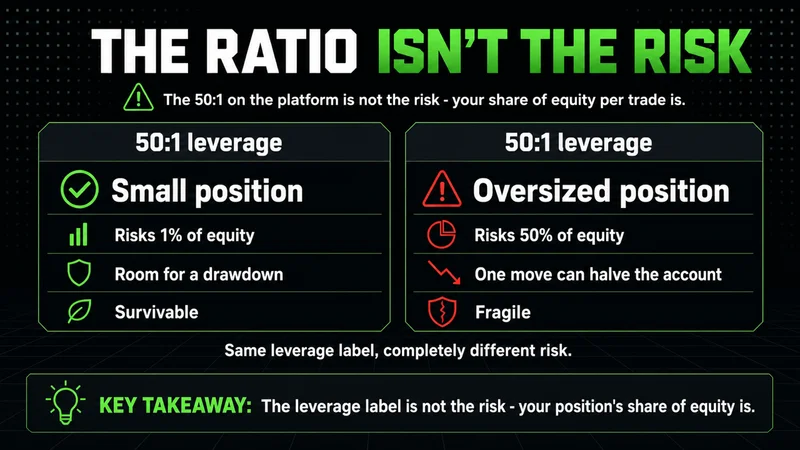
Most traders are overleveraged without realizing it, because they watch the ratio on the label and ignore the fraction of their account each trade puts at risk. The 50:1 number on the platform is not the risk. The risk is how much equity disappears if the trade hits your stop.
A trader on 50:1 who risks half a percent of the account per trade is far safer than a trader on 5:1 who risks a quarter of the account on a single position. The multiplier is a feature of the instrument. The position size is a choice you make, and it is the choice that actually governs leveraged trading risk.
Here is where the clean theory breaks down. The math says a defined stop caps your loss at a known amount. In practice, leverage and a fast market remove that guarantee. During a gap, a news spike, or thin overnight liquidity, price can jump straight past your stop, and you are filled well below it. A position sized so that a normal stop costs 1% of the account can cost far more when the fill is bad. This is how leveraged trading affects trading risk in the real world, and it is the part the calculation never shows you. The neat numbers assume liquidity that is not always there.
Leverage does not create risk. It reveals the risk that was already in your position size.
If one losing trade meaningfully affects how you make the next decision, the position was too large, full stop. That is true at 2:1 and at 100:1. The leverage just sets how quickly the lesson arrives.
Common leveraged trading mistakes beginners make
The common leveraged trading mistakes beginners make are not exotic. They are the same few errors, repeated until the account is gone.
- Sizing off the leverage ratio instead of off account risk, so a single trade can do real damage.
- Treating margin as buying power to deploy fully, rather than a floor the broker can force you to defend.
- Adding to a losing leveraged position to lower the average, which increases exposure exactly when the trade is already wrong.
- Ignoring overnight and weekend gaps, where stops do not protect the way they do in liquid cash hours.
- Confusing a string of leveraged winners with skill, then raising size right before a normal losing streak arrives.
None of these are analysis failures. They are discipline failures. Most blown leveraged accounts do not die from one bad trade. They erode quietly through oversized positions during emotional sessions, and then the gap finishes what the sizing started.
When should traders use leveraged trading
When should traders use leveraged trading is the right question, and the answer is conditional. A simple leveraged trading checklist for new traders sets the bar before any position goes on:
- You have traded these conditions before, unleveraged, and know how they behave.
- The trade has a defined invalidation, set before entry, not after.
- Position size comes from account risk, not from the ratio the platform offers.
- You can take the full stop without it changing how you make the next decision.
If any line fails, the leverage is not the problem yet, but it will be. It does not belong in your first months. Whether leveraged trading is important for beginners is a fair thing to ask, and the honest answer is that understanding it is important, using it heavily is not. Learn the mechanics, trade small or spot while you build screen time, and let leverage scale with your consistency, not with your impatience. The traders who last treat leverage as something they earn the right to use, not a shortcut they reach for early.
Key takeaways
Leveraged trading lets you control a larger position by posting margin and borrowing the rest, with profit and loss computed on the full position. The leverage ratio is the inverse of the margin requirement, and the calculation is straightforward. The risk is not.
The number that decides your survival is position size as a fraction of your account, not the multiplier on the screen. Stops cap loss in liquid conditions and fail in gaps. Leverage rewards clean setups and punishes forced ones. Used with defined risk and discipline, it is a tool. Used to compensate for a small account or impatience, it is the fastest way to end up with a smaller one.
FAQs
What is leveraged trading in simple terms? It is controlling a position larger than your cash by posting a margin deposit and borrowing the rest from your broker. Your profit and loss are based on the full position size, not just the margin you put down.
How is the leveraged trading calculation done? Divide 100 by the margin requirement percentage to get the leverage ratio. A 10% margin requirement is 10:1 leverage, a 5% requirement is 20:1, and gains or losses are then computed on the full position value.
Is leveraged trading important for beginners? Understanding it is important; using it heavily is not. Beginners should learn the mechanics and risks first, trade small or spot while building experience, and let leverage scale with consistency rather than impatience.
What is the difference between leveraged trading and spot trading? Spot trading means buying the asset outright with your own money, so your maximum loss is what you paid. Leveraged trading uses borrowed exposure, which can amplify both gains and losses and can cost more than your initial margin.
Can leveraged trading lose more than you deposit? Yes. Because profit and loss are based on the full position, a sharp move against you, especially during a gap or thin liquidity, can erase your margin and leave you owing the broker.
Worth the read?