Leverage in Trading — What It Is and How It Works
Leverage in trading is borrowed capital that controls a larger position than your cash allows. Here is how it works, the risk, and how to size it.
Leverage is borrowed capital that lets you control a position larger than your own cash would allow. You post a fraction of the trade's value, your broker covers the rest, and your gains and losses are calculated on the full position size. That is the entire idea, and it is also why leverage is the fastest way for a new account to grow or to disappear.
Most beginners learn the leverage meaning as a multiplier on profit. The more useful framing is the opposite: leverage multiplies the consequence of being wrong, and being wrong is a normal, recurring part of trading. Once you treat it that way, the question stops being how much leverage you can get and becomes how much you can survive.
What leverage actually means in trading
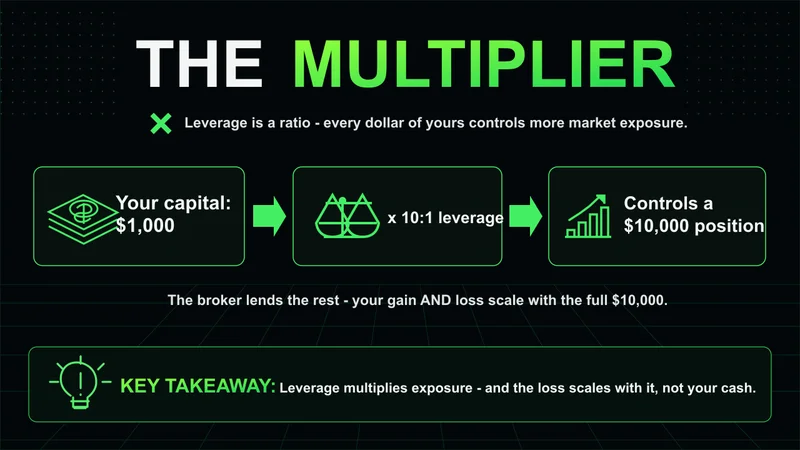
Leverage is expressed as a ratio: 5:1, 10:1, 50:1. A 10:1 ratio means every dollar of your capital controls ten dollars of market exposure. With $1,000 and 10:1 leverage, you can hold a $10,000 position.
The broker is not giving you free money. It is lending you market exposure against a deposit, and it expects that deposit to absorb any loss. When the loss approaches the size of your deposit, the broker steps in. Nothing about the underlying asset changes. Higher leverage does not make a trade more likely to work; it makes the same trade hit your account harder in both directions.
How does leverage work on a real position
Leverage works through margin. You set aside a portion of the position's value, the broker funds the remainder, and your profit or loss is measured against the full position, not against the margin you posted. Take a $10,000 position at 10:1 leverage, where you post $1,000 of your own capital:
- A 2% move in your favor is a $200 gain, a 20% return on your $1,000.
- A 2% move against you is a $200 loss, 20% of your capital.
The market moved 2% either way; your account moved 20%. That asymmetry between the price change and the account change is the whole reason leverage demands respect.
A leverage example you can carry to any market
A leverage example makes the math concrete. Say you have $2,000 and you trade the same instrument three ways on a 1% favorable move:
- No leverage (1:1): you control $2,000, the 1% move earns $20, a 1% account gain.
- 5:1 leverage: you control $10,000, the 1% move earns $100, a 5% account gain.
- 20:1 leverage: you control $40,000, the 1% move earns $400, a 20% account gain.
Now flip the move against you. At 20:1, that same 1% is a $400 loss, 20% of your account, gone on a move the chart would barely register. The leverage calculation never sleeps on the downside, so a leverage example for beginner traders only teaches the right lesson when you run the losing side with the same care as the winning side.
Leverage versus margin, and why people confuse them
Leverage and margin describe the same arrangement from two angles, which is why leverage vs margin trips up almost everyone at the start. Leverage is the ratio of total exposure to your own capital. Margin is the deposit the broker holds to open and maintain that exposure.
Leverage vs margin explained in one line: leverage is the multiplier, margin is the collateral. A 20:1 ratio is the same as a 5% margin requirement, because $1 controlling $20 means your deposit is one-twentieth of the position. The leverage requirement and the margin requirement are the same number from opposite directions.
If a single losing trade changes how you think, the position was too large. That is the clearest signal that leverage has quietly outrun the account, long before any margin call confirms it.
The practical danger lives in maintenance margin. If the trade moves against you and your deposit erodes past the broker's threshold, you face a margin call or an automatic liquidation, and higher leverage means a smaller adverse move triggers that point.
How leverage affects trading risk
This is the part the marketing leaves out. Leverage risk is not a separate risk you add on top of a trade. It is a magnifier bolted onto every risk the position already carries.
The distance between your entry and your stop is fixed by the chart, not by your leverage. What leverage decides is how large that fixed distance becomes in dollars. The same five-point stop costs five times more on 5:1 than on 1:1. The real question is never the ratio in isolation; it is how much of your account a single losing trade is allowed to cost.
Most traders are overleveraged without realizing it. They size to the broker's maximum ratio instead of to their own risk tolerance, then feel the strain on the first red trade. If one loss is enough to disrupt your next decision, the position was too large regardless of what the ratio permitted.
Common leverage mistakes beginners make
Most leverage mistakes come from treating the ratio as a goal instead of a setting. The same pattern repeats across new accounts:
- Sizing to the maximum leverage the broker allows rather than to a fixed percentage of risk per trade.
- Confusing high leverage with high conviction, then adding size on the trades that feel most certain.
- Ignoring maintenance margin until the liquidation notice arrives.
- Increasing leverage after a loss to recover it on the next trade.
- Forgetting that overnight gaps and thin liquidity move price past a stop, so the realized loss can exceed the planned one.
That last point is where the safe-ratio advice breaks down. A conservative ratio protects you only while the market trades in an orderly way. During a news shock, a weekend gap, or a fast illiquid session, price can jump straight through your stop, and a position that looked modest at 5:1 can settle as a much larger loss than the calculation promised. The ratio assumes continuous prices, and the market does not always supply them.
When should traders use leverage
Leverage is a tool for capital efficiency, not for manufacturing returns out of a small account. Used to force size, it shortens the account's lifespan. For someone still learning, the honest answer to whether leverage is important for beginners is that survival comes first. Low ratios, from no leverage up to roughly 5:1, give room to build the habit of defining risk before the multiplier does any damage. The ratio matters far less than whether you decided your maximum loss before you clicked, and whether you can sit through that loss without changing the plan.
A short leverage checklist for new traders
Before any leveraged trade, run a leverage checklist for new traders:
- Define the dollar loss at your stop, not the leverage ratio, as the number that sizes the position.
- Keep risk per trade to a small fixed percentage of the account, independent of the ratio available.
- Confirm the margin requirement and the maintenance level for the position before entry.
- Account for slippage and gaps, and assume the realized loss can exceed the planned one.
- Never raise leverage to recover a previous loss.
If a planned position fails any line on that list, the answer is to reduce size, not to talk yourself past it.
FAQs
What is leverage in simple terms? It is borrowed capital that lets you control a position larger than your cash alone would allow. You post a margin deposit, the broker funds the rest, and your profit or loss is figured on the full position size.
What is the difference between leverage and margin? Leverage is the ratio of total exposure to your own capital, and margin is the deposit the broker holds to support that exposure. A 20:1 ratio is the same as a 5% margin requirement, just expressed from the other direction.
Can you lose more than you deposit with leverage? Yes, in fast or gapping markets. If price jumps through your stop during a news event or a weekend gap, the realized loss can exceed the margin you posted, which is why position sizing matters more than the ratio.
Is leverage good for beginners? Low leverage can be, once risk per trade is defined first. High ratios magnify normal losing trades into account-level damage, so most new traders are better served keeping leverage modest until disciplined sizing is a habit.
What to take away about leverage
Leverage controls one thing: how large each price move lands in your account. It does not improve a trade, predict a direction, or reward conviction. Size to your risk per trade, confirm the margin requirement, assume the market can move past your stop, and treat a low ratio as the default. The traders who last let risk decide the size, then let leverage follow.
Worth the read?