Liquidity Sweep Trading Strategy — Read the Reaction
A liquidity sweep trading strategy trades the reversal after price takes the orders beyond a high or low. The sweep is not the signal; the reaction is.
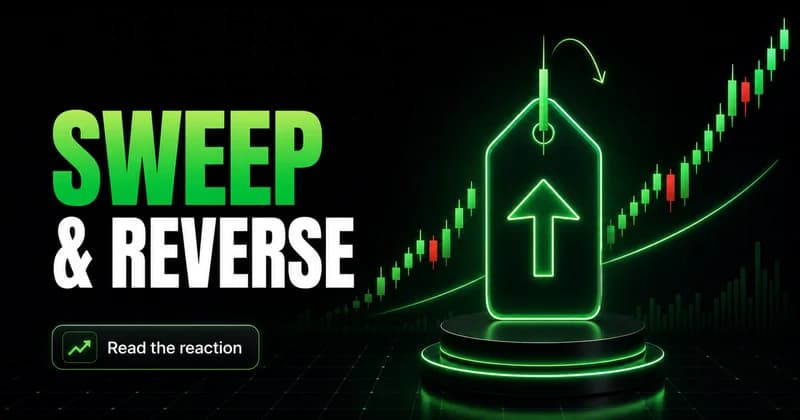
A liquidity sweep trading strategy waits for price to push past an obvious high or low, trigger the resting orders stacked there, then reverse. The sweep is not the signal. What price does in the minutes after the level breaks is the signal. Most traders enter on the break and get caught. The edge sits in the reaction, not the raid.
That reframing matters because liquidity is what moves these levels. Stops and breakout orders cluster just beyond a visible high or low, and price is drawn toward that pool. Taking the orders is mechanical. Holding above or below the level afterward is the test. When price sweeps the high and fails to stay there, the move was about collecting liquidity, not acceptance. From there, the risk shifts to the other side.
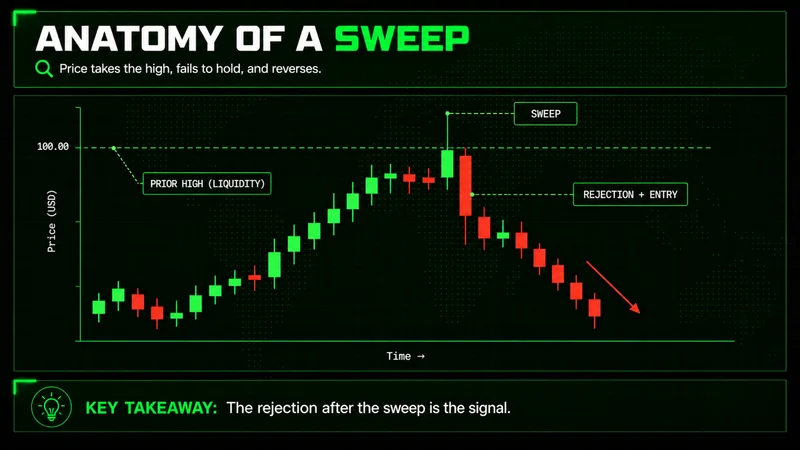
What is a liquidity sweep trading strategy
A liquidity sweep trading strategy is a method built around price taking out a known pool of orders and then rejecting the level it just broke. You are not predicting the break. You are reacting to the failure that follows it. The structure is simple: price runs a high or low, the stops behind it fill, and if buyers or sellers cannot hold the new ground, price snaps back into the prior range with momentum.
This is reactive, not predictive. The market tells you whether the level held or failed, and you respond. A liquidity grab is the same mechanic from the order-flow side: a fast push to absorb resting orders, then a return. Whether you call it a sweep, a grab, or a stop hunt strategy, the behavior is identical. Price reaches for liquidity, takes it, and the reaction decides direction.
The reason this works is positioning. When a high gets swept, late buyers are long into the move and short stops have just triggered. If price reverses, those late buyers are trapped and forced to exit, which fuels the move back down. The sweep creates the imbalance. The strategy trades the unwind of it.
How buy side and sell side liquidity sweeps form
Liquidity has two sides, and the strategy reads both the same way. A buy side liquidity sweep happens above a high. Short sellers park their stops above swing highs and equal highs, and breakout buyers place entries there too. Price pushes up into that cluster, fills the orders, and if there is no real demand to sustain the move, it rejects. The buy side liquidity gets taken, and the path of least resistance flips lower.
A sell side liquidity sweep is the mirror. Below a low, long traders hold their stops and breakout sellers wait to short. Price drives down through the low, triggers the sell stops, and if sellers cannot keep price below the level, it reverses up. The sell side liquidity is collected on the way down, and the reaction carries price back into the range.
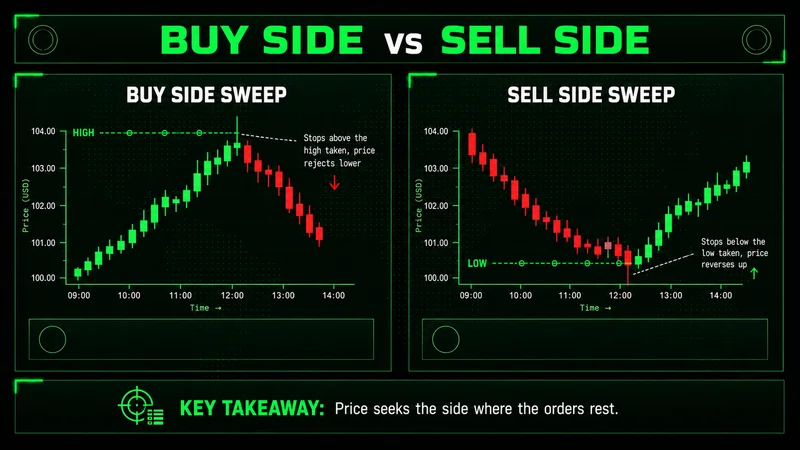
The labels matter less than the behavior. In both cases, price seeks the side where the most orders rest, takes them, and the quality of the reversal depends on what happens next. A clean sweep rejects quickly. A weak one drifts, which is your first clue the setup is not there.
How to identify a liquidity sweep on the chart
Identification starts with the level, not the candle. A sweep needs a pool worth taking, so mark the places where orders obviously sit:
- Equal highs or equal lows, where stops stack on a flat edge
- The prior day's high or low, a level the whole market watches
- A swing point price has tested more than once without breaking
- Session highs and lows from a clearly defined range
Once the level is marked, watch how price interacts with it. A liquidity sweep shows a sharp push beyond the level followed by a quick return inside it. The wick that pokes through is usually long relative to the body, because price reached for the orders and got rejected rather than accepted. Acceptance looks different: price breaks, holds, and builds above or below the level. That is not a sweep. That is a real break, and trading it as a sweep is how the setup goes wrong.
The cleanest sweeps close back inside the range on the same candle or the one after. Speed of rejection is the tell. When price takes the level and immediately fails to hold, the move was about liquidity. When price lingers, the read is unclear, and an unclear read is not a trade.
Liquidity sweep vs breakout — the distinction that decides your entry
The hardest part of this strategy is separating a sweep from a breakout, because they start the same way. Both begin with price moving through a level. The difference is what follows, and that difference decides whether you fade the move or stand aside.
| Behavior | Liquidity sweep | Genuine breakout |
|---|---|---|
| Move through the level | Sharp, often a long wick | Sustained, body closes beyond |
| Action after the level | Returns inside the range quickly | Holds and builds new ground |
| Volume character | Spike then fade | Steady participation continues |
| What it means | Orders collected, reversal likely | Acceptance, continuation likely |
| Your response | Fade on confirmed rejection | Do not fade; trend may extend |
Trading without this distinction is gambling with better vocabulary. A liquidity sweep vs breakout decision is a context decision, not a pattern decision. The same candle can be either one depending on whether price accepts the new level. This is why confirmation matters more than the break itself, and why entering the moment price clears a high is the most common way traders hand their stops to the sweep.
The sweep and reversal entry, step by step
The sweep and reversal is the core setup. It is a sequence, and skipping a step is usually what turns a clean idea into a loss. Run it in order:
- Mark the liquidity level before price reaches it. Decide in advance where the orders rest.
- Wait for price to sweep the level, taking the high or low with a clear push.
- Watch for the close back inside the range. A close beyond the level is not your trade.
- Look for a rejection signal at the level, such as a sharp reversal candle or a failed retest.
- Enter on the reaction, with a stop on the far side of the sweep wick.
- Define the target before entry, usually the opposite side of the range or the next pool of liquidity.
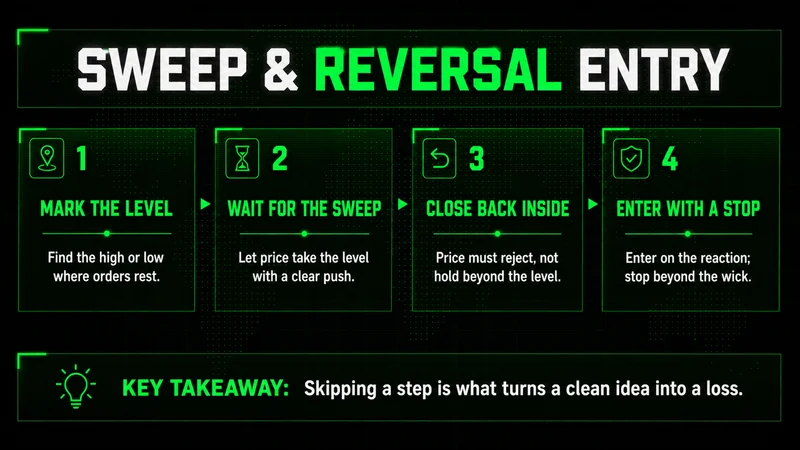
Risk is defined the moment you enter, because the sweep wick gives you a natural invalidation. If price reclaims the level and holds beyond the wick, the sweep was a real break and the idea is wrong. That is a small, clean loss. Most account damage on this setup comes from moving the stop, not from the setup failing. A mediocre entry with a defined stop survives. A perfect read with a floating stop eventually does not.
How to confirm a liquidity sweep before you commit
Confirmation is what separates this from chasing. A liquidity sweep confirmation is not a single indicator. It is a stack of conditions that agree before you act:
- Price closed back inside the range after taking the level, not beyond it
- The rejection came with a visible reaction, a sharp candle or a clear shift in direction
- The sweep fits the higher time frame structure, sweeping into a level that already mattered
- The move that took the liquidity was fast, and the return was equally fast
When these line up, the probability improves. When only one is present, you are filling in the rest with hope. The strongest setups sweep liquidity into an area that already mattered on a higher time frame, so the sweep and the structure point the same way. A sweep against the broader structure can still work, but it is a lower-quality environment, and the right response is a smaller size or no trade.
Liquidity above the prior high was taken first. The reaction afterward mattered more than the sweep itself. Price failed to hold acceptance above that level, which showed buyers were not in control.
Confirmation also keeps you out of the worst version of this trade: the slow grind through a level that never rejects. If price takes the high and keeps going, there was nothing to confirm. Standing aside there is a decision, not a missed opportunity.
When this doesn't work — thin liquidity and low-participation sessions
This strategy reads cleanly in active hours when real participants are in the market. Overnight, on thin liquidity, the same sweep sequence means almost nothing. A handful of orders can push price through a high with no institutional interest behind it, and the rejection you are waiting for never comes because there was never any real demand to reject. The pattern looks identical on the chart and behaves completely differently.
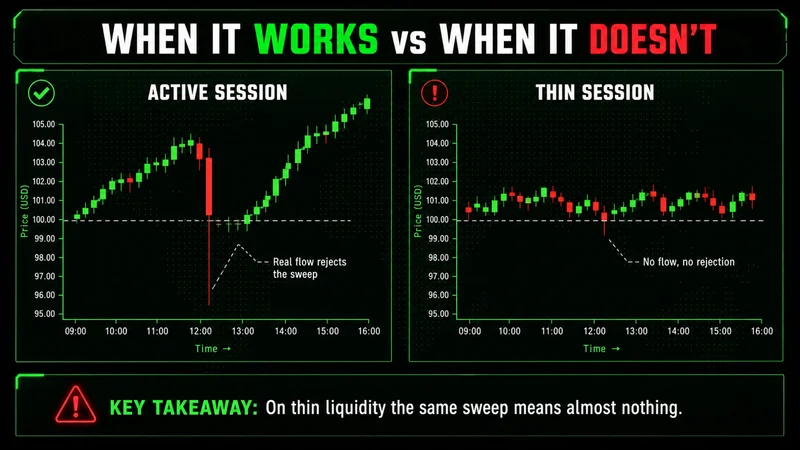
The conditions where the edge thins out are predictable:
- Low-volume sessions and holiday periods, where a few orders move price too far
- The minutes immediately after major news, when volatility spikes and structure has not formed
- Deep overnight hours with no real participation behind the move
- Choppy ranges with no clear level worth sweeping in the first place
No strategy works in all conditions, and adaptation is part of the job. The sweep and reversal is a tool for liquid, structured markets. Forcing it into thin conditions because you want a trade is how a sound setup gets a bad reputation. When participation is low, the disciplined decision is usually to wait for the session that brings real flow back.
Common liquidity sweep trading mistakes
Most traders do not have a strategy problem with sweeps. They have a discipline problem. The setup is simple, and the errors are repetitive:
- Entering on the break instead of the reaction, which puts you long into the exact liquidity the sweep is collecting
- Treating every wick through a level as a sweep, when many are genuine breaks that keep going
- Ignoring higher time frame context and fading a sweep that aligns with a strong trend
- Moving the stop beyond the sweep wick when price threatens it, turning a defined risk into an open one
- Forcing the setup in thin conditions where the rejection has no real flow behind it
- Sizing up after a loss to recover, which has nothing to do with the chart and everything to do with ego
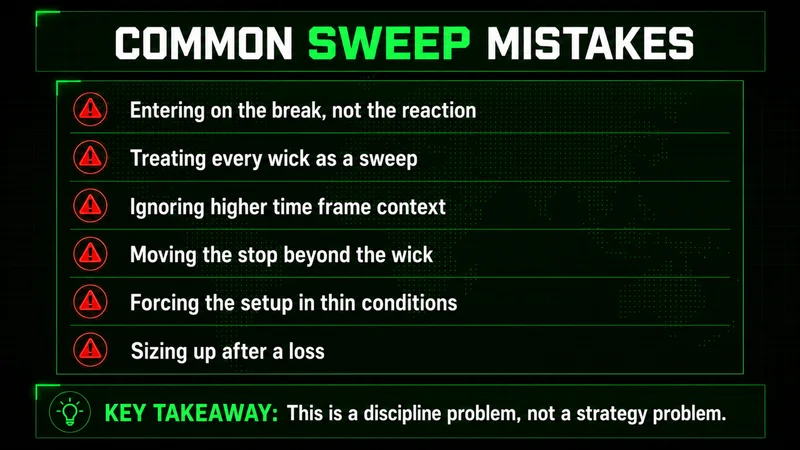
None of these require a better indicator. Execution quality matters more than finding a secret setup. The sweep and reversal has been a known pattern for years. What separates the traders who use it well is patience for the reaction, respect for context, and a stop that stays where they put it.
FAQs
What is a liquidity sweep trading strategy in simple terms? It is a method that waits for price to take out the orders resting beyond an obvious high or low, then trades the reversal when price fails to hold the level it just broke. The signal is the rejection after the sweep, not the break itself.
How do you confirm a liquidity sweep? Look for a stack of conditions: price closing back inside the range after taking the level, a visible rejection candle or shift in direction, alignment with higher time frame structure, and a fast move into and out of the liquidity. One condition alone is not enough.
What is the difference between a liquidity sweep and a breakout? A sweep pushes through a level, fails to hold, and returns inside the range, which signals a likely reversal. A breakout pushes through and holds, building new ground beyond the level, which signals likely continuation. The behavior after the level decides which one it is.
What is the difference between a liquidity sweep and a liquidity grab? They describe the same behavior from different angles. A liquidity grab emphasizes the fast absorption of resting orders, while a liquidity sweep emphasizes the move through a marked level. In practice, traders use the terms interchangeably.
Where should the stop go on a sweep and reversal trade? On the far side of the sweep wick. If price reclaims the level and holds beyond that wick, the sweep was a genuine break and the idea is invalid. That placement keeps the loss small and defined.
Worth the read?