Best Trading Strategy for Beginners — One Setup, Done Right
The best trading strategy for beginners is not a named pattern. It is one simple, risk-defined setup, sized small and traded with discipline.
The best trading strategy for beginners is not a named pattern you discover. It is one simple, risk-defined setup, traded the same disciplined way every session, until the mechanics are second nature. Pick the setup, define where it is wrong, size it small, and repeat it. The edge a beginner needs lives in that repetition, not in the strategy's name.
Most guides answer this question with a catalog. Nine strategies, fifteen strategies, a menu of momentum, breakout, mean reversion, carry, and a dozen others. The catalog is not wrong, but it solves the wrong problem. A new trader does not fail because they chose trend trading over range trading. They fail because they traded any setup without a defined stop, with size that was too large, and abandoned it after two red trades. The strategy was never the bottleneck. The discipline around it was.
This guide takes the opposite approach. Instead of listing strategies, it builds one simple trading strategy you can actually execute, wraps defined risk around it from the first trade, and then names the exact conditions where it stops working. That last part matters more than the entry. A setup you cannot break down, and cannot tell when to stand aside from, is not a strategy. It is a guess with better vocabulary.
What the best trading strategy for beginners actually is
The best trading strategy for beginners is a single setup with three fixed parts:
- A clear reason to enter — a specific, repeatable condition, not a feeling.
- A defined level that proves the idea wrong — the stop, decided in advance.
- A position size derived from that risk — size as an output of the stop, not a guess.
Everything else is detail. If those three parts are in place before the trade, you are trading a strategy. If any of them is decided after the entry, you are improvising.
This is a deliberately narrow definition, and the narrowness is the point. A beginner trading strategy should be boring and repeatable. It should produce the same decision when the same conditions appear, so that the outcome of any single trade tells you almost nothing and the outcome of a hundred trades tells you whether the setup has an edge. That feedback loop is impossible if you change the rules every week.
Notice what is missing from the definition. There is no mention of a specific indicator, a particular timeframe, or a market. Those are choices you fit to yourself later. A simple trading strategy works on a five-minute chart and on a daily chart; what changes is how often it fires and how much screen time it demands. The structure stays the same. Reason to enter, level that invalidates, size that respects the risk.
Beginners often want the definition to be more exciting than this. They expect the best strategy to be a hidden pattern most people miss. It is the reverse. The edge is in execution quality, not in a secret. The traders who survive are the ones who run an ordinary setup with extraordinary consistency, while the ones chasing the next perfect system rarely trade any one of them long enough to find out if it works.
Why most beginner strategies fail before the entry
Most failed trades are decided long before the entry. Poor positioning, an oversized stake, and impatience usually settle the outcome first, and the chart just confirms it later. A new trader watching a clean breakout sees opportunity; a disciplined trader sees a setup that still needs a defined stop and a size that survives being wrong. The difference is not analysis. It is preparation.
Here is the uncomfortable observation, anchored in years of watching new accounts: most traders do not have a strategy problem. They have a discipline problem. The setup is rarely the reason an account bleeds out. The reasons are predictable and human. Position size creeps up after a good week. A stop gets widened mid-trade because moving it feels better than taking the loss. A strategy gets abandoned after a normal losing streak that any edge produces. None of those are flaws in the strategy. They are flaws in the operator.
A mediocre entry with controlled risk survives. A perfect entry with reckless size eventually destroys the account.
This is why a beginner should spend more time on the rules around the trade than on the entry trigger itself. The entry is the easy part. Anyone can learn to spot a pullback into a moving average or a break of a prior high. What separates a strategy that compounds from one that blows up is whether the risk was defined first, whether the size was small enough that one loss does not distort the next decision, and whether the trader can sit through a drawdown without rewriting the plan.
There is a quieter failure mode too. Beginners overload the chart, stacking five indicators in search of certainty that does not exist. More inputs feel like more confidence, but they usually produce conflicting signals and analysis paralysis. A simple trading strategy with one or two reference points is easier to execute under pressure than a complex system you cannot read quickly when price is moving against you.
A simple trading strategy you can actually trade
Here is one concrete setup a beginner can run: the trend pullback. It works because it aligns the entry with the direction price is already moving, which keeps you on the side of momentum instead of fighting it.
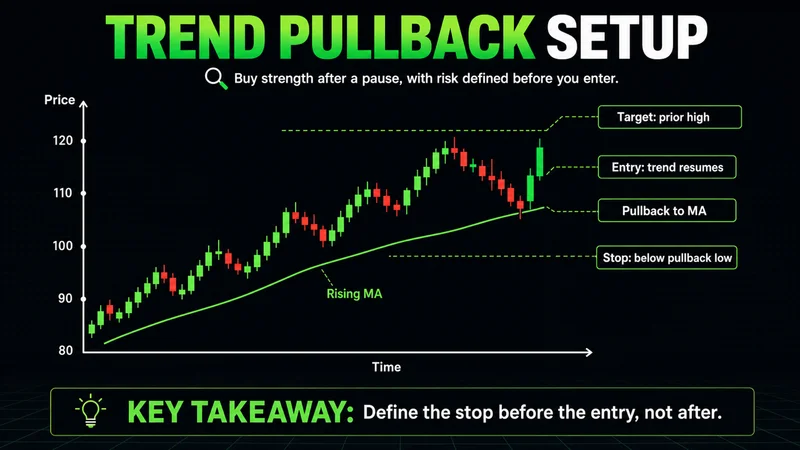
The rules are mechanical:
- Identify a clear uptrend: price making higher highs and higher lows, trading above a rising moving average.
- Wait. Let price pull back toward the moving average rather than chasing it at the highs.
- Enter on the first sign the trend is resuming, a strong candle closing back in the direction of the trend.
- Place the stop just below the pullback low. If price breaks that level, the pullback was a reversal, not a pause, and the reason for the trade is gone.
- Set the target at the prior swing high.
That is the entire setup. Notice that the invalidation is built into it. You are not deciding where to exit after you are already losing; the level that proves you wrong was defined before you entered. This is what makes it a basic trading strategy rather than a hunch. The reason to be in the trade and the reason to be out are both specified in advance.
The same structure applies if you prefer the short side in a downtrend: lower highs and lower lows beneath a falling moving average, a pullback up into that average, an entry on the first sign of the downtrend resuming, and a stop just above the pullback high. The logic is symmetric. Trade in the direction of structure, enter on the pause, define where the idea breaks.
What this setup will not do is fire constantly. In a clean trend it might give you one or two quality entries; the rest of the session you wait. That waiting is not wasted time. It is the job. Forcing a trade when price is chopping sideways with no clear trend is how a good setup turns into a string of small losses, which brings us to risk.
Building risk into the strategy from day one
A strategy is only as good as the risk control wrapped around it. For a beginner, the single most important rule is this: risk a fixed, small percentage of the account on each trade, and let position size fall out of that number rather than guessing at it.
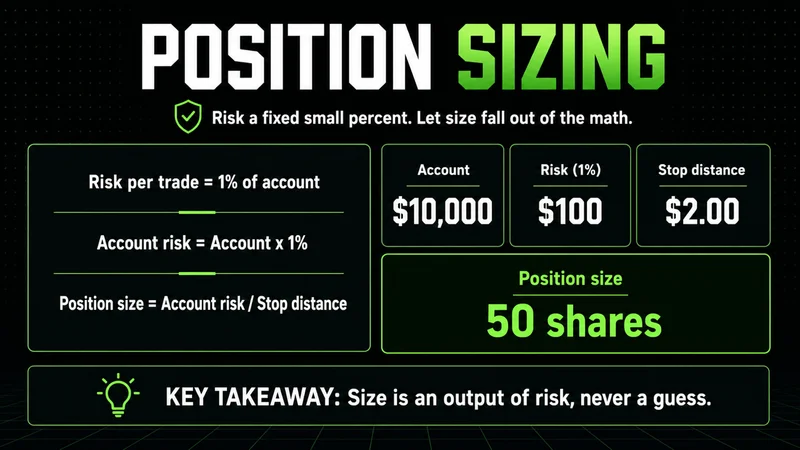
The math is simple and it removes emotion from the decision. Decide the percentage of the account you are willing to lose on one trade. One percent is a sensible starting point for a low risk trading strategy. On a 10,000-dollar account, that is 100 dollars of risk per trade. Now measure the distance from your entry to your stop. If that distance is 2 dollars per share, your position size is your account risk divided by the stop distance: 100 divided by 2, or 50 shares. The wider the stop, the smaller the position. Size is an output of risk, never an input you pick because the trade feels good.
This is what makes a strategy survivable on a small account. With risk fixed at a small percentage, a losing streak is a controlled cost, not an account-ending event. Ten losses in a row at 1 percent each leaves you down roughly 10 percent, bruised but fully able to keep trading the setup. The same ten losses with undefined size can end the account. Protecting capital is the first objective; the returns are a consequence of staying in the game long enough for the edge to show up.
Most beginners are overleveraged without realizing it. The tell is emotional, not mathematical: if a single losing trade ruins your focus or pushes you to trade angry, the position was too large, regardless of what the percentage on paper said. Correct sizing should make any one loss feel routine. When it does not, cut the size until it does. A low risk trading strategy for beginner traders is defined less by the entry and more by the fact that no single trade can do real damage.
How to choose a trading strategy as a beginner
If you are wondering how to choose a trading strategy as a beginner, the honest answer is that the choice matters less than the commitment. Any sound, risk-defined setup, traded consistently, will teach you more than jumping between five strategies ever will. That said, you can narrow the field by matching the setup to three things about yourself:
- Screen time — how many hours a day you can actually watch the market.
- Capital — how large the account is and how much room it has to absorb mistakes.
- Temperament — whether you stay calm under pressure or tend to chase.
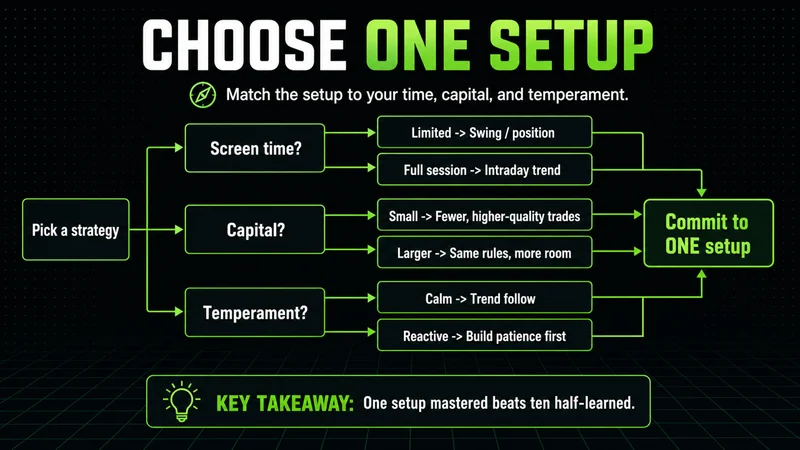
The first input is screen time. If you can watch the market for full sessions, an intraday trend setup like the pullback above suits you. If you have an hour a day, a swing-trading version of the same logic on a higher timeframe fits better, where you check charts once and manage positions over days rather than minutes. The setup does not change; the timeframe adapts to your schedule.
The second input is capital. A smaller account argues for fewer, higher-quality trades rather than frequent activity, because costs and mistakes compound faster when there is less room to absorb them. The best trading strategy for small accounts is not a different strategy at all; it is the same setup traded more selectively, with size held strictly to the risk rule. The third input is temperament. If you are calm and patient, trend following will feel natural. If you are reactive and quick to chase, you have a discipline problem to solve before any setup will work, and the fix is fewer trades, not a new system.
The takeaway is to commit to one setup and trade it long enough to judge it fairly. A strategy needs dozens of trades before its results mean anything. Switching after a handful of losses guarantees you never give any approach the sample size it needs. What trading strategy beginners should learn first is whichever risk-defined setup they will actually trade with discipline, repeatedly, without rewriting it every week.
Writing a trading plan for beginners
A trading plan for beginners turns a setup into a system you can follow under pressure. Without it, every decision is made live, in the moment, when emotion is highest and judgment is worst. The plan moves the thinking to a calm moment beforehand so that during the trade you are executing, not deciding.
A usable plan is short, and it covers five things:
- The setup and entry conditions that have to be present before you act.
- The stop level and why that level invalidates the idea.
- The risk per trade as a fixed percentage, and the position-sizing rule that follows from it.
- The target or the rule for managing the exit.
- The no-trade conditions, such as an unclear, range-bound market or a session after major news where structure has not yet formed.
That last item is as important as the entry rules; knowing when to stand aside protects more capital than any single good trade earns.
The plan should also account for the trader, not just the market. Two limits do most of the work:
- A maximum number of trades per session, so a quiet market does not bait you into forcing setups.
- A daily loss limit, after which you stop for the day regardless of how you feel about the next trade.
A losing day does not require immediate recovery, and the belief that every red day must end green is how small losses compound into large ones. Stepping away from the screen when execution is degrading is often the highest-quality decision available. The plan is what gives you permission to do that, because the rule was written before the frustration arrived.
None of this needs to be elaborate. A first trading strategy and its plan can fit on a single page. The value is not in length; it is in having committed the rules to writing so that you can hold yourself to them and review them honestly afterward. A plan you can see is a plan you can improve. A plan that lives only in your head changes shape every time the market pressures it.
Comparing four beginner-friendly setups
A beginner does not need many setups, but it helps to see how a few simple ones compare so you can pick the one that fits. Each of the following is risk-defined and built on the same principle: trade with structure, define invalidation, size to the risk.
| Setup | Best market condition | Typical timeframe | Defined invalidation | Skill demand |
|---|---|---|---|---|
| Trend pullback | Clear, trending market | Intraday or daily | Below the pullback low | Low to moderate |
| Breakout from range | Consolidation resolving | Intraday or daily | Back inside the range | Moderate |
| Support or resistance bounce | Defined range, clear levels | Intraday or daily | Through the level on closing basis | Low to moderate |
| Moving-average reclaim | Transition back to trend | Daily or swing | Loss of the average again | Moderate |
The trend pullback is the most forgiving starting point because it keeps you aligned with momentum and gives a tight, logical stop. The breakout suits a market coiling in a range, but it demands patience to wait for a real resolution rather than a false push that snaps back. The support or resistance bounce works while a range holds, with invalidation defined as a decisive close through the level. The moving-average reclaim catches a market turning back into a trend, useful but trickier to time.
What every row shares is more important than what separates them. Each has a clear condition where it applies and a clear level where it is wrong. None is a low-quality setup you take in any market; each is matched to a specific structure. Pick one, ideally the trend pullback to start, and leave the others until the first is genuinely second nature. The goal is depth in one setup, not shallow familiarity with four.
When this simple strategy stops working
Here is the part most beginner guides skip. The trend pullback reads cleanly in a trending session, and in that environment the rules do exactly what they promise. Drop the identical setup into a choppy, range-bound market and the framework inverts. The same pullback to a moving average that signals a high-probability entry in a trend becomes a coin flip when price is oscillating sideways, and the same mechanical entry produces a string of small losses as each attempt reverses.
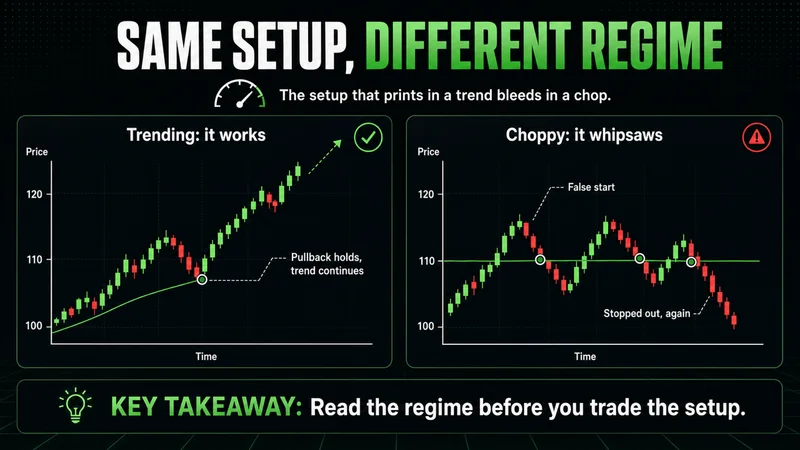
This is not a defect in the strategy. It is the nature of every strategy: no single approach works in all market conditions. A setup built for trends needs a trend. When the market stops trending and starts ranging, the edge the setup relies on simply is not present, and forcing it anyway is how a good trader has a bad week. The skill is not finding a setup that always works. The skill is recognizing when the current regime no longer fits the setup, and standing aside until it does.
The practical signal is the structure itself. If price is no longer making clear higher highs and higher lows, if the moving average has flattened and price is crossing back and forth through it, the trend that the pullback depends on is gone. That is the condition to stop taking the setup, not to take it more aggressively in the hope it resumes. Markets reward adaptation, not stubbornness, and a beginner who learns to read when their one setup is out of season has learned something more durable than the setup itself.
This is also why a single strategy is enough to start but not forever. As you gain screen time, you add setups not to trade more, but to have a tool for the conditions where your first setup goes quiet. Until then, the correct move when the regime turns is simpler: trade less, preserve capital, and wait for structure that fits the one setup you know.
Common mistakes new traders make
Most of the ways a beginner strategy fails are not subtle, and nearly all of them are discipline failures rather than analysis failures. Recognizing them is half the battle, because the same handful of mistakes drains the majority of new accounts.
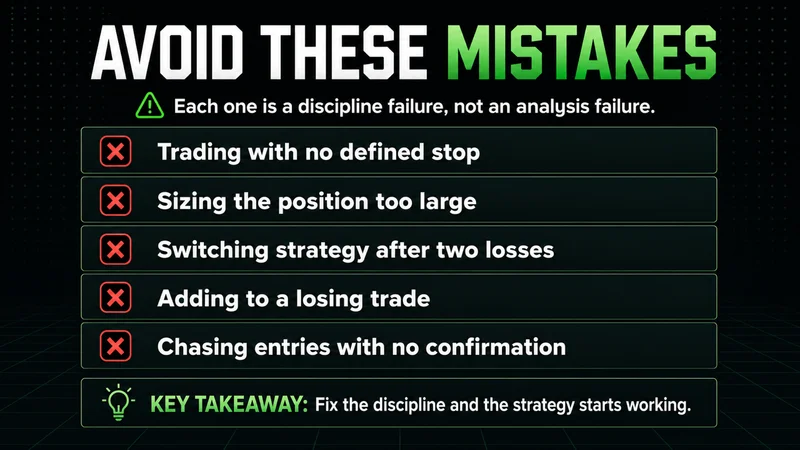
The pattern is consistent across new accounts:
- Trading with no defined stop. Without a level that proves the idea wrong, a small loss has no natural limit and turns into a large one while you wait for a recovery that may not come.
- Sizing the position too large. Oversized risk makes every trade emotionally loud and pushes you toward panic decisions.
- Switching strategy after two losses. This guarantees you never trade any setup long enough to learn whether it works.
- Adding to a losing trade. This is ego trying to be right rather than a plan being followed, and it turns a defined loss into an undefined one.
- Chasing entries with no confirmation. Buying because price is moving and you do not want to miss it is how you end up entering exactly where a disciplined trader is taking profit.
Every one of these has the same cure. Define the risk before the trade, size it small enough that a loss is routine, and follow the plan you wrote when you were calm. The traders who last are not the ones who avoid losses; losses are an operational cost of the business. They are the ones who keep their losses small and their mistakes rare, so the edge in their one simple setup has room to work over hundreds of trades.
FAQs
What is the best trading strategy for beginners? The best trading strategy for beginners is a single, risk-defined setup, such as a trend pullback, traded consistently. The specific setup matters far less than entering for a defined reason, knowing the level that invalidates the trade, and sizing the position from a fixed risk percentage.
What is the simplest trading strategy to start with? A trend pullback is one of the simplest. You wait for a clear uptrend, let price pull back to a rising moving average, enter as the trend resumes, place your stop below the pullback low, and target the prior high. The rules are mechanical, and the invalidation is defined before you enter.
How much should a beginner risk per trade? A common starting point is 1 percent of the account per trade. On a 10,000-dollar account, that is 100 dollars of risk. Position size is then derived from the stop distance, so the wider the stop, the smaller the position. Fixed, small risk keeps any single loss from doing real damage.
How do I choose a trading strategy as a beginner? Match the setup to your screen time, your capital, and your temperament. Full sessions suit intraday setups; limited time suits swing trading on higher timeframes; smaller accounts argue for fewer, higher-quality trades. Then commit to one setup long enough to judge it across dozens of trades.
Do beginners need more than one strategy? No, not at the start. One risk-defined setup, traded with discipline, teaches more than several traded shallowly. Additional setups become useful later, mainly to handle the market conditions where your first setup goes quiet, not to increase how often you trade.
Why do most beginner traders lose money? Most lose to discipline failures, not strategy flaws. Trading without a stop, oversizing positions, abandoning a setup after a normal losing streak, and chasing entries drain more accounts than poor analysis does. The setup is rarely the problem; the rules around it are.
Does a simple trading strategy work on a small account? Yes. The best trading strategy for small accounts is the same risk-defined setup traded more selectively, with size held strictly to the risk rule. A small account simply has less room for error, which makes fixed, small risk and patience even more important.
When does a beginner trading strategy stop working? When the market regime no longer fits it. A trend setup needs a trending market; in a choppy, range-bound market the same setup whipsaws into repeated small losses. The skill is recognizing when conditions no longer suit your setup and standing aside until structure returns.
Worth the read?