Naked Short Selling — What It Is and Why It's Banned
Naked short selling is shorting without a confirmed borrow, ending in a failure to deliver. Here is what it really means, the rules, and why it is banned.
Naked short selling is selling shares you have not borrowed and have not confirmed you can borrow. The seller skips the locate, takes the trade, and assumes the shares will appear before settlement. When they do not appear, the trade becomes a failure to deliver, and that gap is the entire problem regulators built rules around.
Most of what retail traders believe about this term is wrong. The word gets thrown at every red day in a hard-to-borrow name, usually as a reason the price "should" be higher. That framing is comfortable, but it confuses a settlement mechanic with a market opinion. The mechanic is narrow, it is regulated, and for an ordinary trader it is not a strategy you can run.
What naked short selling means in plain terms
Start with the normal version. In a standard short sale, you borrow shares from a broker, sell them, and plan to buy them back later at a lower price. The borrow is the discipline. Someone confirmed the shares exist, located them, and lent them to you before the sale printed.
Naked short selling removes that step. You sell first and source the shares afterward, betting the locate is a formality. The naked short selling meaning that matters here is not "shorting without owning" — every short sells what it does not own. It is shorting without the confirmed borrow that makes delivery possible. That distinction is the whole subject.
How does naked short selling work
The sequence is short. A seller enters a sell order for shares that have not been located. The trade executes. Settlement arrives, and the seller is supposed to deliver real shares to the buyer. If no shares were ever borrowed, there is nothing to hand over, and the position lands in failure-to-deliver status with the clearing system.
A failure to deliver is not automatically naked shorting. Borrows fall through, transfers lag, and ordinary settlements break for boring operational reasons. Persistent, repeated fails in the same name are the signal regulators watch, because that pattern is what abusive naked shorting looks like from the outside. One fail is noise. A standing pile of fails in a low-float name is a flag.
Naked short selling vs covered short selling
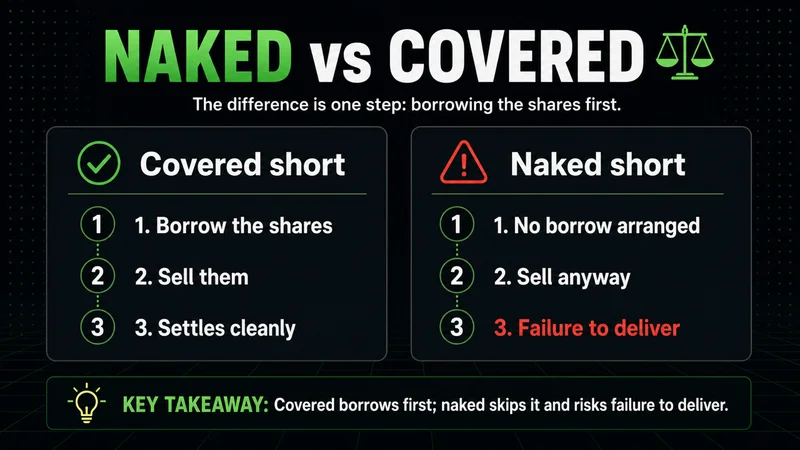
The cleaner contrast is naked short selling vs covered short selling, because the difference is one step, not one philosophy.
- A covered short borrows the shares first. Delivery is arranged before the sale, so settlement is never in question. This is the short selling almost every retail and institutional trader actually does.
- A naked short skips the borrow. Delivery depends on shares the seller has not secured, which is why it can end in a failure to deliver.
The profit logic is identical: sell high, buy back lower, keep the difference. The risk that separates them is settlement risk, and that is exactly the risk the rules target. Calling a covered short "naked" because the price went up is the most common naked short selling mistake new traders make, and it usually replaces analysis with a story.
Why naked short selling is banned and what the rules require
Abusive naked short selling is restricted in the United States because it can deliver real selling pressure backed by shares that may never exist. That breaks the assumption a buyer relies on — that the share they bought is real and will arrive.
The SEC's Regulation SHO is the framework. It requires a broker to have reasonable grounds to believe a security can be borrowed and delivered before a short sale, the locate requirement. It also forces close-outs of persistent fails in flagged securities. These naked short selling rules do not ban shorting; they ban shorting without a credible path to delivery. Bona fide market makers get a narrow exemption, which is why "naked shorting" is not a blanket crime so much as a specific, monitored failure mode.
What failure-to-deliver data actually tells a trader
This is where the practitioner read diverges from the forum read. Fail-to-deliver figures are published, and they get screenshotted as proof of manipulation in any name that drops. As a trader, treat that data as context, not conclusion.
High fails in a thin, hard-to-borrow stock tell you borrow is expensive and settlement is stressed. That is useful. It does not tell you direction, and it does not confirm that anyone shorted naked on purpose. Liquidity and positioning move price; a fail count is a residue of settlement friction, not a forecast. The naked short selling risk worth respecting is operational and legal for the seller — fines, forced buy-ins, and close-outs — not a free payoff for whoever spots the fails.
The approach breaks down the moment you treat fail data as a timing signal. Read fails as an entry trigger and the same number that "confirmed" your thesis on a down day means nothing on the next up day, because it never carried directional information to begin with. Context first, data second. A number without a structural read is just a number.
A naked short selling example for new traders
Picture a small-cap with a tiny float and almost no borrow available. A seller wants downside exposure but cannot find shares to borrow, so the shares are sold anyway with no locate behind them. The order fills. The buyer is now owed shares that were never sourced.
Settlement comes. No shares are delivered, and the position sits in failure-to-deliver. Under Regulation SHO the broker faces a forced close-out, buying shares in the open market to satisfy delivery regardless of price. If the stock has run higher, that buy-in is expensive, and the seller absorbs the loss plus regulatory exposure. The example most people cite is the 2021 meme-stock period, when naked shorting accusations flew across GameStop and similar names — most of that pressure traced to ordinary, located short selling and a brutal squeeze, not to confirmed naked positions.
A naked short selling checklist for new traders
If you are still early, the practical use of this topic is knowing what not to assume. Run this checklist before you repeat the word.
- Confirm your own shorts are covered. If your broker located and lent the shares, you are not naked shorting, regardless of where price goes.
- Separate a failure to deliver from intent. Fails happen for operational reasons; only a persistent pattern points at abuse.
- Treat fail-to-deliver data as context, never as a direction or a timing signal.
- Remember the exemption. Bona fide market making is treated differently from a retail seller skipping the borrow.
- Drop the word as an explanation for losses. "It was naked shorted" is rarely the reason a position went against you.
FAQs
What is naked short selling in simple terms? It is selling shares you have not borrowed and have not confirmed you can borrow, then planning to source them before settlement. When the shares never arrive, the trade becomes a failure to deliver, which is the core problem the rules address.
Is naked short selling illegal? Abusive naked short selling is restricted in the United States under Regulation SHO, which requires a locate before shorting and forces close-outs of persistent fails. It is not a blanket crime, because bona fide market makers receive a narrow exemption.
How does naked short selling work? A seller sells shares without securing a borrow, the trade executes, and at settlement there are no shares to deliver. That gap registers as a failure to deliver in the clearing system, and the broker can be forced to buy shares in the open market to close it out.
What is the difference between naked short selling and covered short selling? A covered short borrows the shares before selling, so delivery is arranged. A naked short skips that borrow, leaving settlement uncertain. The trading logic is the same; the difference is settlement risk.
Is naked short selling a good strategy for beginners? No. For an ordinary trader it is not a usable strategy at all — it carries forced buy-ins, fines, and close-out risk, and the legal short selling you can actually run already gives you downside exposure with a real borrow behind it.
Keep reading
If this cleared up the difference between a settlement mechanic and a market story, the rest of the MRPNL library applies the same lens to short selling, liquidity behavior, and market structure. Subscribe to the newsletter to get each breakdown as it goes live, and work through the short selling and risk-management pieces next.
Worth the read?