New York Stock Exchange — How It Works for Traders
The New York Stock Exchange explained from a trader's seat: how its auction and market makers shape liquidity, execution, and where the model can break.
The New York Stock Exchange is the largest stock exchange in the world by market value, a central marketplace where buyers and sellers trade shares of listed companies through a continuous auction. That is the textbook definition, and it is accurate. From a trader's seat, though, the more useful way to understand the New York Stock Exchange is as a liquidity venue with rules about how orders meet, who stands in the middle, and what happens when too many people want the same price at once.
Most explainers stop at the buttonwood tree and the opening bell. Those details give context. They tell you almost nothing about execution.
New York Stock Exchange meaning, in plain terms
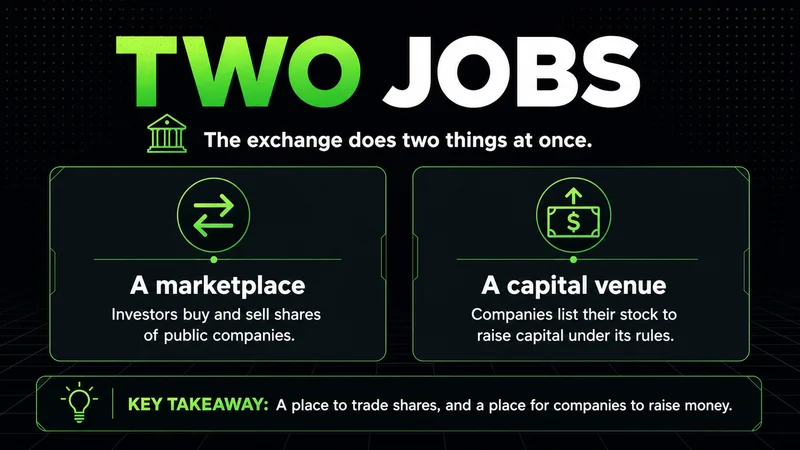
The New York Stock Exchange, often called the NYSE or the Big Board, does two things. It gives investors a place to buy and sell shares of public companies, and it lets those companies raise capital by listing their stock under the exchange's rules. The exchange does not set prices; order flow does. Its job is to provide the matching engine and the rulebook that decides which order trades first.
How the New York Stock Exchange works as an auction
The NYSE runs as a continuous auction. The highest price a buyer will pay meets the lowest price a seller will accept, and when they overlap, a trade prints. Most of this is electronic now, matched in a data center in Mahwah, New Jersey, not on the famous floor.
What separates the NYSE from a fully electronic venue is the designated market maker. Each listed stock has one, obligated to quote and to keep the market orderly during imbalances. That hybrid structure tends to produce deeper liquidity and tighter spreads in large, heavily traded names. For a trader, deeper liquidity means a market order is less likely to walk the book and fill at a price you did not expect.
The session runs from 9:30 a.m. to 4:00 p.m. Eastern. The open and the close are where the most size changes hands, and they behave differently from the calm middle of the day.
What the New York Stock Exchange history actually tells a trader
The exchange traces back to 1792, when twenty-four brokers signed the Buttonwood Agreement under a tree on Wall Street. The relevant point is not the date. It is that the core mechanism, matching buyers and sellers through an auction with someone responsible for orderliness, has survived two centuries of crashes, electronic conversion, and the merger into Intercontinental Exchange. The plumbing changed; the auction did not.
The exchange is infrastructure. It guarantees a fair process for matching orders, not a fair outcome for your position.
The role of the New York Stock Exchange in markets, and where the model breaks
In normal conditions, the NYSE structure works in a trader's favor. Tight spreads, a market maker absorbing small imbalances, and predictable session hours all support clean execution. That is the strongest argument for trading large NYSE-listed names over thin ones.
The advantage thins out at the edges. During the opening auction, the closing auction, or a fast move on heavy news, the orderly market you counted on can gap. The designated market maker manages imbalances; it does not erase them. A stop just under support can fill far below your level when liquidity vanishes for a few seconds. The lesson is narrow: the NYSE structure protects execution during cash-hour liquidity, and it offers far less in the first and last minutes of the session, exactly when many retail traders are most active.
Most blown setups I have watched came not from a bad read of the company but from treating a thin moment as if it had the same liquidity as 11 a.m. The venue does not change your risk. Your sizing and your timing do.
New York Stock Exchange vs Nasdaq for investors
The practical difference is the matching model. The NYSE uses a single designated market maker per stock inside an auction; the Nasdaq is fully electronic with multiple competing market makers. The NYSE leans toward established, dividend-paying blue chips, while the Nasdaq skews toward higher-volatility growth and technology names.
For an investor choosing where a name trades, the venue matters less than the company. For a trader sizing a position, the typical liquidity and volatility profile is worth knowing first.
FAQs
What is the New York Stock Exchange in simple terms? It is a central marketplace where investors buy and sell shares of listed public companies through a continuous auction, and where those companies list their stock to raise capital. It is the largest exchange in the world by market value.
How does the New York Stock Exchange work? Buyers enter bids and sellers enter offers, and when the highest bid meets the lowest offer, a trade executes. Most matching is electronic, and each listed stock has one designated market maker who keeps its quotes orderly.
What are the main risks of trading New York Stock Exchange listed stocks? The same market risk that applies to any equity, plus execution risk during the open, the close, and fast news-driven moves when liquidity thins and prices can gap through your level. Sizing and timing manage that risk far more than the venue does.
Worth the read?