Operating Income — What It Says About a Business
Operating income is the profit from a company's core operations before interest and taxes. Here is how to read it as a signal, not just a definition.

Operating income is the profit a company earns from its core operations, before interest and taxes. It is what remains after you subtract the cost of goods sold and operating expenses from revenue. Most readers stop at the definition. The more useful question is what the number tells you about the business that produced it, because a single line on an income statement only matters in context.
That distinction is where most explanations end and the real reading begins. Operating income is reactive, not predictive. It describes the engine that already ran, not the one that will run next quarter. Read it that way, and it becomes one of the cleaner signals on the statement.
What is operating income, in plain terms
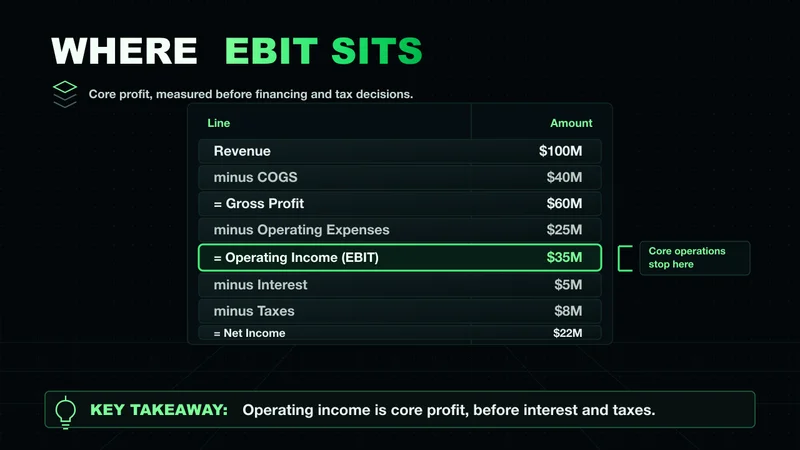
Operating income, sometimes called operating profit or EBIT, measures how much money a company keeps from running its business before financing and tax decisions enter the picture. It strips out interest, taxes, and anything that is not part of day-to-day operations. What is left is the result of the actual business: selling a product or service and paying the costs to deliver it.
The operating income meaning is easiest to hold onto by contrast. Revenue is what the business brought in. Gross profit is what survived the direct cost of producing the thing sold. Operating income is what survived after the cost of running the company on top of that. Each step removes a layer, and each layer tells you something different.
The operating income formula and its components
The operating income formula is direct:
Operating Income = Revenue − Cost of Goods Sold − Operating Expenses
You can also reach it from gross profit:
Operating Income = Gross Profit − Operating Expenses
The operating income components break down into a short list:
- Revenue — total sales from the core business over the period.
- Cost of goods sold (COGS) — the direct cost of producing what was sold, such as materials and direct labor.
- Operating expenses — the indirect costs of running the company: selling, general, and administrative expenses, research and development, and depreciation.
What the formula deliberately leaves out matters as much as what it includes. Interest on debt, income taxes, and one-time gains or losses sit below the operating line. That exclusion is the point. It isolates the operating engine from the financing and tax structure wrapped around it.
A clean operating income example
Consider an operating income example. A company reports 500,000 dollars in revenue for the year. It spends 200,000 dollars on cost of goods sold and 150,000 dollars on operating expenses such as wages and rent.
| Line item | Amount |
|---|---|
| Revenue | 500,000 |
| Cost of goods sold | (200,000) |
| Gross profit | 300,000 |
| Operating expenses | (150,000) |
| Operating income | 150,000 |
The operating income is 150,000 dollars. Divide that by revenue and you get a 30% operating margin. The margin, not the raw dollar figure, is the part worth tracking. A larger company can post a bigger operating income on a thinner margin, and the margin is what tells you how much of each sales dollar the operation actually keeps.
How to read operating income as a signal
This is the operating income interpretation that most guides skip. A single period in isolation says very little. The signal lives in the trend. When you read the line, three things carry the most weight:
- Margin direction — whether the operating margin is holding, expanding, or eroding over several years.
- Revenue context — whether margin moves are happening while revenue grows, stalls, or falls.
- Composition — whether the operating line is clean or padded with items that belong elsewhere.
Watch the operating margin across several years. A margin that holds steady or expands while revenue grows points to an operation with pricing power and cost control. A margin that erodes while revenue climbs is a quieter warning: the company is buying growth by spending more to get each sale. Reading one number without that context is gambling with better vocabulary.
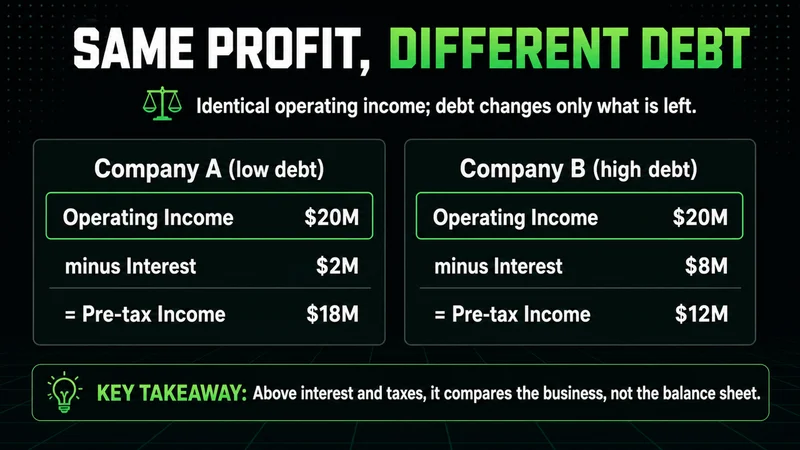
This is also where operating income helps stock analysis in a way net income often cannot. Because it sits above interest and taxes, it lets you compare the operating performance of two companies with different debt loads or tax situations on closer to equal footing. You are looking at the business, not the balance-sheet decisions around it.
There is a condition where this breaks down. In businesses with lumpy, project-based revenue, a single year of operating income can swing hard for reasons that have nothing to do with the underlying engine. A large contract recognized in one period inflates the line, and the next year looks like a collapse by comparison. In those cases the annual figure is noise, and you have to widen the window to several years before the trend means anything.
Operating income vs net income
The operating income vs net income question comes up constantly, and the difference is structural. Operating income stops at the operations. Net income is the final figure after interest, taxes, and every non-operating item have been applied.
A company can show strong operating income and weak net income if it carries heavy debt, because interest expense lands below the operating line. The reverse happens too. A one-time gain, such as selling a building, can lift net income while the operating business is flat or declining. That gap is exactly why the two figures are kept separate, and why reading them together tells you more than either alone.
Operating income red flags worth a checklist
Reported operating income is not always a clean read of the operating engine. A few operating income red flags recur often enough to be worth a standing checklist:
- One-time gains parked in the operating line. A gain from selling an asset should sit below operating income. When it does not, it props up the number artificially.
- Aggressive capitalization. Costs that belong in operating expenses get moved onto the balance sheet as assets, which shrinks reported expenses and inflates operating income.
- Margin masking through revenue growth. Rising operating income on a falling margin can hide a weakening core, as covered above.
- Recurring "one-time" charges. A restructuring charge every year is not one-time. It is an operating cost the company prefers you read as exceptional.
The market does not care about how a number is labeled. It cares about the cash the operation actually produces, and a clean operating income trend is the closest single line you get to that truth.
None of these signals are conclusive on their own. They are prompts to read the footnotes, not verdicts. But a company that triggers two or three of them at once deserves more scrutiny before the operating income number gets taken at face value.
FAQs
What is operating income in simple terms? It is the profit a company makes from its core business before interest and taxes. You take revenue, subtract the cost of goods sold and operating expenses, and what is left is operating income.
What is the difference between operating income and net income? Operating income measures only the operating business and stops before interest and taxes. Net income is the final profit after interest, taxes, and any non-operating items, so it reflects financing and one-time events that operating income excludes.
Is operating income the same as EBIT? In most cases they are used interchangeably, since both sit before interest and taxes. The difference appears when a company has non-operating income, such as investment gains, which EBIT can include but a strict operating income figure does not.
What is a good operating income? There is no single threshold, because it depends on the industry. The more useful read is the operating margin and its direction over several years: a stable or rising margin signals a healthier operation than a high but eroding one.
The takeaway
Operating income tells you how well the core business runs once financing and tax decisions are set aside. The definition and the formula are the easy part. The value is in the read: track the operating margin over time, separate it cleanly from net income, and treat the line with skepticism when one-time items or capitalization choices distort it. A number without that context is just a number.
Worth the read?