Monetary Policy — What It Is and Why Markets Move
Monetary policy is how a central bank sets the cost of money. Here is what it means and how it actually moves the stock market.
Monetary policy is how a central bank manages the supply and cost of money to steer inflation and employment, mostly by setting a short-term interest rate. That is the textbook answer, and it is correct. The part most explanations skip is the part that decides whether you keep your capital: by the time a policy decision prints on the screen, the market has usually already moved on its expectation of that decision, and the cleaner trade is in what happens next.
Most traders read monetary policy as a headline. A rate goes up, a rate goes down, and they react to the direction. The professional read is different. The decision itself is rarely the surprise. The surprise lives in the gap between what was priced in and what was delivered, and in the language used to describe what comes after. That gap is where positioning shifts, where liquidity gets taken, and where the first move often traps the people who treated the announcement as a signal on its own.
What monetary policy actually means
The monetary policy meaning is narrower than most beginners assume. It is the set of actions a central bank takes to influence how much money circulates and what it costs to borrow. In the United States that authority is the Federal Reserve, and its mandate is fixed in law: stable prices and maximum employment. Those two goals are the dual mandate, and almost every decision traces back to balancing them.
The central bank does not set the price of bread or the level of the S&P 500. It sets conditions. It moves a benchmark interest rate, adjusts the size of its balance sheet, and shapes expectations about what it will do next. Everything else, including the path of stocks, bonds, and the dollar, is a downstream reaction to those conditions and to how participants position around them.
Policy is usually described in two directions. Expansionary policy lowers rates and adds liquidity to encourage borrowing, spending, and hiring. Contractionary policy raises rates and drains liquidity to cool an economy that is running too hot. Neither is good or bad in isolation. Each is a response to where the central bank believes the economy sits in its cycle.
How monetary policy is set, not calculated
There is no formula that spits out the right interest rate. People search for how monetary policy is calculated, but that framing is wrong. Policy is set through judgment by a committee, informed by data, not solved like an equation.
In the United States the Federal Open Market Committee meets on a published schedule, reviews inflation and labor data, debates, and votes on a target range for the federal funds rate. The committee then implements that target through open market operations, the interest it pays on bank reserves, and other tools that keep the effective rate inside the range. The mechanism is technical. The decision behind it is human.
This matters at the screen for one reason. Because policy is judgment rather than arithmetic, the market spends weeks pricing in what the committee is likely to decide. By the meeting, most of the expected outcome is already in the tape. The reaction you trade is the difference between expectation and delivery, plus the tone of the guidance about future meetings.
Monetary policy versus fiscal policy
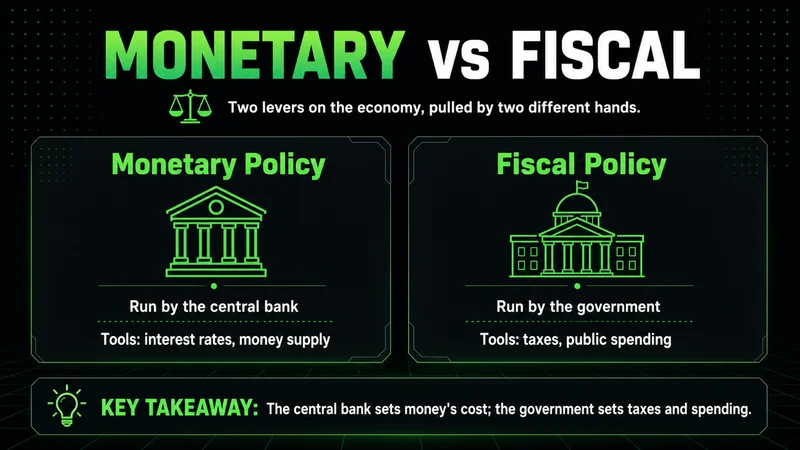
The monetary policy vs fiscal policy distinction trips up a lot of readers, and the difference is cleaner than it sounds. Here is the monetary policy vs fiscal policy explained in one pass:
Monetary policy is run by the central bank. It works through interest rates, the money supply, and the balance sheet. It can move quickly, often between scheduled meetings if conditions demand it.
Fiscal policy is run by the government through taxation and spending. It works through budgets and legislation, and it moves slowly because it has to pass through a political process.
Both aim to smooth the extremes of the business cycle, but they pull different levers and answer to different masters. A central bank can cut rates in an afternoon. A spending bill can take a year. For a trader, the practical takeaway is that monetary decisions arrive on a known calendar with sharp, datable reactions, while fiscal shifts tend to seep into the market over weeks. The first is an event you prepare for. The second is a regime you adjust to.
Monetary policy as an economic indicator
Treating monetary policy as an economic indicator changes how you use it. A rate decision is not just news. It is a read on how the people with the most data interpret the economy, and it resets the cost of capital that prices every other asset.
When rates rise, borrowing gets more expensive, future earnings get discounted harder, and capital tends to rotate toward assets that now pay more to hold. When rates fall, the opposite pressure builds. This is why the same earnings report can be received completely differently depending on the rate backdrop. The policy stance is the lens the market looks through, not a separate story off to the side.
The monetary policy report and the statement that accompanies each decision are where this lens gets described in the central bank's own words. The numbers tell you what was done. The language tells you what the committee is worried about and what it is watching. Experienced participants often weigh the language more heavily than the rate change itself, because the language is the clearest available signal about the next several meetings.
How monetary policy affects the stock market
The monetary policy impact on stocks runs mostly through two channels: the cost of capital and the appetite for risk. Higher rates raise the discount applied to future cash flows, which weighs hardest on long-duration, growth-heavy names. They also make safer assets like short-term government debt more attractive, which pulls some money out of equities. Lower rates reverse both effects.
But how monetary policy affects the stock market is rarely a clean one-to-one move on the day. Markets price expectations in advance, so a rate cut that everyone anticipated can land with almost no reaction, while an unexpected pause can move indexes sharply. The trade is in the surprise, not the headline.
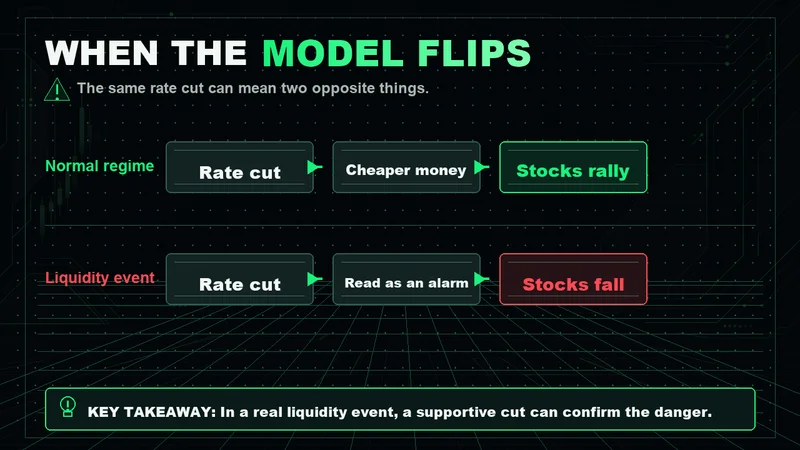
There is a structural caveat worth stating plainly, because it is where the simple model breaks. The relationship between policy and price holds while liquidity behaves normally. In a genuine liquidity event, the framework inverts: a rate cut meant to support markets can be read as confirmation that something is broken, and stocks fall on the very news that textbook logic says should lift them. The 2007 to 2009 period is the obvious example. Easing into a credit crisis did not stop the decline, because the problem was not the price of money. It was the willingness to lend it at all.
How traders read a policy decision at the screen
This is the part the institutional explainers leave out, and it is what separates a monetary policy trading signal from a headline. The signal is never the announcement in isolation. It is the reaction to the announcement, measured against what was already priced in.
A disciplined process around a decision looks less like prediction and more like waiting:
Map the expectation before the meeting. Know what the market has priced so you can recognize a surprise when it appears.
Let the first move happen without you. The initial spike after a release is often liquidity being taken, not direction being set.
Trade the second move, once structure forms and you can define where you are wrong.
The first move after major news is often not the cleanest opportunity. Many traders lose money reacting emotionally to the spike instead of waiting for structure to develop.
The first reaction is frequently a trap. Price runs one way, takes the stops sitting above or below an obvious level, then reverses once that liquidity is gone. A trader who entered on the headline is now offside on a move that looked obvious. A trader who waited for acceptance, for price to hold a level rather than just touch it, has a defined-risk entry instead of a guess. The decision is the catalyst. Confirmation is the signal.
The limitations of monetary policy
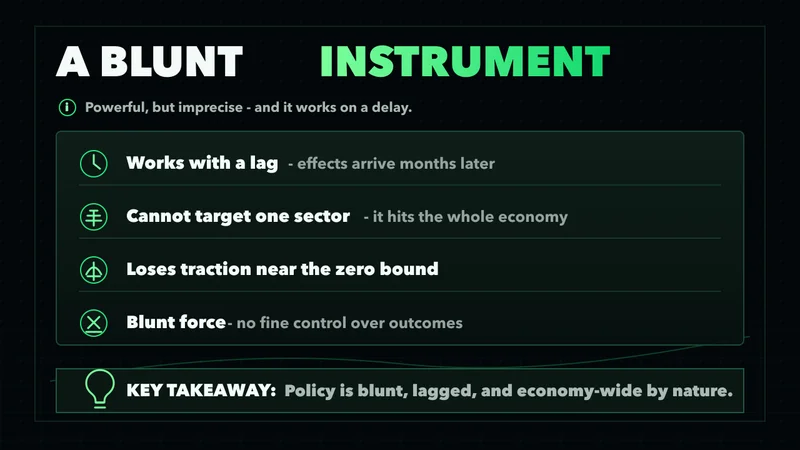
The monetary policy limitations are real, and pretending they do not exist is how traders get caught leaning the wrong way. Policy is a blunt instrument. It works with a lag, it cannot target one sector without affecting others, and it loses traction in specific conditions.
A few constraints worth holding onto:
It works with a delay. A rate change can take months to move through borrowing, spending, and hiring. The market reacts in seconds; the economy reacts in quarters.
It cannot fix supply problems. When prices rise because goods are scarce rather than because demand is hot, higher rates do little except slow everything down.
It depends on credibility. Policy works partly because participants believe the central bank will follow through. When that belief weakens, the same actions carry less weight.
For execution, the takeaway is humility. The central bank does not control the market, and it does not control the timing of how its decisions land. It sets conditions and hopes the lag cooperates. Trading as though policy guarantees an outcome is, in practice, trading without context.
Common mistakes when reading monetary policy
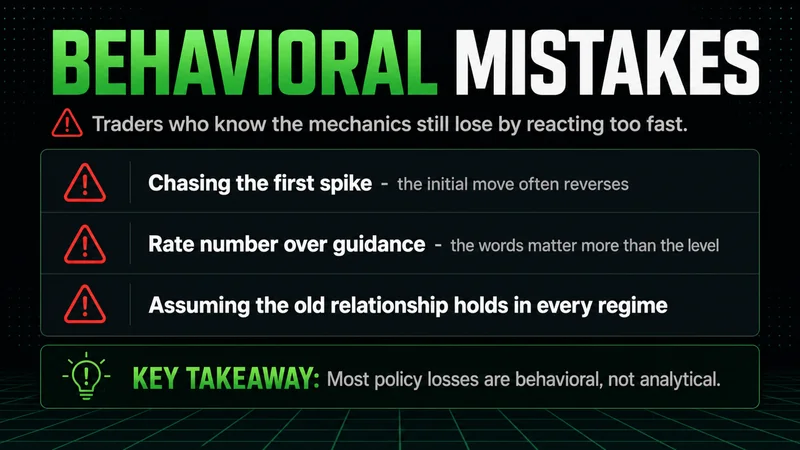
The most expensive mistakes around policy are not analytical. They are behavioral. Traders who understand the mechanics still lose money because they react instead of wait.
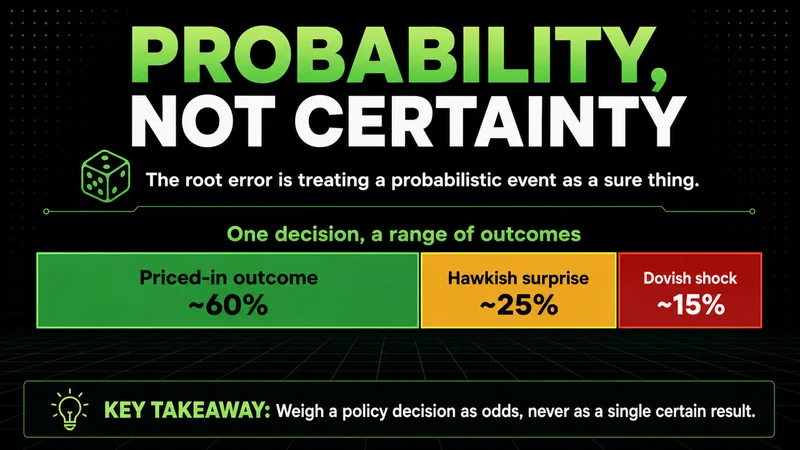
The recurring errors are chasing the first spike, treating the rate number as the whole story while ignoring the guidance, and assuming the historical relationship between policy and price holds in every regime. Each one comes from the same root: treating a probabilistic event as a certain one. The decision is known on the calendar. The reaction is not. Respecting that line is most of the edge.
FAQs
What is monetary policy in simple terms? It is how a central bank manages the cost and supply of money, mainly by setting a short-term interest rate, to keep prices stable and employment high. It sets the conditions that price every other asset rather than setting those prices directly.
What is the difference between monetary policy and fiscal policy? Monetary policy is run by the central bank through interest rates and the money supply, and it can move quickly. Fiscal policy is run by the government through taxes and spending, and it moves slowly because it requires legislation.
How does monetary policy affect the stock market? It works through the cost of capital and risk appetite. Higher rates discount future earnings harder and make safer assets more attractive, which pressures stocks; lower rates do the reverse. The reaction usually depends on the surprise versus what was already priced in.
Why does the market sometimes move opposite to what a rate decision should do? Because markets price expectations in advance and because the relationship inverts under stress. An anticipated cut can land with no reaction, and during a liquidity crisis a supportive cut can be read as confirmation that something is broken.
Where to go deeper
If you want to build on this, the next steps are practical. Study how the federal funds rate transmits through to borrowing and asset prices, read a recent monetary policy report alongside the statement to see how language carries weight, and watch how an index actually behaves in the hour after a decision rather than how it is supposed to behave. The mechanics are quick to learn. Reading the reaction with discipline is the part that takes screen time.
Worth the read?