Floor Trading — What It Was and Why It Still Matters
Floor trading is face-to-face dealing on an exchange floor through open outcry. How it worked, why it faded, and what screen traders can take from it.
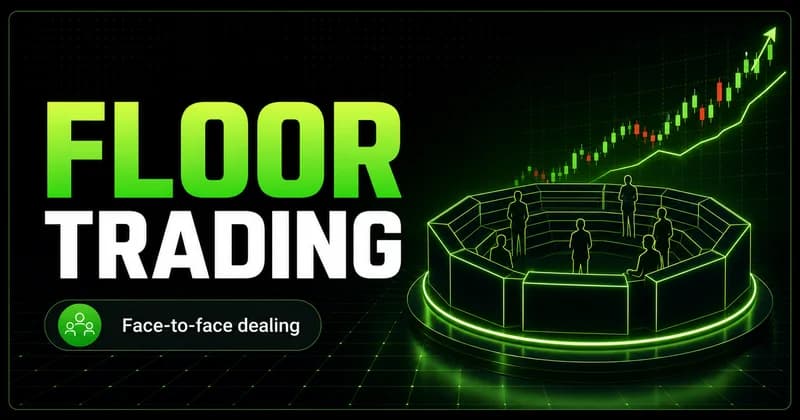
Floor trading is the buying and selling of securities or futures contracts on the physical floor of an exchange, executed face-to-face through open outcry — shouted bids, offers, and hand signals between members standing in a pit. For most of market history, this was how price discovery happened.
The standard story says electronic markets made floor trading obsolete, and on cost and speed, that is true. What the story misses is that the pit was a live model of liquidity and positioning. The traders who learned to read it were doing, in person, what a disciplined screen trader does today with order flow.
What is floor trading?
The floor trading meaning is narrower than the phrase suggests. It refers to exchange members gathering at a designated post or pit and trading directly with one another. Three roles carried the system. Locals traded their own capital and made markets, buying at the bid and selling at the offer. Floor brokers executed customer orders, working size into the crowd without moving the price against the client. Specialists — later designated market makers on the NYSE — were obligated to keep a fair and orderly market in their assigned names.
The floor trading role in markets was simple to state and hard to do: provide continuous liquidity and discover the price. Every shouted bid was public information. Everyone in the pit heard it, and the next trade had to beat it. That open competition is what made the system credible for more than a century.
How floor trading worked when the pit set the price
Orders reached the floor by phone or hand signal from booths at the edge of the pit. A broker holding a customer buy order stepped into the crowd and called it out. Locals answered with offers, the broker hit the best one, and both sides recorded the trade on cards. Confirmation came later, which is where errors lived.
A concrete floor trading example: a local in a futures pit might bid for 20 contracts, get filled by a seller, and immediately offer them out one tick higher. Done many times a day with controlled inventory, that spread was the business. The local's edge was not prediction. It was positioning, speed, and a read on who in the crowd was under pressure.
The floor trading risks were immediate. Out-trades — mismatched trade cards — could erase a week of spreads. An aggressive crowd could run through a local's inventory before the local could adjust. Risk management in the pit was not a slogan; it was the difference between a career and a short story.
Floor trading history — from open outcry to the screen
Organized floor trading in the United States dates to the Buttonwood Agreement of 1792, which led to the New York Stock Exchange. The Chicago Board of Trade followed in 1848, built so grain buyers and sellers could lock in prices ahead of delivery. For the next century and a half, the pit was the market.
The retreat started quietly. CME launched Globex, its electronic platform, in 1992, initially for after-hours sessions. Volume migrated screen by screen as electronic matching proved cheaper, faster, and harder to argue with. By 2015, CME had closed most of its futures pits. The transition was not a single event — it was two decades of liquidity choosing the venue with lower friction, which is what liquidity always does.
Floor trading vs electronic trading — what actually changed
The comparison is usually framed as human versus machine. The more useful frame is what each system rewards.
Speed and cost: electronic matching fills orders in fractions of a second at a fraction of floor-era commissions. The pit could not compete on either, and it did not.
Access: floor trading required exchange membership and physical presence. Screens opened the same book to anyone with capital and a connection.
Anonymity: the pit telegraphed who was buying. Electronic order books hide the actor and show only the action — size, price, and pace.
Information: floor traders read faces, voices, and crowd posture. Screen traders read the tape, the depth, and how price behaves at a level. The inputs changed; the skill of interpreting aggression and absorption did not.
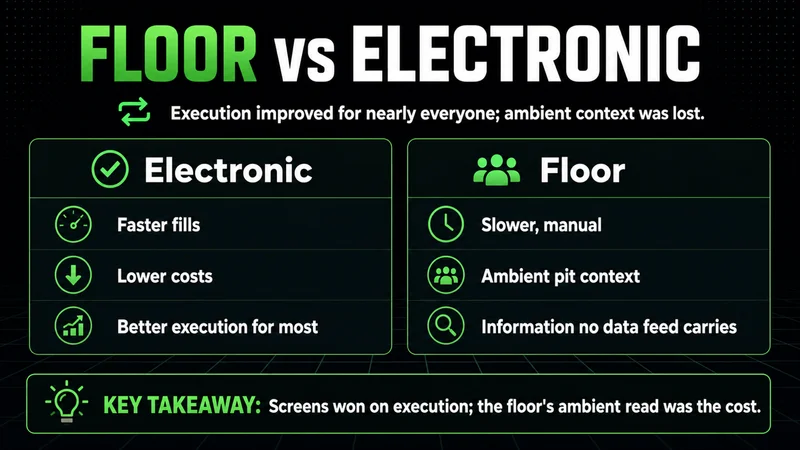
Execution quality improved for nearly everyone. What was lost was the pit's ambient context — the kind of information that never appears in a data feed.
What remains of floor trading in modern markets
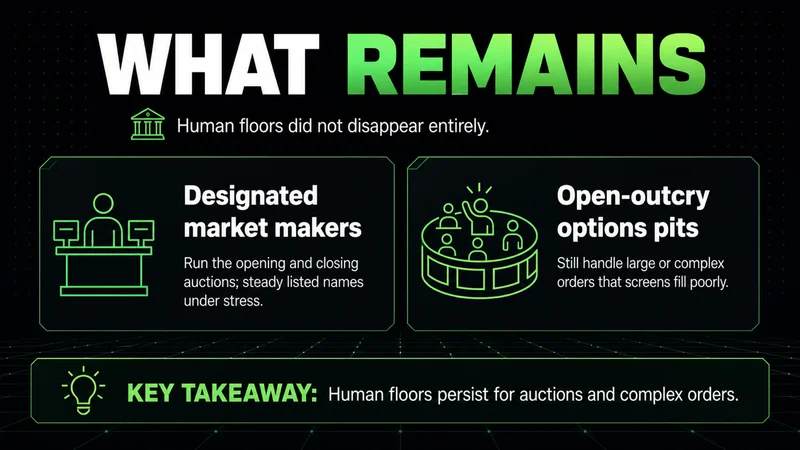
Human floors did not disappear entirely. The NYSE still operates its trading floor, where designated market makers manage opening and closing auctions and can steady their listed names during stressed conditions. Several options exchanges still run open-outcry pits for large or complex orders, where a broker can shop a multi-leg position to a crowd in a way an order book handles poorly.
The pattern is consistent: floors survive where negotiation beats matching — large size, unusual structures, and moments when context matters more than speed. For everything standardized, the screen won, and there is no serious argument otherwise.
What traders should know about floor trading today
The pit's real lesson is not nostalgia. Locals survived on defined risk, fast loss-taking, and thousands of hours reading the same crowd. There is no substitute for that screen time. The pattern recognition that kept a local solvent could not be shortcut through courses or indicators then, and it cannot be now. Watching how price behaves at a level, session after session, is still how the read gets built.
Your first loss is your best loss.
That old pit saying outlived the floor because it describes process, not an era. Take the small loss while it is small, keep inventory controlled, and stay solvent for the next decision.
One caution on the parallel. Reading aggression the way a local read the crowd works when participation is deep — regular hours, liquid contracts, real two-sided flow. In a thin overnight session, the same signals mean very little; a burst of volume that would matter at the cash open is often just one participant crossing a quiet book. Context decides whether the read is information or noise.
What to remember about floor trading
Floor trading was open outcry on a physical exchange floor: locals making markets with their own capital, brokers working customer orders, and specialists keeping the book orderly. It dominated price discovery from 1792 until electronic platforms displaced it through the 1990s and 2000s. Human floors persist where size and complexity reward negotiation over matching. And the discipline that kept pit traders solvent — defined risk, fast exits, and earned pattern recognition — transferred to the screen intact. The venue changed. The job did not.
Worth the read?