Risk Per Trade — How Much to Risk and Why It Matters
Risk per trade is the fixed loss you accept on one position. Learn how to set it, the formula, a good benchmark, and why it matters more than your entry.
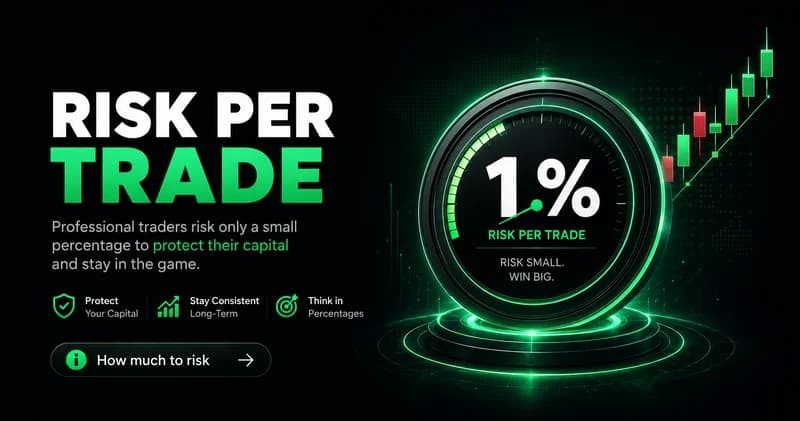
Risk per trade is the fixed amount of capital you accept losing on a single position before the market proves you wrong. It is set in advance, expressed as a percentage of your account, and decided before the entry, not after price moves against you. Most traders obsess over where to get in. The number that actually keeps them in the game is how much they are willing to lose if that entry fails.
That order of priorities is backwards in most retail accounts. A mediocre entry with disciplined risk per trade survives a bad week. A perfect entry with oversized risk eventually finds the one sequence of losses that ends the account. The market does not reward the cleanest call. It rewards the trader who is still solvent when the next high-probability environment shows up.
What risk per trade actually means
Risk per trade meaning, stripped of jargon, is simple. It is the dollar distance between your entry and your stop, multiplied by the size of your position. If you buy 100 shares at 50 and your stop sits at 48, your risk per trade is 200 dollars, regardless of how large the position looks on the screen.
The part that confuses newer traders is that risk per trade is not the same as the money deployed. You can put 5,000 dollars into a position and risk only 200, because the stop defines the loss, not the notional value. The position size is the consequence. The risk comes first.
This is why the percentage framing matters. Professionals do not think in flat dollar amounts that drift as the account changes. They think in a fixed fraction of current capital, so the exposure scales down automatically during a drawdown and scales up only as the account genuinely grows.
Why risk per trade matters more than the entry
Risk per trade is the single variable that decides whether a losing streak is an operational cost or an account-ending event. Every trader gets long stretches of red. The question is never whether they arrive. It is whether your sizing lets you sit through them without your decision-making falling apart.
Consider what a string of losses does at different risk levels. The table below shows how many consecutive losses it takes to draw an account down by roughly a third, the point where most traders stop thinking clearly.
| Risk per trade | Approx. losses to a 33% drawdown | Recovery required |
|---|---|---|
| 1% | About 40 trades | Manageable |
| 2% | About 20 trades | Demanding |
| 5% | About 8 trades | Severe |
| 10% | About 4 trades | Often terminal |
The math is unforgiving in one direction only. A 33% drawdown does not need a 33% gain to recover. It needs roughly 50%. At a 50% drawdown you need to double the remaining capital just to get back to even. Small risk per trade is what keeps you on the manageable side of that curve.
There is a psychological cost the SERP rarely mentions. Most traders do not abandon their risk rule because the math told them to. They abandon it because the loss felt too large to accept, so they widened the stop, added to the loser, or skipped the stop entirely. If one losing trade emotionally affects your next decision, the position was too big. That is the real signal that your risk per trade is wrong, and it shows up in behavior long before it shows up in the equity curve.
The risk per trade formula, step by step
The risk per trade formula is built from three inputs you control before entry:
- Account risk percentage — the fraction of capital you will lose if the trade fails, commonly 0.5% to 2%.
- Entry price — where you actually get filled, not where you hoped to.
- Stop-loss price — the level that proves the idea wrong and where you exit without negotiation.
The risk per trade calculation runs in two moves. First, convert the percentage into a dollar figure. Then divide that figure by the per-unit risk to find position size.
- Dollar risk = account size multiplied by risk percentage.
- Per-unit risk = entry price minus stop price (in absolute terms).
- Position size = dollar risk divided by per-unit risk.
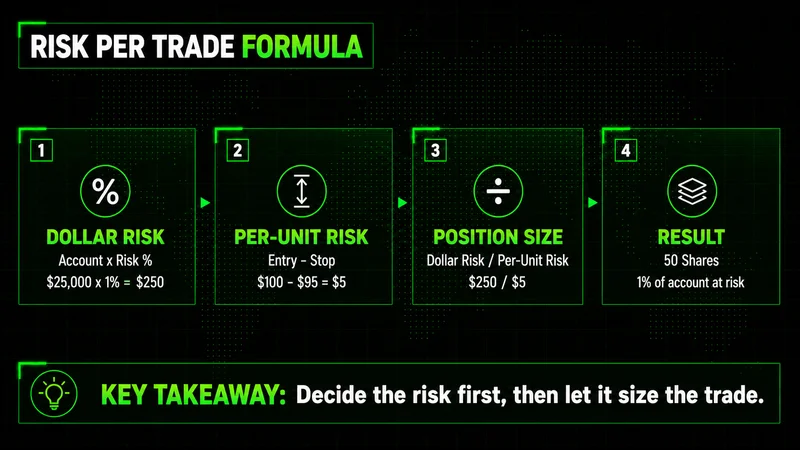
The order matters. You decide the loss you can accept first, then let that number dictate how large the position can be. Reversing the sequence, picking a size you like and backing into the stop, is how accounts quietly get overleveraged.
A risk per trade example you can copy
Here is a risk per trade example with concrete figures. Say the account holds 25,000 dollars and the rule is 1% risk per trade.
- Dollar risk: 25,000 multiplied by 0.01 equals 250 dollars.
- Entry: 100. Stop: 95. Per-unit risk: 5 dollars.
- Position size: 250 divided by 5 equals 50 shares.
The trade controls 5,000 dollars of stock, but only 250 dollars is actually at risk. If price hits the stop, the loss is 1% of the account, exactly as planned. Change the stop to 98 and the per-unit risk drops to 2 dollars, so the same 250-dollar risk now allows 125 shares. A tighter stop lets the rule permit a larger position.
This is the discipline the percentage enforces. The dollar loss stays constant across every trade. Only the share count moves.
Risk per trade vs position size explained
To keep risk per trade vs position size straight, remember which one you choose and which one you calculate. You choose the risk. You calculate the size. Risk per trade is the rule. Position size is the output of that rule once the stop distance is known.
Traders who lead with position size tend to anchor on a round number of shares or contracts and then place the stop wherever the chart looks comfortable. That inverts the relationship and lets emotion set the exposure. Leading with risk keeps the dollar loss fixed and forces the size to adapt to each setup. The same 1% can mean 50 shares on a wide-stop swing trade or 400 shares on a tight-stop scalp.
What is a good risk per trade benchmark
A good risk per trade benchmark for most traders, and especially new ones, sits at 1% or below. The 1% rule is not arbitrary. It is the level that lets you absorb a long losing streak without the account or your composure breaking. Risking 1% means twenty consecutive losses still leaves roughly 80% of capital intact. That is survivable. Twenty losses at 5% is not.
For a new trader specifically, the honest benchmark is often lower than 1%. The first months are when execution is sloppiest and discipline is least tested, which is exactly when a smaller risk per trade does the most work. Half a percent buys room to make the inevitable beginner mistakes without paying for them in capital you cannot replace.
The point is not to chase the highest number your risk tolerance allows. It is to pick the level you can hold to during the worst week you will have this year, because that week is the one that decides whether you are still trading next year.
Where a fixed risk percentage stops working
A fixed risk per trade is a strong default, but it is not a law of nature, and treating the percentage as permanent is where it quietly breaks down. The stop distance is the assumption underneath the whole formula, and that assumption depends on volatility staying inside a normal range.
In quiet conditions a 1% rule with a tight stop works cleanly. Around major macro events it can invert. Index futures like NQ can move through several normal stop distances in seconds when a number prints, and gold can trade technically for hours and then erase the entire move within minutes once volatility expands. In those windows the same 1% rule, applied to a stop that gets blown through on slippage, no longer caps the loss at 1%. The position fills past the stop and the realized risk runs larger than the plan.
The fix is not to abandon the rule. It is to recognize that the percentage assumes a stop that holds, and to size down or stand aside when liquidity is thin enough that the stop cannot. A risk per trade rule is only as reliable as the execution behind it.
Common risk per trade mistakes
The common risk per trade mistakes beginners make are rarely about the math. They are about discipline failing under pressure:
- Increasing size after a loss to recover faster, which converts a normal drawdown into an emotional one.
- Setting the stop after the entry, so the risk is whatever the chart happens to allow rather than a decided number.
- Using a flat dollar risk that never scales down, so a drawdown keeps risking the same amount on a shrinking account.
- Widening the stop mid-trade because the loss feels too large to take, which is the rule quietly being abandoned.
- Ignoring slippage and commissions, so the real risk per trade runs above the planned percentage on every fill.
Most blown accounts do not die from one bad trade. They die gradually, from a sequence of these small rule breaks during emotional sessions, until the account is too small to recover.
How to improve your risk per trade over time
Improving risk per trade over time is a function of review, not ambition. The goal is not to risk more as confidence grows. It is to make the existing rule more precise and more consistently followed.
A practical review loop after each block of trades:
- Confirm every trade used a predefined stop and a fixed percentage, with no exceptions.
- Measure realized risk against planned risk to surface slippage and rule breaks.
- Flag any trade where size was increased emotionally or the stop was moved against the position.
- Adjust the base percentage only when the data, not a good week, supports it.
Raising risk per trade should be the last lever you pull, and only after months of clean execution at the current level. Confidence built on recent PnL is fragile. Confidence built on a consistent process is the only kind worth sizing up on.
FAQs
What is risk per trade in trading? Risk per trade is the fixed amount of capital you accept losing on a single position if the trade fails. It is the distance between entry and stop multiplied by position size, usually capped as a small percentage of the account and decided before entry.
How do you calculate risk per trade? Multiply your account size by your chosen risk percentage to get the dollar risk, then divide that by the per-unit risk (entry price minus stop price). The result is the position size that keeps your loss at the planned percentage.
What is a good risk per trade for new traders? For most new traders, 1% or less is the sensible benchmark. Half a percent is often better in the first months, when execution is least consistent and a smaller risk buys room to make mistakes without serious damage.
What is the difference between risk per trade and position size? You choose the risk per trade and you calculate the position size from it. Risk per trade is the fixed dollar loss you will accept; position size is whatever number of shares or contracts keeps the loss at that level given the stop distance.
Why does risk per trade matter so much in risk management? Because it determines whether a losing streak is survivable. Small, consistent risk per trade lets you absorb a long run of losses without the account or your decision-making breaking down, which is what keeps you trading long enough to improve.
Can you use the same risk per trade in all market conditions? Not reliably. A fixed percentage assumes the stop holds, which it may not around major macro events when volatility expands and fills slip past the stop. In those conditions, size down or stand aside rather than trusting the rule blindly.
How do you improve your risk per trade over time? Review every trade against its plan, measure realized risk versus planned risk, and flag any rule breaks. Tighten consistency first. Raise the base percentage only after months of clean execution support it, never after a single strong week.
The takeaway
Risk per trade decides how long you stay in the game, not how much you make on any single trade. Set the percentage before the entry, let it dictate position size, and hold to it hardest during the weeks it feels worst to follow. Keep the number small enough to survive a losing streak, size down when volatility makes the stop unreliable, and treat every rule break as a warning. The traders who last are not the ones with the best entries. They are the ones whose risk per trade kept them solvent long enough for the good entries to matter.
Worth the read?