Realized P&L — What It Actually Tells You
Realized P&L is the profit or loss locked in when you close a position. Here is what the number actually tells you, and where it quietly misleads.

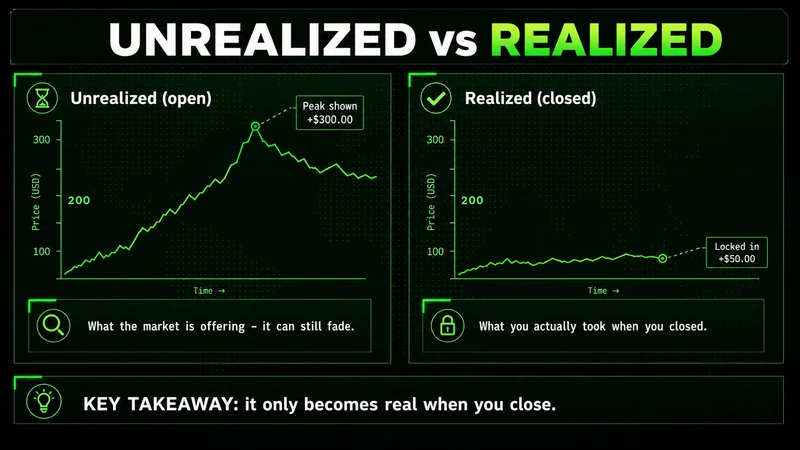
Realized P&L is the profit or loss locked in once you close a position. It is final. The number stops moving the moment the trade is done, which is exactly what separates it from the floating figure on an open position. If unrealized P&L is what the market is offering you, realized P&L is what you chose to take.
That distinction matters more than most beginners expect. A position can show a large unrealized gain for hours and settle as a small realized one, or none at all. The market does not pay you for being right on a chart. It pays you when you close, and only then does the result become real.
What realized P&L means in plain terms
The realized P&L meaning is straightforward: it is the actual gain or loss from a completed trade, after the position is fully exited. Buy, then sell, and the difference between the two prices is realized. Until you close, nothing is settled. That is the whole idea.
Unrealized P&L, by contrast, reflects potential. It updates tick by tick while the position stays open and reverts to zero relevance the instant you exit, replaced by a fixed realized number. One is a live quote on a decision you have not made yet. The other is a record of a decision you already made.
The realized P&L formula and calculation
The realized P&L formula is simple. For a long position, it is the exit price minus the entry price, multiplied by position size. For a short, you reverse the order: entry price minus exit price, multiplied by size. Costs come off the top.
A realized P&L calculation that ignores fees is not a real number. Commissions, exchange fees, and financing on margin or overnight positions all reduce what you actually keep. Gross P&L flatters the trade. Net P&L is the one that pays your bills.
Aspect | Realized P&L | Unrealized P&L |
|---|---|---|
Status | Final, locked in | Floating, changes with price |
Trigger | Position fully closed | Position still open |
Use | Performance and tax record | Live risk on open exposure |
A realized P&L example you can follow
Here is a realized P&L example. You buy 100 shares at 50 and sell them at 54. The gross result is 4 per share across 100 shares, so 400 before costs. Subtract 6 in commissions and the realized P&L is 394. That figure is fixed. It does not improve if the stock later trades to 60, because you no longer hold it.
Now flip it. Suppose the same position ran to an unrealized 800 before you closed at 394. The 800 was never yours. It was a number the market showed and then took back. Realized P&L records what you secured, not what you saw.
Why realized P&L matters for risk management
Realized P&L is the only honest measure of how a strategy is performing, because it removes the hope embedded in open positions. Unrealized gains tempt traders into believing a thesis is working before it has paid anything. Realized losses, by contrast, are operational costs you have already accepted and can study.
This is where most traders quietly distort their own records. They close winners fast to feel the realized gain and let losers sit unrealized, telling themselves the position will come back. The realized column fills with small green numbers while the real damage hides in open exposure. Risk management matters more than entries, and the realized P&L is where that truth eventually shows up. A clean realized record with a growing pile of unrealized losses is not a working process. It is a delayed problem.
Common realized P&L mistakes and how to improve
Most realized P&L mistakes come from reading the number without context. The fixes are not complicated, but they require honesty in a trading review.
Treating an unrealized gain as if it were already booked, then sizing the next trade on money you have not secured.
Ignoring fees and financing, so the realized P&L on the platform looks better than the cash in the account.
Judging a single trade instead of the distribution: one large realized loss can erase many small realized wins.
Improving realized P&L over time is less about finding better entries and more about closing decisions. A realized P&L benchmark is personal, not universal. For new traders, a good realized P&L is one produced by a repeatable process with controlled losses, not a large one-off number from a single position. Track the realized result against your own prior periods, not against someone else's screenshot.
There is a condition where this metric stops being useful. In thin, fast markets, realized P&L on a few closed scalps tells you almost nothing about edge, because the sample is too small and slippage dominates the result. Over hundreds of trades the number means something. Over five, it is mostly noise.
FAQs
What is realized P&L in trading? It is the profit or loss locked in once a position is fully closed. The number is final and no longer moves with the market, unlike unrealized P&L on an open position.
How do you calculate realized P&L? For a long, take the exit price minus the entry price and multiply by position size. For a short, reverse the prices. Then subtract commissions and financing to get the net figure.
What is the difference between realized and unrealized P&L? Realized P&L is settled and fixed once you exit. Unrealized P&L is the floating gain or loss on a position you still hold, and it changes with every price tick until you close.
Why does realized P&L matter for risk management? It is the only measure that removes hope from the equation. It shows what your process actually produced, not what an open position might still do, which makes it the honest input for reviewing risk.
What is a good realized P&L for new traders? One produced by a repeatable process with controlled losses, rather than a large number from a single trade. A consistent, smaller realized result usually signals more durable edge than one outsized win.
How can you improve realized P&L over time? Focus on closing decisions and loss control rather than chasing entries. Review each period's realized result against your own prior periods, account for all fees, and judge the distribution of trades instead of any single outcome.
Worth the read?