Take Profit in Trading — How to Exit With a Plan
A take profit closes your trade at a level you set in advance. Here is how take profit works, where to place it, and the mistakes to avoid.

A take profit is a resting order that closes your position automatically once price reaches a level you chose in advance. You decide the exit before the trade is live, while you are still calm, so the market cannot talk you out of the gain later. For a long, it sits above your entry. For a short, below it. That single decision removes one of the most expensive variables in trading: your emotions in the moment.
Most traders obsess over entries and treat the exit as an afterthought. The opposite is closer to reality. A mediocre entry with a defined exit survives. A perfect entry with no plan for taking profit usually gives the gain back. The exit is where money is realized.
What take profit means, and how it works
The take profit meaning is simple. It is a standing instruction to your broker to close the position when price trades to your target. The order does it for you, at the level you defined, whether you are watching or away.
Mechanically, it is the mirror image of a stop loss. The stop defines where you are wrong. The take profit defines where you are satisfied. Both are set before the trade is live, to keep a single decision from being made under pressure.
Here is a take profit example. You buy a stock at 100 and set the target at 110. If price trades to 110, the order fills and the gain is locked in. If price stalls at 107 and reverses, you avoided sitting frozen while the move unwound. The level was chosen with a clear head, not a racing one.
Where to place a take profit
Take profit placement is not a round number you like the look of. It should sit at a level the market respects. A few anchors that hold up under live conditions:
- A prior swing high or low where price reacted before
- A clear area of resistance for longs, or support for shorts
- A liquidity pool above old highs or below old lows, where stops rest
- A fixed reward multiple of your risk, such as two times the distance to your stop
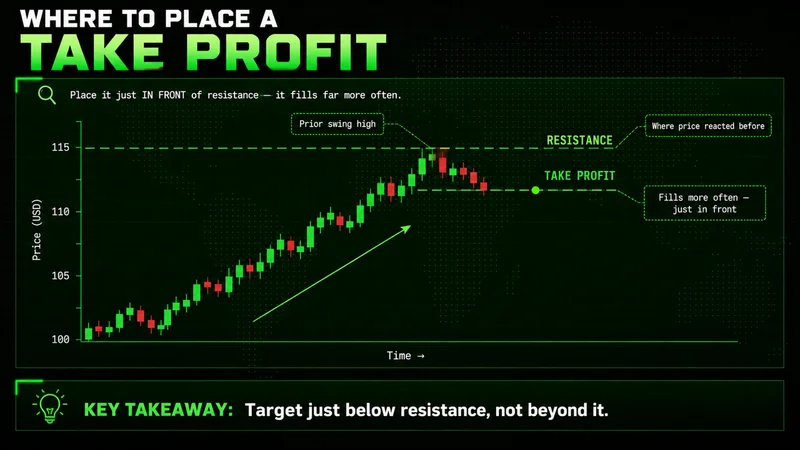
A take profit placed just in front of obvious resistance fills far more often than one on the other side of it. You give up the last stretch of the move on purpose, in exchange for a higher chance of getting paid.
Take profit vs stop loss, and how it controls risk
The take profit vs stop loss question confuses newer traders, but the two are partners, not rivals:
- The stop loss caps the downside. It answers how much you are willing to lose if you are wrong.
- The take profit defines the upside you will accept. It answers where you stop being greedy.
Used together as a bracket, they fix your risk and reward before a single tick moves against you. A trade without both ends defined is open-ended exposure, and that is where accounts quietly bleed out.
That is the heart of take profit risk control. When your exit is predefined, your reward-to-risk ratio is known before you click buy. This is how take profit affects trading risk over a sample: if your average winner is a defined two-to-one and your stop is honored, you can be wrong on more than half your trades and still come out ahead. Remove the planned exit and the math collapses.
The market rewards patience far more than activity. Most traders do not need more aggressive targets. They need to let a well-placed one fill.
Scaling out against structure instead of a fixed target
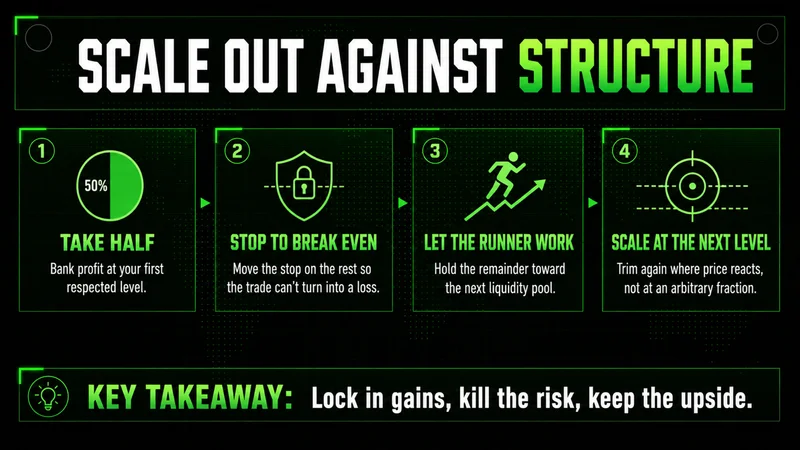
A single take profit is the starting point, not the ceiling. Once you trust your read of structure, you can scale out: take half at your first respected level, move your stop on the rest to break even, and let that runner work toward the next liquidity pool. You lock in a realized gain, remove the risk of the trade turning into a loss, and keep exposure to more upside.
That is the difference between a fixed reward multiple and a take profit strategy that adapts to price. Each exit level is tied to a place price actually reacts, not to an arbitrary fraction of the gain. The fixed multiple is fine when you are learning. Reading structure lets you keep more of the moves that deserve it.
When a fixed take profit costs you
A fixed take profit is not free. It works cleanly inside a defined range and stops working the moment the market leaves it. This is where most guides go quiet. Two failure modes show up again and again:
- In a strong trend, a tight target caps you out near the start of a move that runs for hours. You take a small gain and watch price travel several times that distance without you. The order did what you told it to; the instruction was the problem.
- During a volatility expansion, a target set in quiet conditions can get blown through on a news-driven push. You may exit far past your level or, with a strict limit, not fill at all as price gaps over it.
The framework that protected you in a calm range inverts the instant conditions change. The fix is not to abandon take profits. Size the target to the regime, scale out so a runner can capture the trend, and accept that no exit rule survives every condition.
Common take profit mistakes
Most take profit mistakes are not technical. They are emotional decisions made after the trade is live. The common take profit mistakes beginners make cluster into a short list:
- Moving the target further out mid-trade because the move feels strong, then watching it reverse before it fills
- Cutting the winner early out of fear, which shrinks every win
- Setting the target on the wrong side of obvious resistance, so it almost never fills
- Using a tight fixed target in an obvious trend and capping a move that wanted to run
- Having no take profit at all and deciding the exit live, under pressure, every time
The pattern underneath them is the same. The plan was sound, then it got overridden by emotion. Defining the exit in advance only helps if you respect it once the trade is on.
A take profit checklist before you enter
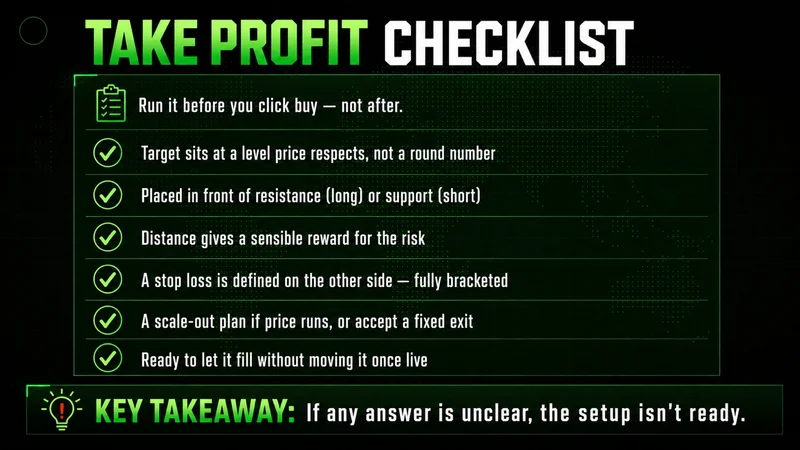
A take profit checklist for new traders keeps the exit honest before money is at risk. Run it before you click buy, not after:
- Is my target at a level price respects, not a round number I like?
- Is it placed in front of resistance for a long, or in front of support for a short?
- Does the distance to my target give me a sensible reward for the risk I am taking?
- Do I have a stop loss defined on the other side, so the trade is fully bracketed?
- If price runs, do I have a scale-out plan, or am I accepting a single fixed exit?
- Am I prepared to let this fill without moving it once the trade is live?
If any answer is unclear, the setup is not ready. The point is to make every exit decision before the market makes it for you.
FAQs
What is take profit in trading? It is a resting order that closes your position automatically when price reaches a target you set in advance. It sits above entry for a long and below entry for a short, locking in the gain without you watching the screen.
How does take profit work in trading? You attach the order at a chosen price when you open the trade. If price trades to that level, the broker closes the position for you at, or near, that price.
What is the difference between take profit and stop loss? The stop loss caps your downside and defines where you are wrong. The take profit defines the upside you will accept. Together as a bracket, they fix both risk and reward before the trade moves.
When should traders use take profit? On almost every trade where you want a defined reward and do not intend to manage the exit tick by tick. The main exception is a strong trend you plan to ride, where scaling out often beats a fixed target.
Is take profit important for beginners? Yes. It removes the hardest live decision a new trader faces and forces a defined reward-to-risk plan before the trade starts. It is one of the fastest ways to stop giving gains back.
Worth the read?