Best Traders in History — What Actually Made Them Last
The best traders in history are remembered for one trade. What lasted was their risk control. A study of what actually transfers to your account.
The best traders in history are not the people who made one famous trade. They are the ones who survived long enough to make the next one. The headline numbers — a billion in a day, a fortune built from a few thousand dollars — get remembered. The risk management, the drawdowns, and the years of patience that made those numbers possible get forgotten almost immediately.
That gap is the whole point. Most coverage of legendary traders reads like a highlight reel. It lists the wins, attaches a net worth, and moves on. What it skips is the part that actually transfers to your account: how these traders sized positions, where they defined invalidation, and what they did during the long stretches when nothing worked.
This piece treats the best traders in history as case studies, not trophies. We look at what they did, why it worked in their conditions, and where copying them directly would quietly damage a modern account.
What "best traders in history" actually means
The phrase gets used loosely. In practice, "best traders in history" usually points to a small group of market operators who produced large, repeatable returns over many years and left enough of a record to study. The meaning is not "made the most money once." It is closer to "extracted edge from markets consistently, across different regimes, without blowing up."
That distinction matters because it filters the list. A trader who turned a small stake into a fortune and then lost all of it is a cautionary tale, not a model. Jesse Livermore made and lost several fortunes. He belongs on the list for what he understood about price and risk, not because his ending was something to copy.
So when we say best, we mean a combination of three things:
- Edge that held up over time, across more than one market regime.
- Risk control strong enough to keep them in the game through deep drawdowns.
- A process clear enough that a serious trader can still learn from it decades later.
Net worth is the least useful filter of the three. It measures the result, not the method, and the method is the only part you can study.
The traders worth studying — and the one trade that defined each
The names below come up in almost every serious discussion of market history. The point here is not the biography. It is the single decision in each career that tells you how the person actually thought about risk and structure.
| Trader | Defining trade or record | What it actually demonstrates |
|---|---|---|
| George Soros | Short the British pound, 1992 | Conviction sized to the asymmetry, not to the emotion |
| Jesse Livermore | Short into the 1929 crash | Reading distribution before the break, then pressing |
| Paul Tudor Jones | Short into the 1987 crash | Risk-defined positioning ahead of a structural failure |
| Jim Simons | Quant returns at Renaissance | Systematic edge that removed discretion entirely |
| John Paulson | Short subprime, 2007 to 2008 | A single asymmetric bet with capped, known downside |
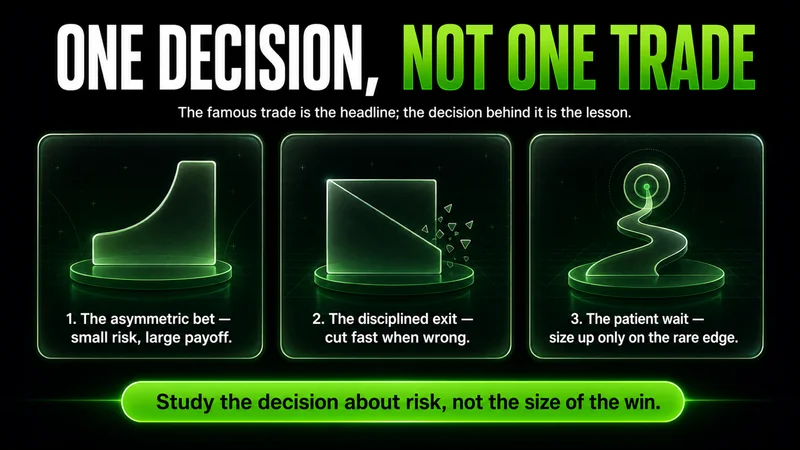
George Soros is remembered for the 1992 pound trade that reportedly earned around a billion dollars. The lesson buried under that number is sizing. Soros did not bet a billion because he was certain. He bet large because the payoff was lopsided — limited downside if he was wrong, enormous upside if the peg broke. That is asymmetry, and it is the part most people skip when they tell the story. He was not predicting the pound would fall on a specific day. He was positioning so that being early or even slightly wrong cost little, while being right paid in multiples.
Jesse Livermore read price behavior in an era without screens. His short positioning into the 1929 crash worked because he recognized distribution and weakening structure before the break, then added as the move confirmed. He did not enter all at once on a hunch. He scaled in as price proved the thesis, which is a form of confirmation most traders abandon the moment they feel certain. His failures came later, and they came from the same place most modern blowups come from: position sizing and discipline, not analysis. The analyst and the gambler were the same man at different points in his career, and the only variable that changed was risk control.
Paul Tudor Jones is one of the few who positioned for the 1987 crash and managed the risk around it. His reputation rests on defined risk as much as on the call itself. He has said publicly that his first concern is defense, not offense — protecting capital before pursuing the next idea. The interesting part is that the famous trade was not a single brave bet. It was a position built with tight invalidation, where being wrong would have been survivable and being right was structural.
Jim Simons is the outlier on every list. His edge at Renaissance was systematic, model-driven, and almost entirely free of discretionary judgment. Studying him is useful precisely because his approach is the hardest to imitate. It is a reminder that not every edge is one a discretionary trader can borrow. The lesson is not "build models." It is that an edge has to come from somewhere real and be applied with consistency, and that consistency, not brilliance on any single trade, is what compounds.
John Paulson built the 2007 to 2008 subprime trade around capped downside. He bought protection with a known, limited cost and an asymmetric payoff if housing credit failed. The trade was patient, structural, and risk-defined. It was not a gamble, even though the outcome looked spectacular. He had to hold the position through a stretch where it cost money and looked wrong, which is the part almost nobody mentions. The conviction was real, but it sat on top of a known maximum loss, not in place of one.
Why these traders still matter for how you trade now
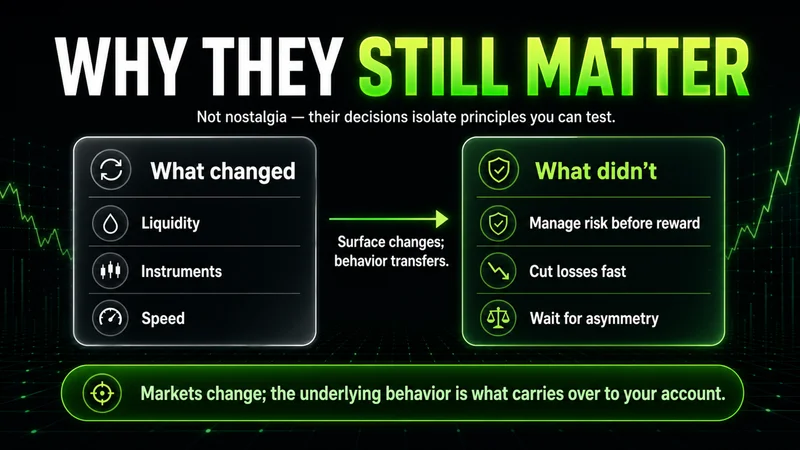
The importance of studying the best traders in history is not nostalgia. It is that their decisions isolate principles you can test against your own behavior. Markets change. Liquidity, instruments, and speed are different now. The underlying behavior — how capital reacts to risk, how positioning builds and unwinds — rhymes across eras.
A few principles repeat across almost every name on the list:
- They thought in probabilities, not predictions. None of them claimed certainty. They sized for being wrong.
- Risk control came before the entry. The defining trades had defined invalidation and a known maximum loss.
- They waited. The famous trades are separated by long stretches of doing very little.
- They reacted to structure rather than forcing a view onto the market.
The market rewards patience far more than activity. Most traders believe they need more setups. What the historical record shows is that the best operators took fewer trades and managed risk better than everyone around them. The waiting was not passive. It was the job. The defining trades in this article are separated by years, and in those years these traders were mostly doing nothing, which is the single hardest thing for a newer trader to accept.
There is also a survivorship point worth naming directly. For every Livermore who read distribution correctly, there were others who took the same aggressive posture and never made it into any list because they blew up. The names we remember are partly the names that managed risk well enough to still be standing when the big trade arrived. That is not a small detail. It is the difference between a strategy and a story.
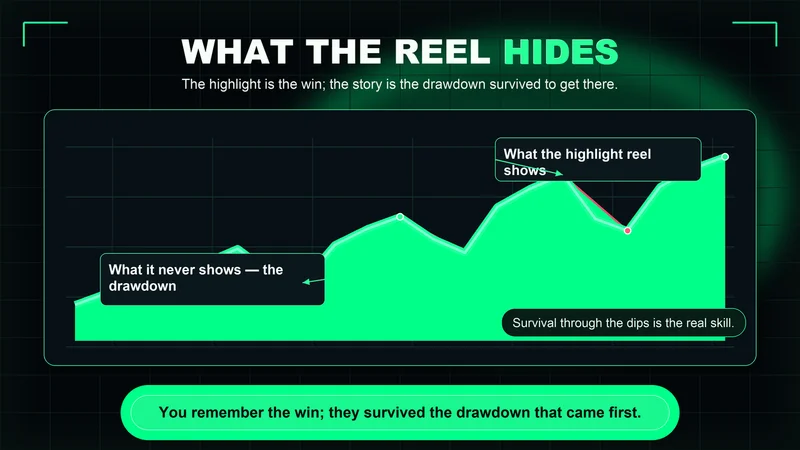
What the highlight reels never show: risk and drawdown
Here is the part that gets edited out. Every trader on this list lived through extended drawdowns. The clean story is the billion-dollar bet. The real story includes the months and years where the edge did not show up and the account had to survive on discipline alone.
The risks in studying these traders come from copying the wrong layer. People copy the position, not the sizing. They copy the conviction, not the asymmetry. They copy the aggression, not the defense underneath it. That inversion is where accounts get damaged. The most common version of this mistake is simple: a trader reads about a concentrated bet that paid off enormously, takes a concentrated bet of their own, and skips the part where the original had a defined and survivable downside.
The first rule of trading is defense, not offense. You stay in the game by protecting capital, not by being right.
That idea — capital preservation first — is the thread connecting Soros, Jones, Paulson, and the rest. Their edges differed. Their respect for downside did not. A mediocre entry with proper risk control survives a long time. A perfect entry with poor sizing eventually finds the one market that ends the account.
There is a hard limit on how far this study transfers, and it is worth stating plainly. These edges were era-specific. Livermore's tape reading worked in a market without algorithmic liquidity; run the same approach into modern microstructure and the same patterns mean almost nothing. Soros's macro asymmetry depended on a fixed-currency regime that no longer exists in that form. The principles — asymmetry, defined risk, patience — survive the change. The specific trades do not. Copy the trade and you are fighting a market that has already moved on. Copy the process and you have something durable.
How to actually learn from the best traders in history
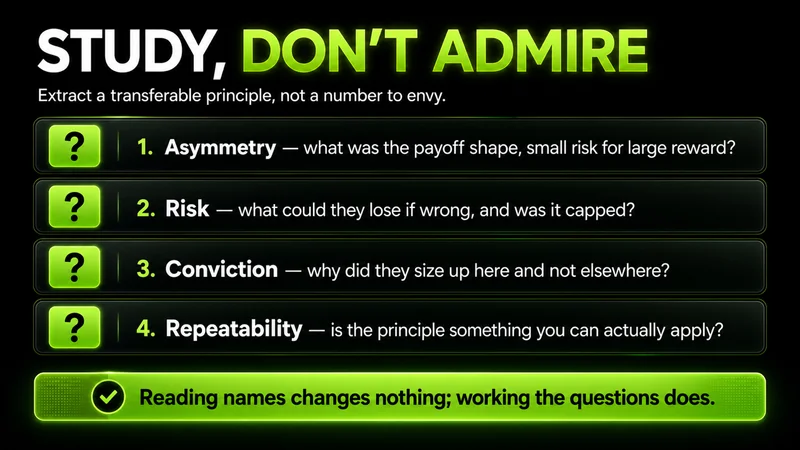
Reading a list of names changes nothing. Studying behavior does. The difference is whether you extract a transferable principle or just admire a number.
Work through each trader with the same questions:
- What was the asymmetry? Find the payoff structure, not just the direction.
- Where was the invalidation? Identify what would have told them they were wrong.
- How was it sized? Estimate the risk relative to the account, not the headline profit.
- What did they do while waiting? The inactivity is part of the method.
- What regime made it work? Name the market conditions the edge depended on.
That last question is the one most people skip, and it is the one that protects you. An edge that worked in one regime can invert in another. Gold can trade technically for hours and then erase the entire move within minutes when macro volatility expands. The same is true of any historical edge studied out of context. The behavior that made money in one set of conditions can be exactly the behavior that loses money in the next.
It helps to keep the study close to your own trading rather than abstract. After you read a defining trade, pull up two or three of your own recent positions and run the same five questions against them. The point is not to admire Soros. The point is to notice where your own asymmetry was undefined, where your invalidation was vague, or where you sized off excitement instead of off the drawdown you could actually tolerate.
How does studying the best traders in history actually work in practice
The practical workflow is narrow. You are not trying to become Soros. You are trying to isolate one principle and test it against your own decisions.
Pick one trader. Take one decision. Strip it down to asymmetry, risk, and timing. Then look at your own recent trades and ask whether you applied the same discipline or whether you were copying the excitement. Most of the value is in that comparison, not in the biography.
This is also where the common beginner mistake shows up. Newer traders read about a billion-dollar trade and conclude that conviction is the edge. Conviction without defined risk is just a larger loss waiting for the wrong market. The historical record says the opposite: the survivors led with defense. They were comfortable being wrong cheaply, often, and on purpose, because that is what let them be right at scale when the rare high-probability environment finally appeared.
The other practical trap is timing. The defining trades look obvious in hindsight, which makes them feel easy to repeat. In real time they were uncertain, uncomfortable, and surrounded by reasons to exit early. Studying the outcome teaches you nothing about sitting in that discomfort. Studying the process — the predefined risk, the scaling, the willingness to wait — is the only part that prepares you for it.
A checklist for studying historic traders without copying their risk
Use this as a filter before you let any historical example influence a live decision. It keeps the principle and discards the parts that do not transfer to a modern, risk-defined account.
- Identify the asymmetry before the direction. If you cannot describe the payoff structure, you have not understood the trade.
- Define invalidation first. Know what would make the idea wrong before you size anything.
- Size for the drawdown, not the headline. Assume you are wrong and check whether the position still leaves you operational.
- Name the regime. Confirm the conditions the original edge needed still exist, or accept that they do not.
- Separate process from outcome. A good decision can lose; a bad decision can win. Judge the process.
- Respect the waiting. If the setup is not there, doing nothing is the position.
That checklist is the honest version of "trade like the greats." It is unglamorous, and that is the point. The headline trades were the visible result of an invisible process built on patience and capital preservation. Run any historical example through these six lines and most of the imitation risk drops away, because what survives the filter is principle rather than spectacle.
FAQs
Who is considered the best trader in history? There is no single answer, because edge takes different forms. George Soros, Jesse Livermore, Paul Tudor Jones, Jim Simons, and John Paulson are named most often. Each demonstrates a different version of the same core skill: asymmetric risk taken with disciplined sizing.
What makes a trader one of the best in history? Consistency over time, survival through drawdowns, and a process clear enough to study decades later. A single large win does not qualify someone. Repeatable edge plus capital preservation does.
Can a beginner actually learn from the best traders in history? Yes, but only by studying behavior rather than copying trades. The transferable lessons are asymmetry, defined risk, patience, and reacting to structure. The specific positions belonged to specific market conditions.
What is the biggest mistake people make studying famous traders? Copying the conviction instead of the risk control. The headline is the billion-dollar bet; the substance is the sizing and defined invalidation underneath it. Conviction without risk control is how accounts get damaged.
Why do the famous trades not work if you copy them today? Because the edges were regime-specific. Tape reading, fixed-currency macro bets, and pre-algorithmic structure depended on conditions that have changed. The principles survive the shift; the exact trades do not.
What should investors take from the best traders in history? Process over outcome. Define risk before entry, size for the drawdown, wait for high-probability conditions, and judge decisions by their quality rather than their result. That discipline is what the survivors had in common.
Worth the read?