Company Analysis — How to Read a Business First
Company analysis is how you read a business before you buy the stock — its model, financials, competitive edge, and management, in the right order.

Company analysis is the process of studying a business on its own terms — its model, financials, competitive position, and management — to judge whether the stock is worth owning at the current price. It is the company-specific layer of fundamental analysis: not the broad economy, not the sector, but the single business you are about to put capital behind. Most investors skip straight to the price chart. The order should be reversed. Understand the business first, then decide what the price is telling you.
The goal is not to predict the next quarter. It is to build a clear enough picture that you know, in advance, what would make you wrong. That discipline separates analysis from opinion.
What company analysis actually means
Company analysis meaning comes down to one question: how does this business make money, and how durable is that process? You are not rating the stock yet — you are rating the company behind it.
That means reading the business model before the ratios. A company that sells one product to one customer is fragile, regardless of how clean its margins look this year. A company with recurring revenue across many customers can survive a weak quarter without breaking. The numbers describe the past; the model tells you how the past is likely to repeat.
This is why company analysis in fundamental analysis sits at the bottom of the stack. The economy sets the weather, the industry sets the terrain, and the company is the path you actually walk. You can be right about the sector and still lose money on a poorly run business inside it.
Company analysis vs industry analysis
These two get blurred constantly, and the distinction matters. Industry analysis asks whether the pond is worth fishing in — demand, competitive intensity, pricing power, regulatory pressure. Company analysis asks whether this particular fish is healthy.
A strong industry full of weak operators is a trap. A difficult industry with one disciplined, low-cost operator can be an opportunity. Industry analysis frames the opportunity; company analysis decides whether to act on it.
The practical rule: never let a strong industry thesis excuse a weak company. A sector tailwind lifts the good operators and the bad ones together until conditions tighten. When they tighten, the difference between the two becomes the whole trade.
A company analysis framework that holds up
A usable company analysis framework moves from qualitative to quantitative, then back to price. Each layer filters the next.
- Business model. What is sold, to whom, and why they keep buying. Recurring versus one-time. Concentration of customers and suppliers.
- Competitive position. What protects the margins — scale, switching costs, brand, regulation, or nothing. Be honest when the answer is nothing.
- Financial health. Revenue trend, profitability, cash flow, and debt across at least five years, not a single quarter.
- Management and capital allocation. Where the cash goes — reinvestment, buybacks, dividends, or acquisitions — and whether those choices have paid off historically.
- Valuation. Only now do you ask what the market is charging for all of the above.
This is the part most people invert. They start at valuation, anchor to a price target, and reason backward to justify it. The framework only works in one direction.
The company analysis metrics that carry weight
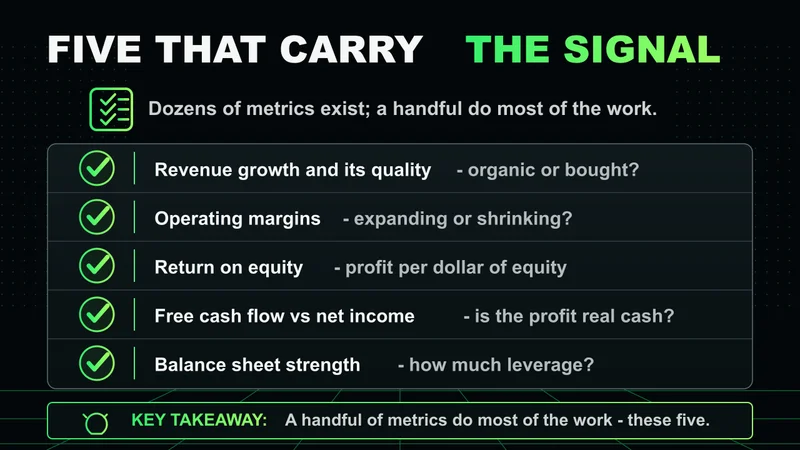
There are dozens of company analysis metrics. A handful do most of the work, and overloading the page with the rest is a way to feel thorough without being clear. These five carry most of the signal:
- Revenue growth and its quality — is it organic, or bought through acquisitions and dilution.
- Operating margin trend — whether the business gets more or less efficient as it scales.
- Return on equity — how well management converts retained capital into earnings, though debt can flatter it.
- Free cash flow versus reported earnings — cash is harder to fake than accounting profit.
- Debt relative to cash flow — how much room the business has when conditions turn.
Cash flow is where stories meet reality. A company that reports profits but never generates cash deserves more scrutiny, not less. Debt that looks fine in an expansion becomes the first problem in a contraction.
How to do company analysis, step by step
How to do company analysis is less about a formula and more about a repeatable order of operations. The same sequence works whether you hold for years or trade around a position.
- Read the latest annual report and the business description before any ratio. Understand what you are buying.
- Pull five years of income statement, balance sheet, and cash flow. Look for trends, not single data points.
- Calculate the core metrics — growth, margin, return on equity, free cash flow, and leverage — and write down what each one says.
- Compare against two or three direct competitors. A number means little until it has a peer to sit beside.
- Read management's capital-allocation history. Past behavior predicts future behavior better than stated intentions.
- Estimate a rough valuation range, then compare it to the current price and decide whether the gap is wide enough to act.
The last step is where discipline lives. If the gap between your estimate and the price is thin, the correct response is usually to wait. Waiting is part of the job, not a failure of it.
A short company analysis example
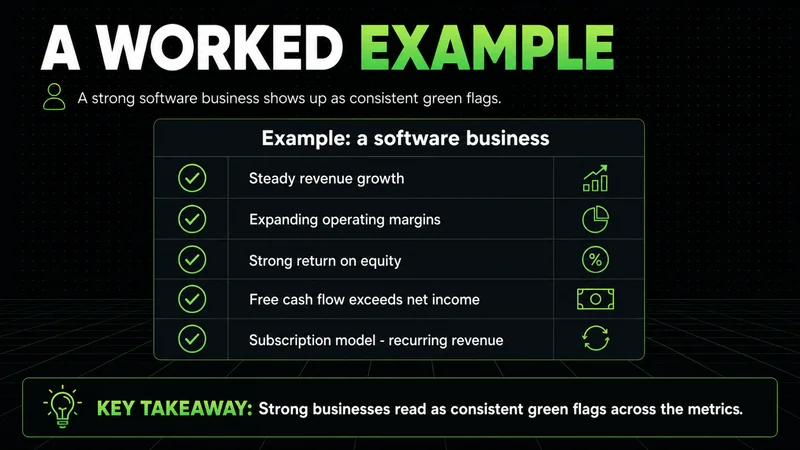
A company analysis example makes the sequence concrete. Suppose a software business shows steady revenue growth, expanding operating margins, strong return on equity, and free cash flow that consistently exceeds reported net income. The model is subscription-based with low customer concentration.
That profile describes a durable business, but the analysis does not end there. You still compare it to peers, confirm the growth is organic, and check the balance sheet can absorb a slow year. Only then do you ask whether the price leaves room. A strong company at the wrong price is still a poor decision; business quality and entry price are separate judgments, and both have to clear.
A company analysis checklist you can reuse
A company analysis checklist keeps the process consistent when conviction or boredom tempts you to cut corners. Run the same list every time.
- Do I understand how the business makes money in one sentence?
- Is revenue growing, and is the growth organic?
- Are margins stable or improving over five years?
- Does the business convert earnings into actual cash?
- Is leverage manageable if the next year is weak?
- How does each metric compare to direct competitors?
- Has management allocated capital well in the past?
- What specific outcome would prove this thesis wrong?
The last item is the one most people leave blank. Defining your invalidation before you buy is what turns an opinion into a position you can manage. Without it, every drawdown becomes a debate with yourself.
When company analysis stops working
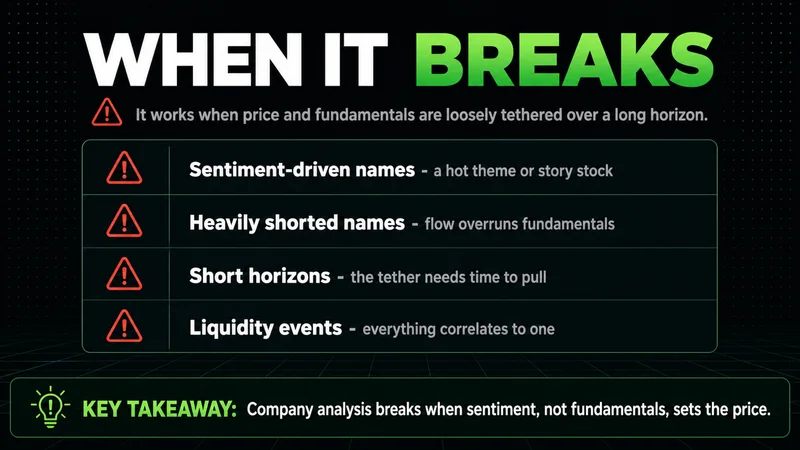
Company analysis is powerful, but it is not universal. It works best when price and fundamentals are loosely tethered over a long horizon. In several conditions, that tether breaks.
In sentiment-driven names — a hot theme, a heavily shorted stock, a story the crowd loves — fundamentals can be ignored for months. The cleanest balance sheet means nothing while positioning and liquidity are setting the price. Macro regimes do the same at scale: when rates move sharply or liquidity contracts, correlations rise and good companies sell off with bad ones. Liquidity drives markets more than opinions do, and during those windows the fundamental case has to wait for conditions to normalize.
This is the honest limit. Company analysis tells you what a business is worth. It does not tell you when the market will agree, and on thin liquidity or in a risk-off regime, the gap between the two can stay wide longer than a position can comfortably hold.
The mistake that undoes good analysis
The most common company analysis mistake is not a math error. It is confirmation. An investor likes a company, builds a thesis, and reads every new data point as support. Applying the framework selectively is worse than not applying it at all, because it produces false confidence.
The defense is mechanical. Write the thesis and its invalidation down before buying, and treat disconfirming data as the most valuable input, not a threat. Most poor outcomes are not analysis problems; they are discipline problems wearing an analytical disguise. The numbers were available. The willingness to act on the inconvenient ones was missing.
FAQs
What is company analysis in simple terms? It is the study of a single business — its model, financials, competitive position, and management — to decide whether the stock is worth owning at its current price. It is the company-specific part of fundamental analysis, separate from broad economic or sector analysis.
Why does company analysis matter in fundamental analysis? Fundamental analysis works in layers: economy, industry, then company. The company layer is where the investment decision lives, because you can be right about the sector and still lose money on a poorly run business inside it.
How do you do company analysis as a beginner? Start with the business model and the annual report, then pull five years of financial statements, calculate a few core metrics, compare against competitors, and finish by checking the valuation against the current price. Follow the same order every time.
What is the difference between company analysis and industry analysis? Industry analysis judges whether a sector is worth investing in — its demand, competition, and pricing power. Company analysis judges whether one specific business inside that sector is healthy and reasonably priced. You need both, and they answer different questions.
Which metrics matter most in company analysis? Revenue growth and its quality, operating margin trend, return on equity, free cash flow relative to reported earnings, and debt relative to cash flow. A few well-understood metrics beat a long dashboard of ratios you never act on.
What is the most common company analysis mistake beginners make? Confirmation bias — building a thesis and then reading every new data point as support for it. The fix is to define what would prove the thesis wrong before buying, and to treat disconfirming evidence as the most useful input rather than a threat.
Worth the read?