Bond Market Explained — What It Is and How It Works
The bond market is where governments and companies borrow by issuing debt. Learn how it works, the types of bonds, the risks, and how to read it.
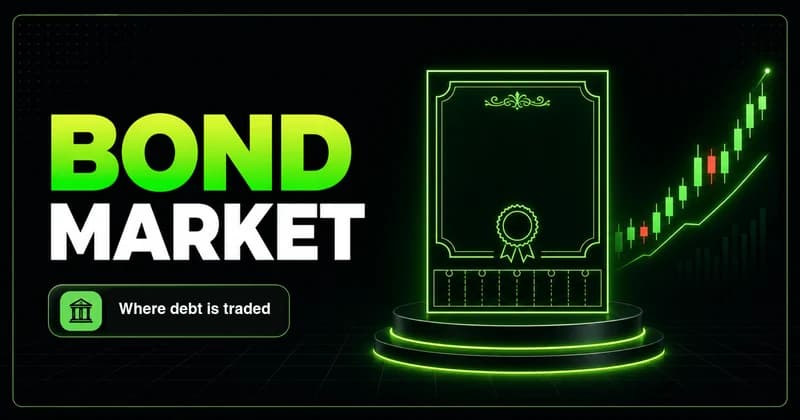
The bond market is where governments, companies, and local authorities borrow money by issuing debt, and where investors buy and trade that debt. It is the largest financial market in the world, and most of what moves stock and futures prices starts there first. Equities get the attention. Bonds set the conditions everyone else trades inside.
That order matters. A beginner who learns the bond market meaning before chasing setups understands something most retail traders skip: interest rates and credit are the foundation, and price action sits on top of them. This guide explains what the bond market is, how it works, the types of bonds you will encounter, the benefits and risks of holding them, and how to read bond moves as a signal rather than a savings product.
What is the bond market?
A bond is a loan with a fixed schedule. You lend the issuer money today, they pay you interest over a set term, and they return your principal on a stated maturity date. The bond market is simply the network where those loans get created, priced, and exchanged. There is no single building and no central exchange the way there is for stocks. Most bonds trade over the counter through dealers, which is one reason the market feels invisible to newer participants.
Two numbers define every bond:
- The coupon is the interest rate the issuer pays, usually twice a year, and it stays fixed once the bond is issued.
- The face value, often 1,000 dollars, is the amount the issuer returns to you at maturity.
Once a bond exists, its price floats in the secondary market while the coupon and face value stay fixed. That gap between a fixed payment and a moving price is the entire game.
The market itself splits into two layers:
- The primary market is where new debt is issued and the borrower receives cash.
- The secondary market is where existing bonds change hands between investors after issuance.
A 10-year Treasury auctioned this month lives in the primary market for a day, then trades in the secondary market for the next decade.
How does the bond market work?
Bond prices move inverse to interest rates, and that single relationship explains most of what beginners find confusing. When rates rise, newly issued bonds pay more, so existing bonds paying less become worth less. When rates fall, older bonds paying higher coupons become more valuable. The price adjusts until the older bond yields the same as a fresh one of similar risk.
A bond market example makes it concrete. You buy a bond paying a 4 percent coupon. Six months later, similar new bonds pay 5 percent. No one will buy your 4 percent bond at full price when they can earn 5 percent elsewhere, so its market price drops until the effective yield matches. Your coupon never changed. The price did all the work.
Yield is the number that actually carries information. It folds the coupon, the current price, and the time to maturity into one figure that tells you the real return at today's price. When traders say yields are climbing, they mean bond prices are falling and the cost of money is rising across the economy. That single read filters into mortgages, corporate borrowing, and the discount rate applied to every stock.
What are the main types of bonds?
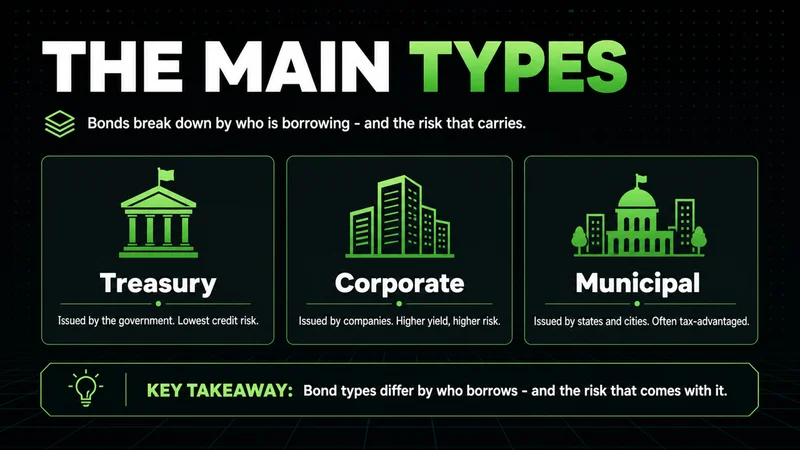
The bond market types break down by who is doing the borrowing, and each carries a different risk and tax profile.
- Treasury bonds are issued by the U.S. government. Bills mature in under a year, notes in two to ten years, and bonds in twenty to thirty. They are treated as the baseline for risk because they are backed by the federal government, and their yields set the reference point for almost everything else.
- Municipal bonds fund public projects like roads, schools, and water systems. Their interest is often exempt from federal tax, which makes them attractive to investors in higher tax brackets.
- Corporate bonds let companies raise money for operations and expansion. They pay more than government debt because they carry more credit risk. Investment-grade issuers rated BBB or higher are more stable than the high-yield names below them.
- Mortgage-backed and agency bonds bundle home loans or quasi-government debt into tradable securities, and they behave differently as rates shift because borrowers can refinance.
The further you move from Treasuries, the more yield you collect and the more credit risk you accept. That trade-off is the spine of the entire market.
Why does the bond market matter?
The bond market matters because it prices the cost of money for the whole economy, and the bond market benefits go well beyond steady income. For a saver, bonds provide predictable cash flow and a counterweight to stock volatility. For a trader, they provide context that equities alone cannot give you.
Here is the practitioner read. The bond market is the cleanest risk-appetite signal available. When money rotates into Treasuries and yields fall, capital is moving toward safety, and that flight usually shows up in index futures before it shows up in headlines. When yields rip higher and bonds sell off, the cost of capital is rising and richly valued equities feel it first. I have watched the NQ struggle to hold a breakout on a session where the 10-year yield was pressing higher all morning, simply because the backdrop was working against every long. Liquidity and positioning in the bond market often matter more than the stock-specific story you are looking at.
This is the gap most beginner explainers leave open. They treat bonds as a product to buy and hold. The more useful frame, even if you never own a single bond, is to read the bond market as the condition your other trades operate inside.
What are the risks of the bond market?
Bonds are often described as safe, and that label causes real damage when beginners take it literally. The bond market risks are specific and worth naming.
- Interest rate risk is the big one. Rising rates push existing bond prices down, and the longer the maturity, the harder the hit. A 30-year bond loses far more value per rate move than a 2-year note.
- Credit risk is the chance the issuer cannot pay. Treasuries carry almost none; high-yield corporate bonds carry a lot. Ratings are a guide, not a guarantee.
- Inflation risk quietly erodes the value of fixed payments. A 4 percent coupon loses ground when inflation runs hotter than the coupon itself.
- Liquidity risk appears in stressed conditions, when even normally tradable bonds become hard to sell at a fair price.
None of these are theoretical. A so-called safe bond fund can post a meaningfully negative year when rates rise quickly, and beginners who expected stability are the ones who sell at the worst moment. Safe means lower volatility than stocks, not absence of loss.
How is the bond market different from the stock market?
The bond market vs stock market distinction comes down to what you own and how you get paid. A stock is ownership. You hold a piece of the company and your return depends on the business doing well. A bond is debt. You are a lender with a contractual claim that sits ahead of shareholders if the company runs into trouble.
That structural difference drives their behavior. Stocks carry higher potential return and higher volatility. Bonds carry lower return and steadier cash flow, and they often hold up or gain when stocks fall, which is why the two are paired in a portfolio. The relationship is not mechanical, though. There are stretches, usually when inflation is the dominant worry, where stocks and bonds fall together and the usual hedge stops working. Treating the negative correlation as a permanent rule is exactly where that assumption breaks down.
For a trader, the practical point is that the two markets inform each other. The bond market sets the rate backdrop. The stock market reacts to it. Reading only one of them is reading half the page.
How should a beginner approach the bond market?
For bond market for beginners, the goal is not to predict rates. It is to understand the relationships well enough that bond moves stop surprising you. Start with the read, not the trade.
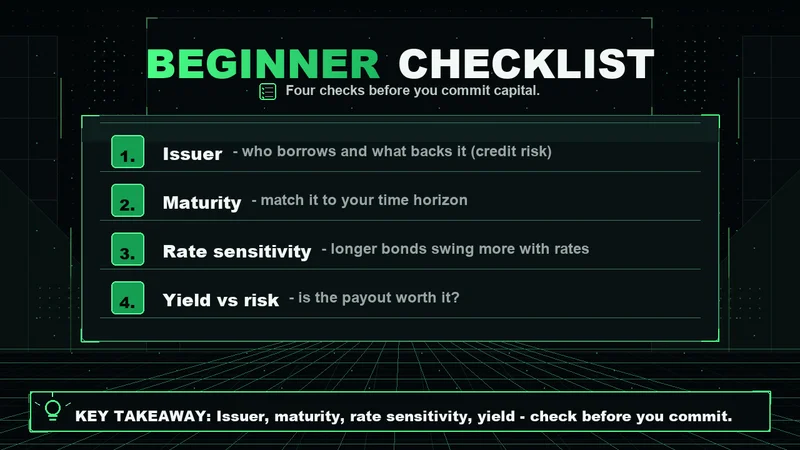
A simple bond market checklist keeps the basics in view before you commit capital or read a bond signal into another market:
- Know the issuer and what backs the bond, because that defines the credit risk you are taking.
- Check the maturity and match it to your time horizon, since longer maturities swing harder when rates move.
- Compare the yield to similar bonds, not just the coupon, because price already reflects current rates.
- Decide why you hold it, whether for income, ballast against stocks, or a read on the rate environment.
- Watch the direction of yields as a market-wide signal, not only as a number on your own position.
Two beginner mistakes show up again and again:
- Buying long-dated bonds for safety, then getting surprised when rising rates mark them down.
- Ignoring the bond market entirely while trading stocks, then wondering why a strong setup kept failing on a day the whole rate backdrop was working against it.
Both come from treating bonds as a separate world rather than the foundation under everything else.
Used inside a portfolio, bonds do two jobs:
- They generate steady income from the coupon payments.
- They cushion drawdowns when equities sell off, acting as ballast against stock volatility.
The mix depends on your time horizon and how much volatility you can hold without making emotional decisions. The discipline is the same as anywhere else in markets: define what you own, define what would make you wrong, and size it so a bad year is survivable rather than account-ending.
FAQs
What is the bond market in simple terms? It is the global market where governments, companies, and local authorities borrow money by issuing bonds, and where investors buy and trade that debt. The buyer is the lender, the issuer is the borrower, and the bond is the contract that sets the interest and repayment schedule.
How does the bond market work? Issuers sell bonds in the primary market to raise cash, then those bonds trade between investors in the secondary market. Prices move inverse to interest rates, so when rates rise existing bonds fall in value, and when rates fall existing bonds rise.
What are the main types of bonds? The most common are Treasury bonds backed by the U.S. government, municipal bonds that fund public projects and often pay tax-free interest, and corporate bonds issued by companies. Treasuries carry the least credit risk and the lowest yield; corporate bonds pay more for taking on more risk.
Is the bond market safer than the stock market? Bonds are generally less volatile than stocks and pay steadier income, but safer does not mean risk-free. Rising interest rates, inflation, and issuer default can all produce losses, and a bond fund can post a negative year.
Why does the bond market matter for beginners? The bond market sets the cost of money for the whole economy, which feeds into mortgages, corporate borrowing, and stock valuations. Even if you never buy a bond, reading whether yields are rising or falling tells you whether the broader environment is leaning toward risk or toward safety.
Keep learning
The bond market rewards understanding relationships over memorizing definitions. Once the price-yield link, the role of credit, and the read on risk appetite click into place, the rest of the market becomes easier to interpret. For the next step, study how the yield curve shifts across maturities, how Treasury yields anchor other asset prices, and how rate expectations move index futures before the move reaches individual stocks. Each one builds on the foundation laid here, and together they turn the bond market from background noise into a signal you can actually use.
Worth the read?