SpaceX IPO: The Numbers Behind The Risk
SpaceX's IPO risk is not only valuation. Float, lockups, index inclusion, and passive demand all shape the trade.
The SpaceX IPO story is not only about demand for a rare growth asset. It is also about valuation, float, lockups, index mechanics, and whether passive capital is being forced into a thinly traded stock before real price discovery has time to form.
The Deal Is Built Around A Fixed Price
The Odaily source says SpaceX is set to list on Nasdaq at a fixed $135 per share. The offering is expected to issue about 556 million shares, raise about $75 billion, and value the company around $1.75 trillion to $1.8 trillion.
Reported demand is far larger than the supply. The source cites more than $250 billion of subscriptions, or close to four times the available deal size. That kind of imbalance can create strong opening pressure, but it also raises the standard for risk management. A crowded book does not remove valuation risk.
The structure is unusual. Instead of a traditional IPO range and roadshow price discovery, the source says SpaceX opened subscription at a fixed $135 price, with the book expected to close from June 8 to June 10 and pricing on June 11. SpaceX also received approval for a 5-for-1 split.
Goldman Sachs and Morgan Stanley are the two lead underwriters, with Goldman in the lead-left position. Barclays, Deutsche Bank, UBS, Royal Bank of Canada, and Mizuho are listed across regional distribution. Based on the raise size, the source estimates the underwriting fee pool at $800 million to more than $1 billion.
Retail Allocation Changes The Liquidity Question
The IPO float is small relative to the company. New shares represent about 4.3% of total shares, and those shares enter the float after listing. Of the new issuance, 30% is allocated to retail investors. That equals about $22.5 billion.
That retail share is large compared with the normal 5% to 10% allocation in major U.S. IPOs. E*Trade, Bank of America, Fidelity, Robinhood, Charles Schwab, and SoFi are named as access points or distribution channels.
The market question is whether that cash has to come from somewhere else. A $75 billion raise does not automatically drain the entire equity market, but a large retail allocation can pressure marginal liquidity. The source points to stocks and crypto assets as possible funding sources and notes that Bitcoin had been under pressure in recent weeks.
Historical IPO windows are mixed. The source says QQQ performance around large technology listings has varied. Facebook, Snowflake, Airbnb, and Coinbase mostly posted positive returns over the 20 days after listing, while Uber, parts of Alibaba's early trading, and Arm were weaker or more volatile. The simulated SpaceX IPO window showed about a -6.3% return over the prior four trading days.
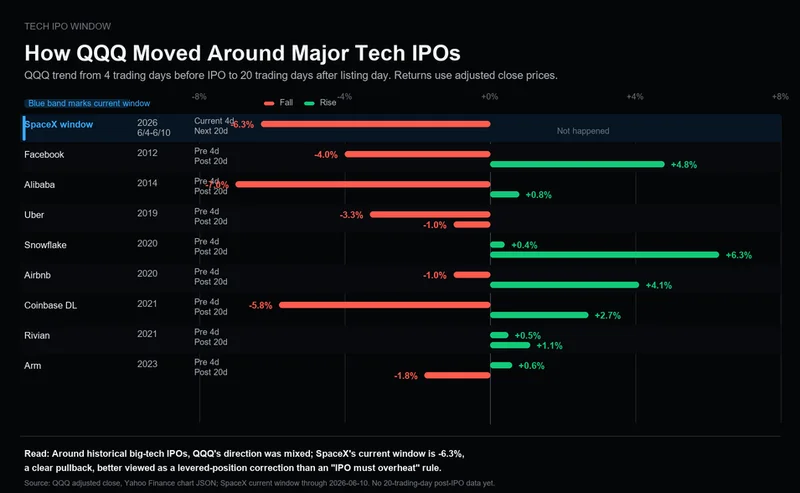
The cleaner conclusion is not that every asset is at risk. It is that high-beta positions, long-tail assets, and crowded momentum trades are more exposed when capital has to rotate into a major new listing. Bitrue Research Institute's Andri Fauzan Adziima called that pressure an IPO tax.
The Valuation Depends On More Than Rockets
The financial base is the main tension. The source says SpaceX generated about $18.7 billion of revenue in 2025 and lost about $4.9 billion. At a $1.75 trillion valuation, that works out to roughly 94 times 2025 sales for a company that is still unprofitable.
The operating story has several layers. Starlink is the most mature recurring business. Rocket launches provide deployment capability and technical advantage. Starship and orbital data centers carry more uncertainty. AI is the part of the story that pushes the ceiling higher.
After absorbing xAI in February 2026 at a combined valuation of $1.25 trillion, SpaceX is no longer only an aerospace company in the source's framing. The full narrative connects cheaper access to orbit, global connectivity through Starlink, heavier orbital deployment through Starship, AI compute demand, and eventually data centers in space.
That is a powerful story. It is also a broad bundle. Investors are not only buying Starlink and Falcon 9. They are also being asked to price uncommercialized Starship economics, uncertain orbital-computing feasibility, and an AI business that the source describes as still consuming capital.
Valuation Models Are Far Apart
The disagreement across valuation models is wide. Morningstar's fair value estimate is about $780 billion, less than half the IPO target. The source says Morningstar still recognizes SpaceX's technical capability and narrow moat, and notes that SpaceX accounted for more than half of global rocket launches last year. Its caution centers on the timing, feasibility, and financial outcome of orbital computing and AI.
NYU finance professor Aswath Damodaran's model is higher, at $1.22 trillion to $1.29 trillion. That range gives credit for engineering strength but still leaves limited upside above $1.75 trillion. Scottish Mortgage, a long-term holder, is described as anchored around $1.25 trillion and not directly following the IPO target.
The underwriter side is far more aggressive. Goldman forecasts the AI division alone producing $322 billion of annual revenue by 2030, with total company revenue above $470 billion. Morgan Stanley's longer model is even larger, projecting 2040 revenue of $3.4 trillion and adjusted EBITDA above $2.7 trillion.
On-chain markets are the most aggressive. Binance's SPCXUSDT perpetual contract reflected a $1.75 trillion to $2 trillion valuation range after launching in May. Polymarket odds for a final IPO valuation above $2 trillion were above 70%. The source also says Binance adjusted the estimated SpaceX share count behind SPCXUSDT from 11.87 billion to 13.08 billion, which pushed implied valuation above $2 trillion at current pricing.
When estimates range from $780 billion to more than $2 trillion, the market is not arguing about small inputs. It is arguing about the entire path of the business.
Starship Is A Narrative Catalyst And A Risk Point
The source flags the next Starship test flight in June as a major narrative checkpoint. If Starship can move toward stable, frequent, low-cost commercial operations, it strengthens the long-term chain behind the valuation.
If the test fails or progress comes in below expectations, the opposite happens. The valuation depends on a future where launch cost, orbital logistics, AI demand, and space-based infrastructure fit together. A weak Starship update does not break every part of SpaceX, but it can reduce confidence in the highest-multiple part of the story.
This is where traders need to separate company quality from trade quality. SpaceX can be an exceptional company and still be a difficult stock if expectations are already priced for perfect execution.
The Lockup Is Not As Simple As 180 Days
A standard IPO lockup gives the market time to establish a real price before insiders sell. The source says SpaceX has a nominal 180-day lockup, but the structure includes staged early releases.
The first release can arrive after Q2 earnings. Eligible insiders may sell 20% of their shares between mid-July and September. Other insiders may begin selling as early as the second trading day after the first quarterly report, likely in August.
More releases can follow. If the stock trades more than 30% above the issue price for five of the 10 trading days before the first earnings report, up to another 10% can release early. Additional time-based releases are scheduled at 70, 90, 105, 120, and 135 days. After Q3 earnings, up to another 28% can release, and day 180 in mid-December releases the rest.
Musk has promised not to sell for 366 days. That helps the headline, but it does not remove selling pressure from early employees, venture investors, banks, or other holders who may want liquidity after the first report.
For a buyer at $135, the practical issue is timing. The first meaningful insider supply may arrive much sooner than a simple 180-day lockup headline suggests.
Index Inclusion May Force Price-Insensitive Demand
The index mechanics may be the most important market-structure issue. The source says Nasdaq changed the relevant path so SpaceX can enter the Nasdaq-100 within 15 trading days. FTSE Russell's path is described as five trading days, while MSCI also confirmed a fast track for large IPOs. The S&P 500 did not follow because it requires sustained profitability, which SpaceX does not yet meet.
Float makes the setup more sensitive. The source says more than 95% of shares remain held by Musk, early employees, and institutional investors under lockup. The tradeable float is about 4.3%. That is very different from Microsoft at 99.97% float, Nvidia at 95.8%, and Amazon at 90.5%.
Nasdaq also allows low-float stocks to be weighted at up to three times actual float. The result is a thinly traded stock receiving a larger index footprint than its real float alone would suggest.
Institutions cited by the source estimate passive funds could buy about 30% of free float within 15 trading days after listing. Funds tracking the Nasdaq-100 total about $1.4 trillion. Because no existing constituent is removed to create space, Nasdaq-100 funds would need to sell pieces of their current holdings to buy SpaceX.
That is not normal discretionary demand. It is rule-based demand. For traders, the difference matters because price-insensitive buyers can lift a stock in the short term while also creating poor entry conditions for investors who arrive late.
The Real Risk Is Transfer, Not Just Valuation
The criticism is not only that SpaceX may be expensive. The deeper concern is who absorbs the risk and when.
Michael Burry reposted criticism of the rule changes. The source also cites a Wall Street veteran calling the structure shameless index manipulation, a Wall Street Journal columnist describing Nasdaq's fast-inclusion rule as arbitrary, unfair, and potentially dangerous, and a Financial Times reporter calling it the largest bag-holding game in history.
The core argument is clear. Low-fee index funds were designed to give ordinary investors broad market exposure at low cost. In this structure, they may become a forced buyer for a loss-making company trading near 94 times sales while early capital receives earlier exit paths.
That does not mean the IPO must fail. It means the risk is being distributed through mechanisms many passive investors do not actively choose.
The Takeaway Is Position Discipline
SpaceX may be the most ambitious IPO of this era. It may also be one of the most controversial because the trade combines a rare asset, a very high valuation, small float, staged insider releases, aggressive index inclusion, and huge passive demand.
The right question is not whether the company is impressive. It is whether the price, float, lockup schedule, and forced-buying mechanics create a favorable risk-reward for the buyer. Until real price discovery develops, this is not a clean momentum trade. It is a structure that demands smaller sizing, clear invalidation, and patience.
Worth the read?