EBITDA — What It Really Tells an Investor
EBITDA is operating earnings before interest, taxes, depreciation, and amortization. Here is what the metric really tells an investor, and where it lies.
EBITDA is a company's earnings before interest, taxes, depreciation, and amortization. It strips financing and accounting choices out of profit so you can compare the raw operating engine of one business against another. That is the textbook EBITDA meaning, and it is useful. It is also where most beginners stop reading, which is exactly where the metric starts to mislead them.
The number is a starting question, not an answer. A high EBITDA tells you a business produces operating earnings before the bills that depreciation and interest represent. It does not tell you whether those bills are large, recurring, and unavoidable. Treating EBITDA as a clean profit figure is one of the most common ways a new investor overpays for a company that never converts those earnings into cash.
What EBITDA measures and what it deliberately ignores
Start with what the metric is built to do. EBITDA isolates operating performance by removing four items that have little to do with how well the core business runs day to day.
- Interest reflects how the company financed itself, not how it operates. Two identical businesses with different debt loads should be comparable at the operating level.
- Taxes depend on jurisdiction, structure, and one-time events. Removing them standardizes across companies.
- Depreciation spreads the cost of past capital spending across years. It is a non-cash charge in the current period.
- Amortization does the same for intangible assets like patents and acquired goodwill.
The logic is sound for a specific job: comparing the operating output of companies with different capital structures and tax situations. That is why EBITDA shows up constantly in valuation, lending, and acquisition work. The problem appears when you forget what was removed. Depreciation is non-cash this quarter, but the machines still wear out and still need replacing. Interest is a financing choice, but a company drowning in debt still has to make the payments. EBITDA quietly sets those realities aside, and a careless reader sets them aside too.
The EBITDA formula, with a worked example
There are two common ways to calculate EBITDA, and both land in the same place.
The first builds up from the bottom of the income statement:
EBITDA = Net Income + Interest + Taxes + Depreciation + Amortization
The second starts from operating income, which already excludes interest and taxes:
EBITDA = Operating Income + Depreciation + Amortization
Work through an EBITDA example with round numbers. A company reports net income of 400,000, interest expense of 90,000, taxes of 110,000, depreciation of 150,000, and amortization of 50,000. Add them back and EBITDA is 800,000. The same company might report operating income of 600,000, and adding back the 150,000 in depreciation and 50,000 in amortization gives the identical 800,000. When the two methods disagree, the gap usually traces to a one-time item buried below operating income, and that gap is worth chasing down rather than ignoring.
Most analysts also track the EBITDA margin, which is EBITDA divided by revenue. A 30% margin means thirty cents of every revenue dollar survives as operating earnings before interest, taxes, and the two non-cash charges. Margin matters more than the absolute figure because it lets you compare a small company to a large one on the same footing.
There are a few related EBITDA metrics worth knowing once the base calculation is clear, since each one bends the figure for a different purpose.
- EBITDA margin measures operating efficiency as a percentage of revenue, useful for peer comparison.
- Adjusted EBITDA strips out items management labels as non-recurring, which can be reasonable or self-serving depending on the company.
- EV/EBITDA prices the whole enterprise against its operating earnings and sits at the center of comparable-company valuation.
- EBITDA coverage measures how comfortably operating earnings cover interest and lease obligations, a lender's favorite.
Each variation answers a narrower question than the headline number. Knowing which one a source is quoting is half the work, because an adjusted figure and a reported figure can describe the same company in very different language.
Why EBITDA matters in fundamental analysis
In fundamental analysis the metric earns its place because it makes businesses comparable. Enterprise value divided by EBITDA, the EV/EBITDA multiple, is one of the most widely used valuation ratios precisely because it sidesteps capital structure. A company financed mostly with debt and one financed mostly with equity can be lined up side by side, since the numerator captures the whole capital base and the denominator ignores how that base is split.
These are the roles EBITDA tends to play once you move past the definition.
- A standardized comparison metric across companies in the same sector.
- The denominator in EV/EBITDA, a core valuation multiple.
- A proxy for operating cash generation, used as a rough screen before deeper work.
- A common reference point in lending covenants and acquisition pricing.
- A way to track operating trend over time, stripped of financing noise.
Notice that every one of these is comparative or directional. EBITDA is most honest when it ranks businesses against each other or against their own history, and least honest when it is read as a standalone measure of how much a company is truly worth. The metric answers "how does the operating engine compare," not "how much cash ends up in the owner's pocket."
EBITDA vs EBIT and the other earnings layers
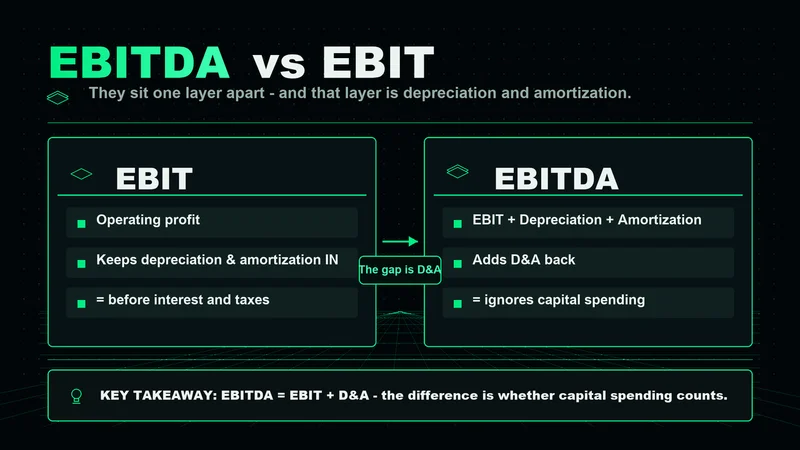
A recurring point of confusion is EBITDA vs EBIT. They sit one layer apart, and the layer is depreciation and amortization. EBIT keeps those charges in; EBITDA adds them back. The choice between them is really a choice about whether capital spending belongs in your picture of profitability.
| Metric | What it includes | What it removes | Reads best for |
|---|---|---|---|
| EBIT | Operating earnings after depreciation and amortization | Interest, taxes | Capital-heavy businesses where asset wear is real cost |
| EBITDA | Operating earnings before depreciation and amortization | Interest, taxes, depreciation, amortization | Comparing operating engines across capital structures |
| Net income | Bottom-line profit | Nothing further | What is left for equity holders after everything |
For a software company with almost no physical assets, EBIT and EBITDA sit close together, so the distinction barely matters. For an airline, a manufacturer, or a telecom carrier, depreciation is enormous and recurring, and EBITDA can flatter the business badly by pretending that cost does not exist. This is the first place the framework breaks: in a capital-intensive business, the depreciation EBITDA ignores is not an accounting artifact, it is next year's unavoidable spending. Lean on EBITDA there and you will overpay.
The deeper point is that each earnings layer answers a different question, and stopping at the wrong layer is where investors get hurt. EBITDA asks how the operating engine compares before financing and capital charges. EBIT asks how it compares after the cost of using up assets. Net income asks what is left for shareholders after everything, including the tax bill and the interest the company actually pays. None of the three is more correct than the others. They are tools for different jobs, and the discipline is in matching the tool to the business in front of you rather than defaulting to whichever number looks best.
A simple EBITDA framework and checklist for beginners
You do not need a complicated model to use this metric responsibly. You need a short EBITDA checklist that forces you to look at what the number hides.
- Compare EBITDA to operating cash flow. If EBITDA is large but cash flow is thin, the difference is working capital and capital spending the metric ignored. Trust the cash.
- Read the adjustments. "Adjusted EBITDA" can be reasonable or it can be a place to bury recurring costs as one-time items. Count how aggressive the add-backs are.
- Check capital intensity. High depreciation relative to revenue means EBITDA is overstating the durable earning power.
- Look at the debt load. Interest was removed, but a heavy balance sheet still claims a large slice of operating earnings before owners see anything.
- Use the margin, then the multiple. EBITDA margin for quality, EV/EBITDA for price. Neither alone is enough.
Run a business through those five checks and EBITDA becomes what it should be: a fast, comparable read on the operating engine, with clear flags for where it might be lying. The framework is reactive, not predictive. It tells you what the company has produced and where to dig, not what the stock will do next.
The common EBITDA mistakes beginners make
The errors are predictable, and they cluster around treating the metric as more than it is.
The first mistake is reading EBITDA as cash. It is not. A profitable-looking EBITDA can coexist with negative free cash flow once capital spending and interest are paid. Many drawn-out value traps started as a company that looked cheap on EBITDA and never converted those earnings into anything an owner could use.
The second mistake is accepting adjusted EBITDA without reading the footnotes. Management has wide latitude to label costs as non-recurring. When the same "one-time" charges appear three years running, they are recurring, and the adjusted figure is fiction dressed as discipline.
The third mistake is ignoring capital intensity. EBITDA was designed to be capital-structure neutral, not capital-spending neutral, and beginners routinely confuse the two. The same caution that protects a trader from sizing into a setup without checking the broader context protects an investor from buying a business without checking what EBITDA quietly removed.
If you want a quick way to remember where the metric tends to fail, keep these failure conditions in mind.
- Capital-heavy businesses, where depreciation represents real, recurring spending rather than a paper charge.
- Highly leveraged companies, where the interest EBITDA removed still consumes most of the operating earnings.
- Aggressive adjusted figures, where recurring costs keep getting relabeled as one-time items.
- Roll-ups built through acquisition, where amortization of acquired intangibles is heavy and the add-backs flatter the picture.
Outside of those conditions, EBITDA behaves well and earns its reputation as a fast comparison tool. Inside them, the framework inverts, and the very thing it removed becomes the most important part of the analysis. That is the discipline the metric demands: not abandoning it, but knowing the specific terrain where it stops being trustworthy.
FAQs
What is EBITDA in simple terms? It is a company's operating earnings before interest, taxes, depreciation, and amortization are subtracted. The point is to show how the core business performs before financing choices and non-cash accounting charges enter the picture, which makes companies easier to compare.
What is the difference between EBITDA and EBIT? EBIT keeps depreciation and amortization as expenses; EBITDA adds them back. For asset-light businesses the two are close, but for capital-heavy companies EBITDA sits well above EBIT and can overstate durable earning power.
Is a higher EBITDA always better? Not on its own. A higher figure looks attractive, but it can hide heavy debt, large recurring capital spending, or aggressive adjustments. Compare EBITDA to operating cash flow before trusting it.
What is a good EBITDA margin? It depends entirely on the sector. Software firms routinely post high margins because they spend little on physical assets, while low-margin industries like retail run far thinner. Margin is only meaningful against peers in the same business.
Why do investors use EBITDA in valuation? It standardizes operating earnings across companies with different debt levels and tax situations, which is why the EV/EBITDA multiple is so common. It is a comparison tool, not a measure of cash an owner actually keeps.
Where to go from here
EBITDA is worth understanding precisely because so many people use it carelessly. Treat it as a comparison metric and an opening question, run it against cash flow, read the adjustments, and check capital intensity, and it becomes a reliable part of fundamental analysis. Read it as profit and it will eventually cost you. To build the rest of the picture, the natural next steps are operating cash flow, free cash flow, and the EV/EBITDA multiple in the context of a full company analysis.
Worth the read?