AMD After The Selloff: Risk Or Opportunity
AMD's selloff created a real process test: strong data-center growth and MI400 upside against Nvidia's moat and a rich valuation.
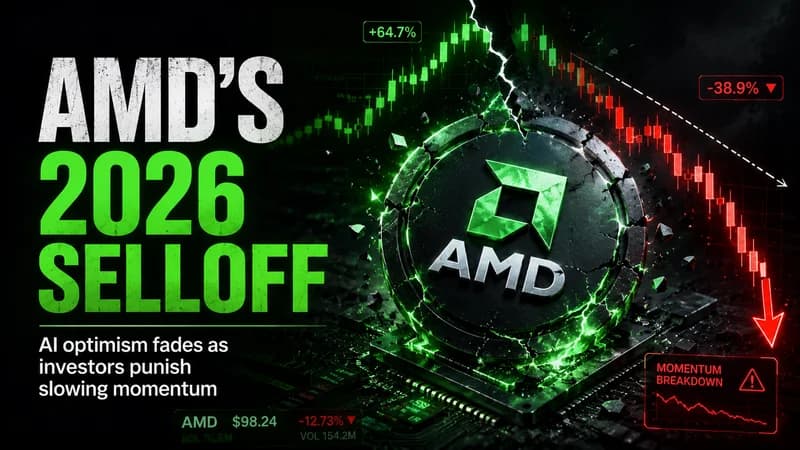
AMD's 2026 selloff created a clean test of process. The stock was hit with the chip sector even though AMD's own growth numbers stayed strong, which leaves investors weighing a real AI accelerator opportunity against valuation and execution risk.
The Selloff Started Away From AMD
AMD did not fall because its internal story broke. The pressure began with Broadcom's early-June outlook, then moved through the semiconductor complex.
For Q3, Broadcom projected roughly $16 billion in AI chip sales. Wall Street had been looking for $17.2 billion. The company also left its full-year AI forecast unchanged, which weakened confidence across a sector that had already priced in aggressive growth.
Kavout estimated that this guidance disappointment helped remove more than $1.3 trillion of chip-sector value within days. Memory-chip oversupply, weaker smartphone demand, renewed inflation concern, and higher oil prices added more pressure. In that environment, investors were quick to sell names that had already moved hard.
AMD fell with the sector, not on a company-specific breakdown.
Its Q1 2026 revenue and data-center numbers still showed strong growth.
The risk is whether that growth is enough to justify the valuation.
AMD's Drop Was Sharp But Sector Driven
On June 5, 2026, AMD finished near $466 after a 10.86% decline. Earlier in June, the stock had traded around $542, so the move was meaningful.
The important detail is participation. Intel and Nvidia also moved lower, which confirmed a broader semiconductor reset. That context matters because sector contagion carries a different signal than a failed company roadmap, weak demand, or broken margin story.
That does not make the drop automatically bullish. It only means the first question should be whether price moved further than fundamentals justified. That is where opportunity and value-trap risk start to look similar.
The Bull Case Is Data-Center Share Gain
AMD's underlying numbers were not weak. Q1 2026 sales reached $10.3 billion, a 38% increase from the prior year. Data-center revenue hit a record $5.8 billion after rising 57%, which made the segment more than half of AMD's business.
That is the real bull case. AMD does not need to become Nvidia to grow. It needs to keep taking enough share in a large, expanding AI accelerator market for the numbers to compound.
The MI-series roadmap is central to that view. MI350 products are already in market, and MI400 is expected before 2026 ends. The flagship MI455X is positioned around 40 PFLOPS of FP4 compute. It also carries 432GB of HBM4 memory. For large deployments, AMD pairs the roadmap with Helios, a rack-scale design aimed at hyperscale GPU clusters.
If the MI400 cycle keeps data-center growth above 50%, the market can keep underwriting AMD as a credible challenger. The opportunity is not based on dominance. It is based on meaningful share capture inside a very large market.
The cleanest AMD bull case is not that Nvidia disappears. It is that AMD captures enough incremental demand for the data-center segment to keep carrying the business.
The Bear Case Is Nvidia's Moat And AMD's Multiple
The risk is just as clear. Nvidia still has about four-fifths of AI accelerator revenue, or roughly 80%. AMD sits much lower, around 5% to 7%. That gap shows up in scale, customer depth, and ecosystem strength.
Hardware specifications alone do not solve that gap. Nvidia's CUDA software ecosystem creates real switching costs for developers and enterprise customers. AMD's ROCm software continues to improve, but customers do not rewrite years of optimized AI code casually.
Valuation adds pressure. Even after the selloff, AMD traded near 58 times forward earnings and much higher on trailing profits. That kind of multiple requires strong execution. It leaves little room for a slow MI400 ramp, weaker hyperscaler spending, or delayed adoption.
This is where the value-trap scenario comes from. A stock can look cheaper after a large drop and still be expensive if expectations remain high.
Position Size Has To Respect Volatility
AMD is not a passive core holding in this setup. It is a high-volatility semiconductor position tied to AI accelerator execution, data-center spending, and market tolerance for premium multiples.
That argues for satellite sizing. A smaller position can capture upside if the MI400 cycle works without allowing one thesis to dominate portfolio risk. Averaging in can also reduce timing pressure, especially after a sharp sector move.
The most important decision is the maximum acceptable loss. That should be defined before entry. If MI400 deployment slips, hyperscaler demand cools, or the valuation compresses, the plan needs an invalidation point. Hoping through a value-trap setup is not risk management.
The Takeaway Is Conditional, Not Certain
AMD after the selloff is not an obvious bargain and not an automatic trap. It is a conditional bet on whether strong data-center growth and the MI400 roadmap can offset Nvidia's CUDA moat, market-share lead, and AMD's premium valuation.
The disciplined approach is to size it as a volatile satellite, average in only if the thesis remains intact, and let the next data-center cycle confirm whether the selloff created opportunity or exposed too much risk.
FAQs
What caused AMD's 2026 selloff? The source ties AMD's decline to the broader semiconductor reset that followed Broadcom's weaker AI chip outlook, not to a specific AMD operating miss.
How much did AMD fall? AMD declined 10.86% and ended June 5, 2026, near $466 after trading close to $542 earlier that month.
What supports the AMD bull case? AMD reported $10.3 billion of Q1 2026 revenue, up 38%. Its data-center segment reached $5.8 billion, up 57%, and MI400 gives the company another AI accelerator cycle to prove share gain.
What makes AMD a possible value trap? Nvidia still controls roughly four-fifths of AI accelerator revenue, CUDA keeps customers sticky, and AMD's forward earnings multiple remained near 58 after the decline.
What does AMD's MI accelerator roadmap include? AMD Instinct is the data-center AI GPU line. The roadmap includes MI350 products already shipping and MI400 models expected later in 2026, led by MI455X.
Worth the read?