Depository Trust Company — Who Actually Holds Your Shares
The Depository Trust Company holds nearly every U.S. security in book-entry form. Here is what that means for ownership, settlement, and trading risk.

The Depository Trust Company (DTC) is the central securities depository for the U.S. market — the institution that holds nearly every share and bond in electronic book-entry form so trades can settle without paper certificates changing hands. It is the custody layer underneath every exchange, every broker, and every fill.
Most traders never think about it, and that is the part worth questioning. You almost certainly do not hold your shares in your own name. They sit registered to Cede & Co., the DTC's nominee, while your broker holds a claim against the DTC and you hold a claim against your broker. In a liquid name, this changes nothing about your trading. In a small set of situations — covered below — it decides whether you can trade at all.
What is the Depository Trust Company?
The depository trust company meaning is simpler than the name suggests: it is a vault. Founded in 1973 and based in New York, the DTC immobilizes securities — it takes certificates in once, parks them, and from that point forward records ownership changes as accounting entries rather than physical deliveries. Since 1999 it has operated as a subsidiary of the Depository Trust & Clearing Corporation (DTCC), alongside the clearing entities that handle trade netting.
The scale is easy to underestimate. The DTC provides custody and settlement for almost all corporate equities, bonds, and money market instruments in the United States, processing transactions measured in the trillions of dollars. When you buy 100 shares of anything liquid, the DTC's ledger is where the change of ownership actually lands.
Its role in markets is structural: without a central depository, every trade would mean matching, moving, and verifying paper — a process that nearly broke Wall Street once already.
How does the Depository Trust Company work?
The mechanics rest on three functions:
Custody. Securities are held in fungible bulk under the nominee name Cede & Co. Your broker's records say which clients own what; the DTC's records say which brokers hold what.
Settlement. When a trade settles, the DTC moves positions between participant accounts as book entries — debits and credits, not deliveries.
Asset servicing. Dividends, interest payments, and corporate actions flow from issuers through the DTC to participants, then down to end clients.
A concrete depository trust company example: you sell 500 shares through Broker A, and the buyer sits at Broker B. After clearing, the DTC debits Broker A's participant account and credits Broker B's. No certificate moves. Nothing physical happens. The share total registered to Cede & Co. is unchanged — only the internal allocation shifts.
This is why settlement is fast and cheap in modern markets. It is also why "your" shares are, legally, a layered set of claims rather than a certificate in a drawer.
The history behind the DTC — a crisis response, not an innovation
The depository trust company history starts with failure. In the late 1960s, trading volume on U.S. exchanges grew faster than the paper-based back offices processing it. Certificates had to be physically delivered for every trade, and the industry drowned. Exchanges shortened trading hours and closed on Wednesdays just to let back offices catch up. Brokerages failed under the operational load. The episode is known as the paperwork crisis.
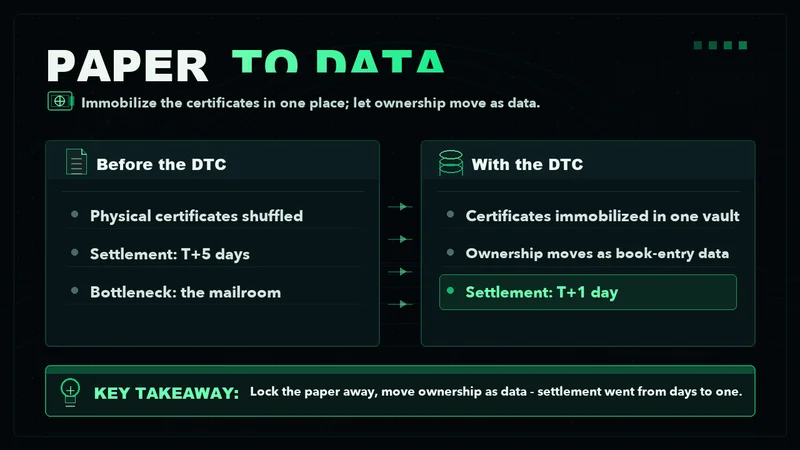
The DTC was the industry's structural answer: immobilize the certificates in one place, and let ownership move as data. It worked. The settlement cycle that once required five business days now completes in one, and the binding constraint on volume stopped being the mailroom.
Depository trust company vs clearing house — two different jobs
The depository trust company vs clearing house distinction trips up almost everyone, partly because both functions now live under the same parent. They are not the same desk.
A clearing house — in U.S. equities, the National Securities Clearing Corporation (NSCC) — stands between buyer and seller after the trade. It nets obligations across the day, guarantees the trade if one side defaults, and tells everyone what they owe. It manages counterparty risk.
The DTC is the depository. It holds the securities and executes the final movement of positions that the clearing house instructed. Clearing decides who owes what; depository custody is where the settlement actually happens. One is a risk manager, the other is a ledger. A trader who confuses them will misread how settlement failures, clearing margin calls, and custody restrictions propagate — they travel through different pipes.
Why the depository trust company matters for investors and traders
For investors, the practical meaning of DTC custody is street name ownership. Your broker is the DTC participant; you are a beneficial owner. Dividends arrive, votes get passed through, and everything works — with the qualifier that you are trusting two layers of record-keeping instead of zero. Investors who want their name on the register can use direct registration with the issuer's transfer agent instead. That trade-off is real: direct registration gives cleaner legal title and slower execution, since shares must move back into street name before they can be sold quickly.
For traders, the DTC affects trading in quieter ways. Settlement plumbing defines when capital is actually free, when short locates exist, and whether a security can move between brokers at all. None of that shows up on a chart. All of it shows up in execution eventually.
Where the plumbing stops working: chills, freezes, and real risks
Book-entry custody is invisible right up until the DTC restricts a security. The depository trust company risks worth knowing are concentrated here:
A chill limits specific services — often blocking new deposits or withdrawals of a security while a compliance question gets resolved.
A freeze halts all DTC processing of the security. Positions stop moving between participants entirely.
These restrictions cluster in thin OTC names with irregular share issuance histories. In a liquid large cap, custody mechanics never enter your decision-making. In a thinly traded stock under a chill, the plumbing becomes the trade: brokers stop accepting the shares, market makers step away, and the exit you assumed was a click becomes a process measured in weeks.
Liquidity drives markets more than opinions do. The fastest way to watch a bid disappear is not bad news — it is a custody restriction that stops brokers from touching the shares.
The DTC system works, at scale, every day, for nearly everything. It stops working for the specific securities least able to absorb it — and traders in those names are usually the least aware of the dependency.
FAQs
What is the depository trust company in simple terms? It is the central vault of the U.S. securities market. It holds nearly all shares and bonds in electronic form under its nominee, Cede & Co., and settles trades by adjusting account entries instead of moving paper certificates.
Is the DTC a government agency? No. It is a member-owned clearing agency registered with the SEC and overseen as part of the Federal Reserve System's regulatory framework. It is private infrastructure performing a public-utility function.
What is the difference between the DTC and the DTCC? The DTCC is the parent holding company. The DTC is its depository subsidiary, sitting alongside the NSCC and FICC, which handle clearing for equities and fixed income.
Where the DTC fits in your market education
The DTC is one piece of the settlement stack, and it makes the most sense studied next to its neighbors: the clearing house function at the NSCC, the role of transfer agents and direct registration, and how the settlement cycle shapes margin and buying power. None of these will generate a single trade idea. They will tell you what actually happens after your fill — and traders who understand the plumbing read settlement-driven headlines with context.
Worth the read?