Exchange Fund — What It Is and How It Actually Works
An exchange fund lets you swap a concentrated stock position for a diversified portfolio without triggering capital gains. What it solves, and what it costs.
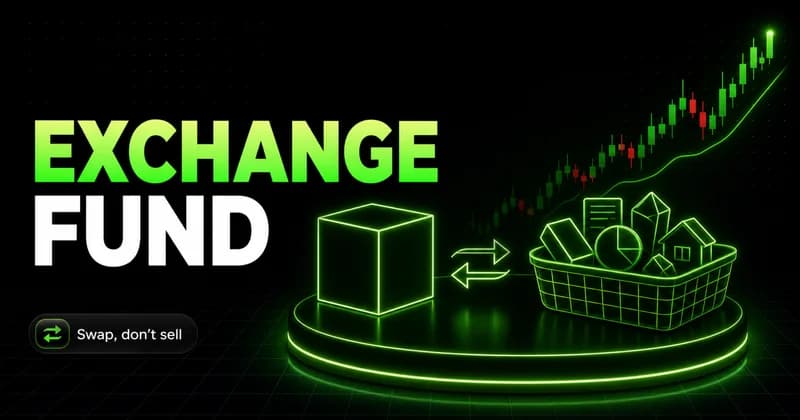
An exchange fund is a private pooled vehicle that lets an investor swap a large, concentrated stock position for shares in a diversified portfolio — without selling and without triggering capital gains tax. The cost is liquidity: a seven-year holding period, restricted access to the capital, and fees that compound quietly in the background.
Most coverage of exchange funds reads like product marketing. The structure deserves a more honest treatment, because what it actually sells is not diversification — it is tax deferral, paid for with liquidity. Whether that trade is worth making depends on conditions most marketing pages never spell out.
What is an exchange fund?
The meaning of the name is literal. You exchange your stock for shares of a fund. Multiple investors contribute their own concentrated positions into one pool, and each walks away holding a slice of everything inside it. The fund manager curates which stocks get accepted, usually targeting a risk profile that resembles a broad index such as the S&P 500.
Because the contribution is structured as a transfer into a partnership rather than a sale, no taxable event occurs. Your original cost basis carries over into the fund shares. Taxes come due only when you eventually sell what you redeem — which can be decades later, or never, if the position passes through an estate.
The structure has existed for decades, and Congress has tightened the rules around it more than once. One artifact of that history still shapes every fund today: to keep the tax deferral, an exchange fund must hold at least 20% of its assets in qualifying non-securities, which managers usually satisfy with real estate.
Access is narrow by design. These are private placements, not retail products:
Most established funds require qualified-purchaser status — generally $5 million or more in investable assets — with minimum contributions that often start between $500,000 and $1 million.
Newer platforms have opened the door to accredited investors with minimums closer to $100,000, but the lockup mechanics are the same.
How an exchange fund works
The lifecycle is simple to describe and slow to live through.
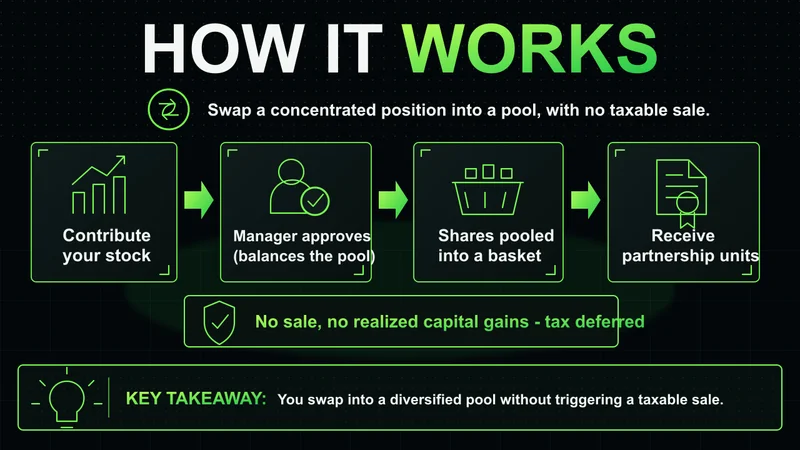
You apply to contribute your stock. The manager accepts or declines based on what the pool already holds — too much of one name or one sector, and the answer is no.
Your shares transfer into the fund, and you receive partnership units representing your stake in the whole basket. No sale, no realized gain.
The fund holds the pooled portfolio, plus the 20% qualifying-asset sleeve, for the duration. You report your share of fund-level income along the way.
After seven years, you can redeem your units for a diversified basket of stocks drawn from the fund — still tax-deferred, with your original basis spread across the new positions.
The seven-year mark is the hinge. Redeem early, and the structure works against you: most funds return your original shares — or your original shares minus fees — rather than cash. The concentration problem you paid to solve comes back fully intact.
Exchange fund vs exchange traded fund — not the same thing
The name collision causes real confusion, and almost nobody addresses it head-on. An exchange traded fund is a public vehicle: liquid, priced intraday, tradable for the cost of a commission, and available to anyone with a brokerage account. An exchange fund is the opposite on nearly every axis — private, illiquid, gated by wealth requirements, and built around a seven-year commitment.
If you are new to this and want the structure explained simply: an ETF is something you trade; an exchange fund is something you enter. One is an instrument, the other is an arrangement. A trader can be in and out of an ETF a dozen times in a session. An exchange fund position will likely outlast the account you bought it from.
An exchange fund example in the stock market
Consider a hypothetical early employee holding $3 million of one tech stock with a cost basis near zero. Selling outright could surrender more than 23% of the gain to federal taxes alone, before state taxes. Selling also converts a low-basis problem into a smaller portfolio — capital that compounds from a reduced base for the rest of its life.
Contributing those shares to an exchange fund changes the shape of the decision. The full $3 million keeps working inside a diversified pool. The single-stock risk drops immediately, the tax bill defers indefinitely, and after seven years the investor can walk away with a basket of names instead of one.
What the example hides is the path. For seven years, that capital is committed. A career change, a business opportunity, a market dislocation worth deploying into — none of it frees the money early without unwinding the entire benefit.
Where an exchange fund stops working
An exchange fund works while your goal is deferral and your timeline is genuinely long. It stops working the moment you need the capital inside the window. That is not a footnote risk — it is the central one, and it deserves the same weight as the tax math.
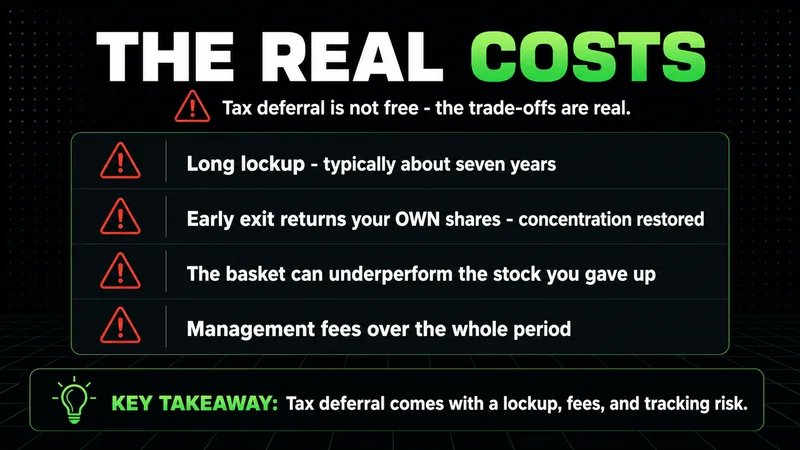
The full risk picture includes more than the lockup:
Early redemption typically returns your own shares, not cash — concentration restored, fees gone.
The pooled basket can underperform the stock you contributed, and watching that spread widen for seven years tests discipline in a way few investors price in ahead of time.
Management fees and the real-estate sleeve introduce costs and exposures you did not choose.
The basket's quality depends on what other investors contributed — you diversify into their positions, not into an index you selected.
Tax law can change. The structure survives at the discretion of a tax code that has already narrowed it more than once.
There is a discipline parallel here worth naming. Most traders are overleveraged without realizing it, and concentration is the buy-and-hold version of the same mistake — the difference shows up the first time a position that represents most of someone's net worth gets cut in half during an ordinary sector drawdown, and every decision that follows is made under stress. Keeping the capital intact has to come before optimizing the tax outcome, and an exchange fund is one of the few tools that addresses concentration without forcing a taxable exit.
"Diversification is protection against ignorance. It makes little sense if you know what you are doing." — Warren Buffett
Both halves of that line apply. If you have no view on your concentrated stock, diversifying through an exchange fund is rational risk control. If you hold the position with conviction and full awareness of the downside, the lockup may cost you more than the tax deferral saves.
A checklist before you commit capital
The most common mistakes beginners make with exchange funds are not analytical — they are timeline mistakes. A short checklist forces the right questions before the commitment, not after:
Can this capital stay untouched for seven years under realistic stress — job loss, relocation, a major purchase?
Does the tax deferral outweigh the fees over the full holding period, using your actual basis and your actual bracket?
Would you accept the fund's current basket if it were offered to you as a portfolio today?
Have you compared the alternative — selling in staged tranches across tax years — with real numbers?
Do you understand what early redemption returns to you, and what it costs?
If any answer is uncertain, the position size is probably too large for the structure, or the structure is wrong for the position.
Is an exchange fund right for you?
For investors holding a large, low-basis stock position with no need for the capital and no strong view on the underlying name, an exchange fund solves a genuine problem: it removes single-stock risk without handing a quarter of the gain to the tax bill. That is why the structure matters, and why it has survived decades of regulatory pressure.
For anyone who values liquidity, holds conviction in the stock, or cannot say with confidence where they will be in seven years, the math gets thinner. Deferral is not elimination, fees are certain while outperformance is not, and the exit is slow by design. The decision is less about the tax savings and more about whether your timeline can honor the commitment — which is a risk-management question, not a tax question.
Worth the read?