Initial Margin — What It Is and How It Limits Risk
Initial margin is the cash you deposit to open a leveraged trade. Here is how it works, how it is calculated, and how it sets your trading risk.
Initial margin is the cash or collateral you must put down to open a leveraged position. It is the minimum equity a broker or clearinghouse requires before it lends you the rest of the buying power. Think of it as your stake in the trade, set as a percentage of the full position size. The smaller that percentage, the more leverage you are using, and the faster the position can move against you.
Most explanations stop at the definition. That is a mistake. Initial margin is not regulatory trivia. It is the first number that decides how much risk you are actually carrying, long before your entry fills.
What initial margin actually is
The initial margin meaning is straightforward once you strip away the jargon. When you trade on margin, you borrow capital from your broker to control a larger position than your account alone could fund. The initial margin is the portion you fund yourself.
If you buy 15,000 dollars of stock at a 50% initial margin requirement, you deposit 7,500 dollars and borrow the other 7,500 dollars. Your money is the buffer. The broker's money is the leverage.
That buffer exists for a reason. It protects the broker against a position that turns against you, and it keeps real capital committed to every trade. You have skin in the game from the first tick.
Different markets set the requirement differently. For U.S. stocks, the Federal Reserve's Regulation T fixes the floor at 50% of the purchase price, and brokers can demand more but never less. Futures work on a smaller percentage, often in the single digits of contract value, which is why a futures position can swing your account so quickly. The asset decides the number.
How initial margin works and how it is calculated
The initial margin calculation is simple arithmetic. Take the full position value, multiply by the required percentage, and you have your deposit.
Say you want exposure to 20,000 dollars of a stock at a 50% requirement. The math is 20,000 times 0.50, or 10,000 dollars. You put up 10,000 dollars and the broker funds the rest. That is two-to-one leverage.
The percentage moves with the instrument and the conditions:
- Regulation T sets 50% as the baseline for marginable U.S. equities.
- Brokers raise the requirement on volatile or thinly traded names.
- Futures contracts post a much smaller initial margin relative to notional value.
- Requirements can rise during earnings or known event risk.
Here is what beginners miss. The initial margin is a one-time gate to open the trade, not the amount you can afford to lose. A sharp move can wipe out a large share of your deposit, because you are still responsible for the borrowed half. The borrowed capital has to be repaid regardless of how the trade ends.
Initial margin vs maintenance margin
These two terms get confused constantly, and the difference matters when a position moves against you.
Initial margin is what you post to open the trade. Maintenance margin is the minimum equity you must keep to hold that trade open afterward. Once your equity drops below the maintenance level, the broker issues a margin call and can liquidate your position.
| Initial margin | Maintenance margin | |
|---|---|---|
| When it applies | At trade entry | While the trade is open |
| Typical U.S. equity level | 50% (Regulation T) | 25% (FINRA minimum) |
| What triggers it | Opening a leveraged position | Equity falling below the threshold |
| Consequence of failing it | Trade cannot open | Margin call, possible forced liquidation |
The gap between the two is your room to be wrong. A 50% initial requirement and a 25% maintenance level mean a position can lose value before a margin call forces the issue. That cushion feels generous until volatility expands, at which point it disappears faster than most traders expect.
How initial margin shapes your trading risk
This is the part the textbook definitions leave out. The initial margin requirement is not just paperwork. It is a leverage governor, and it sets the size of your risk before you have placed a single stop.
A low initial margin lets you control a large position with little capital. That sounds efficient, but it is where most accounts get into trouble. The smaller your deposit relative to the position, the less the market has to move to threaten your equity.
Most traders are overleveraged without realizing it. If a single losing trade emotionally affects your decision-making, the position was too large for the account.
Treat the initial margin as a sizing input, not a green light. Before you open a leveraged trade, ask what a normal adverse move does to your equity, not just whether you cleared the deposit. A position that clears the initial margin can still be far too large for disciplined risk.
There is a condition where the buffer stops protecting you entirely. Initial and maintenance margin assume orderly markets where you can exit near your stop. In a gap, a halt, or a fast liquidation, price can jump straight through both levels before you act. The framework holds in normal conditions and breaks in exactly the moments you most need it. That is when overleveraged accounts do real damage.
Common initial margin mistakes new traders make
The rules around margin accounts are simple. The discipline to respect them is not. A few mistakes show up over and over.
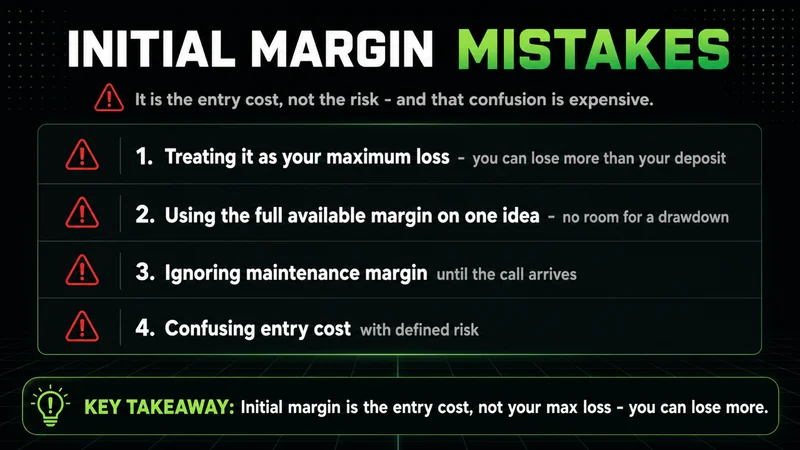
- Treating the initial margin as the maximum loss. It is the entry cost, not the risk. You can lose more than your deposit on a leveraged position.
- Using the full available margin on one idea, which leaves no room for a normal drawdown or a second opportunity.
- Ignoring maintenance margin until the call arrives, by which point your options have already narrowed to bad and worse.
- Assuming the requirement is fixed. Brokers raise margin on volatile names and around events, sometimes mid-trade.
- Confusing low margin with low risk. A smaller required deposit means more leverage, which means more risk, not less.
The through-line is simple. New traders treat margin as a way to trade bigger. Experienced traders treat it as a constraint they respect. The requirement is the floor the regulator and the broker enforce; your own sizing rule should sit well above it.
FAQs
What is initial margin in simple terms? It is the cash or collateral you deposit to open a leveraged trade, set as a percentage of the full position size. Your broker funds the rest. It is your committed stake in the position.
What is an example of initial margin? If you buy 15,000 dollars of stock at a 50% initial margin requirement, you deposit 7,500 dollars and borrow the other 7,500 dollars from your broker. Your 7,500 dollars is the initial margin.
How is initial margin calculated? Multiply the full position value by the required percentage. A 20,000 dollar position at 50% requires a 10,000 dollar initial margin deposit. The percentage depends on the asset and the broker.
What is the difference between initial margin and maintenance margin? Initial margin is what you post to open a trade. Maintenance margin is the minimum equity you must keep to hold it open. Falling below the maintenance level triggers a margin call.
Is initial margin important for beginners? Yes. It sets your leverage and therefore your risk from the first trade. Understanding it before you use a margin account is the difference between controlled exposure and an account-threatening position.
Keep building your foundation
Initial margin is one of the first numbers that decides how much risk you carry. Treat it as a sizing constraint, not a tool to trade bigger. From here, the natural next steps are leverage and margin trading, maintenance margin and margin calls, and position sizing with a defined risk-reward ratio. Each one builds on the same idea: protect capital first, and let the size of the trade follow the risk you can actually afford.
Worth the read?