Futures Explained — What They Are and How They Work
Futures are standardized contracts to buy or sell an asset at a set price on a future date. Here is how futures work, the real risks, and where to start.
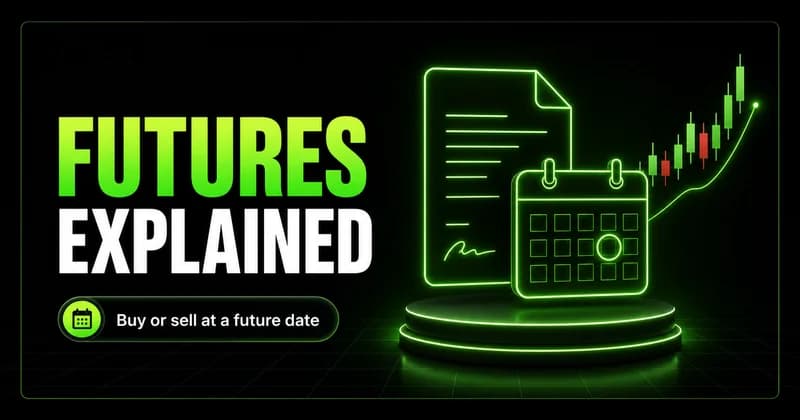
Futures are standardized contracts to buy or sell an asset at a set price on a set future date, traded on regulated exchanges. That is the whole definition. Everything else — leverage, margin, the appeal, the risk — follows from that one sentence. Most beginners skip the sentence and go straight to the leverage, which is usually where the trouble starts.
The futures market exists so that someone who needs price certainty can lock it in, and someone willing to take the other side can speculate on where price goes. A grain producer sells futures to fix a price before harvest. A trader buys or sells the same contract to participate in the move. Both use the same instrument for opposite reasons. Understanding that split is the foundation of futures trading basics, and it explains why these markets behave the way they do.
Futures meaning, in plain terms
A futures contract has four fixed parts: the underlying asset, the contract size, the expiration date, and the price agreed today. You are not buying the asset now. You are agreeing on terms now and settling later. When you go long, you profit if price rises before you exit. When you go short, you profit if price falls. Most retail traders never hold to expiration; they close the position before the contract settles and keep the difference.
The contract is standardized by the exchange, not negotiated between two people. That standardization is what makes the futures market liquid. Because every E-mini S&P 500 contract is identical, buyers and sellers can match instantly, and price discovery stays tight. Liquidity drives these markets more than opinions do, and standardization is what creates the liquidity.
How futures work in financial markets
The mechanism that defines futures is margin. You do not pay the full value of the contract to open a position. You post a deposit — the initial margin — and the exchange marks your position to market every day. Gains are credited and losses are debited against your account daily. This is the core of how futures work in financial markets, and it is why a small deposit controls a large notional position.
That daily settlement is also where leverage becomes real instead of theoretical. A single E-mini S&P 500 contract represents a notional value many times the margin required to hold it. The exposure is the full contract; the cash you put up is a fraction of it. Price moves against you, and the loss is measured against the full exposure, not the deposit. This is the part beginners underestimate most.
Leverage and margin are the same risk seen from two sides
Leverage is the upside framing. Margin is the downside framing. They describe one fact: your account moves with the full size of the contract while you have only posted a slice of it. A 1% move in the underlying can be a large percentage swing in your account. That cuts both ways, and it cuts faster than most new traders expect during volatile sessions.
The main risks of futures trading
The risks of futures are not exotic. They are the ordinary risks of any market, amplified by leverage and accelerated by daily settlement. The honest version of futures risk looks like this:
Leverage magnifies losses, not just gains. The same exposure that makes a good trade profitable makes a bad trade expensive. Position sizing matters more than entry.
Margin calls force decisions at the worst time. If your account drops below maintenance margin, you add funds or the position is liquidated, often near a local extreme.
Gaps and overnight moves skip your stop. Markets reprice on news while you sleep. A stop does not help if price opens past it.
Volatility expands without warning. A market that traded technically for hours can invalidate the entire structure within minutes on a macro headline.
Emotional sizing destroys accounts quietly. Most blowups happen gradually through oversized positions long before they happen suddenly.
Most traders are overleveraged without realizing it. A reliable test: if one losing trade affects your next decision, the position was too large. That is not a discipline slogan; it is the single most common reason new futures accounts do not survive their first volatile week.
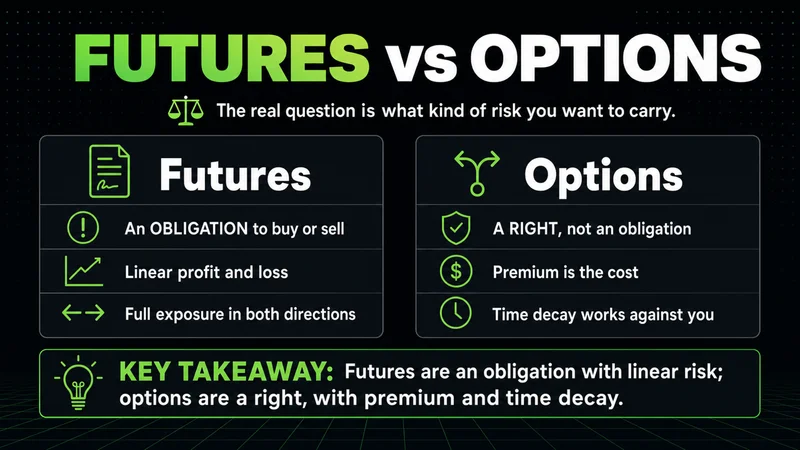
Futures vs options — which instrument fits your plan
Beginners often treat futures vs options as a feature comparison. The more useful question is what kind of risk you want to carry. The two instruments expose you to different problems, and the right choice depends on your plan, not on which one looks more powerful.
Aspect | Futures | Options |
|---|---|---|
Obligation | Both sides are obligated to the contract terms | Buyer has the right, not the obligation; seller is obligated |
Risk profile | Linear — loss tracks price one-to-one with leverage | Non-linear — affected by time decay and volatility |
Time sensitivity | No decay; value tracks the underlying | Loses value as expiration approaches, all else equal |
Typical use | Direct directional exposure and hedging | Defined-risk bets, premium strategies, hedging |
Beginner trap | Underestimating leverage | Underestimating how volatility and time erode a position |
Futures give you clean directional exposure with predictable mechanics. Options give you defined risk on a long position but add variables — time decay and implied volatility — that punish traders who only modeled direction. Neither is safer in the abstract. Futures vs options explained honestly is a question of which complexity you would rather manage.
Futures examples for beginner traders
Concrete cases make the mechanics clearer than definitions do. A few futures examples for beginner traders:
Index futures. The E-mini and Micro E-mini S&P 500 (ES, MES) and Nasdaq-100 (NQ, MNQ) let you trade the broad market directly. The Micro contracts are one-tenth the size, which is why most beginners start there — the same structure, a fraction of the risk per tick.
Commodity futures. Crude oil, gold (GC), and natural gas let traders participate in or hedge physical markets. Gold respects structure for hours and then invalidates a clean move within minutes when macro volatility expands.
Interest rate futures. Treasury and short-rate contracts react to policy expectations and are how institutions hedge rate exposure.
The pattern across all of them is identical: a standardized contract, a margin deposit, daily settlement, and a position you close before expiration. The asset changes; the mechanics do not.
Futures account requirements and getting started
The futures account requirements are lighter than most beginners assume, and that is part of the risk. To open and trade a futures account, you generally need three things:
A futures-enabled brokerage account with approval for the leverage the contracts involve.
Enough capital to meet initial and maintenance margin on the specific contracts you intend to trade.
A defined risk plan that sizes positions to the account, not to the margin minimum the broker allows.
Micro contracts have lowered the entry capital significantly, but lower margin does not mean lower risk per decision.
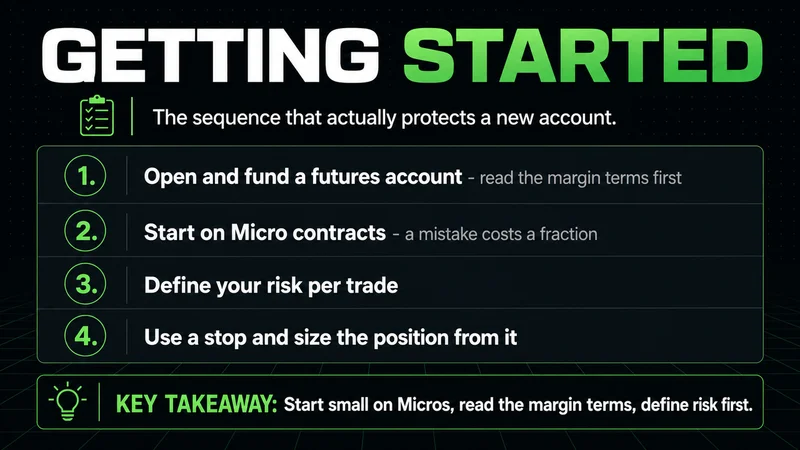
For futures trading basics step by step, the sequence that actually protects a new account looks like this:
Open and fund a futures-enabled brokerage account, and read the margin terms before the first trade.
Start on Micro contracts so a mistake costs a fraction of a full contract.
Define risk per trade as a fixed, small percentage of the account, and size the position to fit that — not the reverse.
Trade in a simulator until execution is consistent, then move to live with the same sizing.
Keep a record of every trade so the account teaches you what is actually working.
Protecting capital is the first objective. Consistency is built by surviving difficult periods, not by maximizing the good ones.
When futures are the wrong instrument for you
Futures are not universally appropriate, and the marketing rarely says so. The leverage that makes them efficient is the same leverage that ends accounts when the process behind the trade is unstable. If a single position size emotionally affects your decisions, the instrument is working against you regardless of the setup quality.
There is also a structural condition where the usual approach breaks down. Futures behave predictably in liquid cash-session hours, where order flow is deep and price discovery is orderly. Overnight, on thin liquidity, the same chart that read cleanly during the day means almost nothing — a small order can push price through levels that mattered in the session and trip stops that would have held in daylight. Traders who learned the instrument during regular hours and then carry size overnight discover this the hard way. The market does not care about effort or conviction; the risk exists whether it is acknowledged or not.
So the answer to whether futures suit you is not about the product. It is about whether your risk process is stable enough to survive leverage. For a trader with defined risk and the patience to wait for liquid conditions, futures are an efficient, transparent instrument. For a trader looking for fast recovery after a loss, they accelerate the damage.
FAQs
What are futures in trading? Futures are standardized contracts to buy or sell an asset at a set price on a set future date, traded on regulated exchanges. Traders use them to speculate on price direction, and businesses use them to lock in a price and hedge risk. Most retail traders close the position before expiration rather than settling the contract.
How do futures work in financial markets? You post a margin deposit instead of paying the full contract value, and the exchange marks your position to market every day, crediting gains and debiting losses. That daily settlement and the margin mechanism are what create leverage — a small deposit controls a large notional position.
Are futures good for beginner traders? They can be, if the trader starts on Micro contracts, defines risk per trade before sizing, and respects the leverage. Futures punish unstable process faster than slower instruments because losses are leveraged and settled daily. The instrument is fine; the discipline is the hard part.
What are the main risks of futures trading? Leverage magnifies losses, margin calls force liquidation at bad moments, overnight gaps can skip stops, and volatility can expand without warning. The most common real-world risk is emotional position sizing that is too large for the account.
What is the difference between futures and options? Futures obligate both parties to the contract terms and move one-to-one with price under leverage. Options give the buyer a right rather than an obligation but add time decay and volatility as variables. Futures carry linear risk; options carry non-linear risk.
What are the futures account requirements? You typically need a futures-enabled brokerage account, approval for the leverage involved, and enough capital to meet the margin on your chosen contracts. Micro contracts have lowered the capital needed, but lower margin does not reduce the risk of any single decision.
How do I choose which futures to trade for my plan? Match the contract to your capital and your risk tolerance, then start small. Micro index futures suit most beginners because they offer the same structure as full contracts at one-tenth the size, which keeps the cost of a mistake low while you build consistency.
Worth the read?