Liquidation in Trading — What It Is and Why It Happens
Liquidation in trading is the forced closure of a leveraged position when your account can no longer cover its losses. Here is how and why it happens.
Liquidation is the forced closure of a leveraged position when your account can no longer cover the losses on it. The broker or exchange steps in, sells what you hold, and ends the trade for you. It is not a penalty and it is not a warning. By the time liquidation runs, the decision has already been taken out of your hands.
Most traders meet liquidation the same way: too much size, a move against them, and an account that ran out of room before they did anything about it. The mechanism itself is simple. The reason it keeps happening is not.
What liquidation actually means
Liquidation in trading is the process where a broker or exchange closes your position because your margin can no longer support it. You borrowed buying power through leverage. When the loss on the trade eats into the collateral that backed that borrowing, the system closes the position to stop the loss from growing past what you posted.
This is the core liquidation meaning that the crypto-heavy explanations tend to bury: it exists to protect the counterparty, not you. Without it, a losing trader could owe far more than they deposited, and the venue would inherit unbounded credit risk. Forced liquidation is the line that keeps the whole structure solvent.
There are two ways a position ends. You close it, or the venue closes it. Voluntary liquidation is you selling to raise cash or step aside. Forced liquidation is the venue selling because your maintenance requirement was breached. The word is the same. The control behind it is not.
How leverage sets up the liquidation
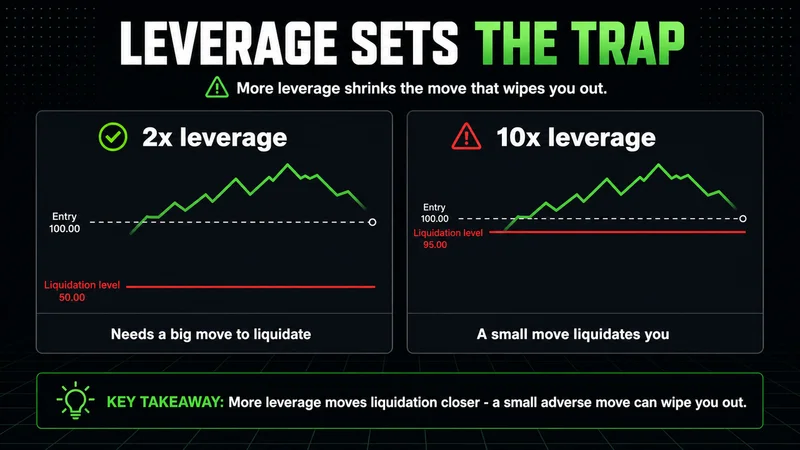
Leverage is the reason liquidation exists as a routine event rather than a rare one. It lets you control a position larger than your capital. That cuts both ways. The same multiplier that expands a gain expands the loss, and it shrinks the distance price has to travel before your margin is gone.
Think of it in plain terms. On 10x leverage, a 10% move against you wipes the margin behind the position. On 20x, a 5% move does it. The higher the leverage, the closer the liquidation price sits to your entry, and the less noise the market needs to reach it. Most traders are overleveraged without realizing it. If a single ordinary pullback can end the position, the size was already too large.
Volatility is the second input. A liquidation price that looks comfortable in a quiet range can be hit in seconds when volatility expands. Gold respects structure for hours and then invalidates the entire move within minutes during macro-driven conditions. A position sized for the calm tape does not survive the violent one.
How liquidation is calculated
The liquidation calculation comes down to one question: how far can price move against you before your equity falls below the maintenance margin requirement? Every venue frames it slightly differently, but the inputs are consistent.
Entry price — where the position was opened.
Position size and leverage — how much exposure sits on top of your collateral.
Maintenance margin — the minimum equity the venue requires you to hold against the position.
Mark price — the reference price the venue uses to value the position, often an index rather than the last trade, so a single bad print does not trigger you unfairly.
The liquidation price is the level at which your remaining equity equals the maintenance requirement. Work a simple long example. You enter at 100 with 10x leverage, so you post 10% of the notional as margin. If the maintenance requirement is 0.5%, price has to fall roughly 9.5% before your equity is exhausted and the position is closed near 90.50. Raise the leverage and that 90.50 climbs toward your entry. Lower it and the cushion grows.
The number matters because it is knowable in advance. You can read your liquidation price before you click, not after. Traders who get surprised by it almost never checked it.
Liquidation versus a margin call
Liquidation and a margin call are not the same event, and treating them as one is how people lose the chance to act. A margin call is the warning. Forced liquidation is the consequence.
Margin call | Forced liquidation | |
|---|---|---|
What it is | A demand to add funds or reduce size | The venue closing the position for you |
Timing | Before the breach is fatal | At or past the maintenance threshold |
Your control | You can still act | The decision is already made |
Outcome | Position survives if you respond | Position is closed at market |
In fast markets the gap between the two collapses. A margin call assumes there is time to respond. When volatility expands and price gaps through your level, the venue may liquidate with no usable warning at all. NQ rewards discipline and punishes hesitation immediately, and a margin call in that environment can arrive and resolve faster than a trader can fund it. The lesson is to manage the position so a margin call is rare, because the version where you get a polite warning and a comfortable window is not the version the market always offers.
When liquidation does not behave the way the textbook says
The clean account of liquidation assumes an orderly market with depth on the other side. That assumption breaks exactly when it matters most. In a thin or one-sided tape, the venue's forced sell finds no bids near your liquidation price, so it fills lower, and your loss runs past what the maintenance math implied. On the worst days this chains: forced selling pushes price down, which triggers the next account, which forces more selling. The liquidation cascade is the textbook calculation failing in aggregate. Your liquidation price is a target, not a guarantee, and in disorderly conditions it is the floor of your loss, not the ceiling.
How to keep liquidation off the table
Avoiding liquidation is mostly about the decisions made before the trade, not the scramble during it. Risk management matters more than entries. A mediocre entry with controlled size survives a bad day. A perfect entry with oversized leverage eventually ends in a forced close.
Size so an ordinary move cannot reach your liquidation price. Keep that level far enough away that normal volatility does not touch it.
Use a stop-loss inside your liquidation price. Your own exit should trigger first, on your terms, at a price you chose, rather than the venue's forced fill at whatever the book offers.
Lower leverage before you raise it. Less leverage pushes the liquidation price further from entry and buys room when volatility expands.
Check the liquidation price before entry, not after. It is knowable in advance. Read it, and reject any trade where it sits inside the range price moves through on a normal session.
Most traders do not have a strategy problem. They have a discipline problem. Liquidation is rarely a knowledge failure. It is a sizing decision made under pressure, defended after the fact.
FAQs
What is liquidation in trading? It is the forced closure of a leveraged position when your account equity falls below the maintenance margin required to hold it. The broker or exchange sells the position to stop the loss from growing past the collateral you posted.
What is the difference between liquidation and a margin call? A margin call is a warning that your equity is running low and you need to add funds or cut size. Forced liquidation is what happens when that threshold is breached and the venue closes the position for you. The margin call comes first, when you can still act.
How is the liquidation price calculated? It is the price at which your remaining equity equals the maintenance margin requirement. The main inputs are your entry price, position size, leverage, and the venue's maintenance margin. Higher leverage moves the liquidation price closer to your entry.
Can liquidation make me lose more than I deposited? On most retail venues, mechanisms are designed to close you before that happens, but in fast or illiquid markets a forced fill can land well past your liquidation price. In those conditions the loss can exceed the maintenance math, which is why disorderly markets are the real danger.
How do beginner traders usually get liquidated? Almost always through size. They take more leverage than the position warrants, the liquidation price sits close to entry, and an ordinary move reaches it before they react. It is a risk decision, not a market surprise.
Is understanding liquidation important for beginners? Yes. Any trader using leverage is exposed to it from the first position. Knowing where your liquidation price sits, and sizing so normal volatility cannot reach it, is core risk management, not an advanced topic.
Worth the read?