Margin Explained for Beginners — What It Really Is
Margin is the collateral a broker requires to hold a leveraged position. Here is what margin really is, how it works, and the risk beginners miss.

Margin is the cash a broker requires you to put up to open and hold a leveraged position. It is not the cost of the trade and it is not money you spend. It is collateral, a deposit the broker holds against the borrowed exposure you control. Understand that one distinction and most of the confusion around margin disappears.
Most beginners meet margin the wrong way. They see it as a feature that lets them trade larger, treat it as free buying power, and only learn what it actually does when a losing position eats through their deposit faster than they expected. Margin does not change the market. It changes how much of the market a small account can carry, and that is exactly why it deserves more attention than it usually gets.
What margin actually means in trading
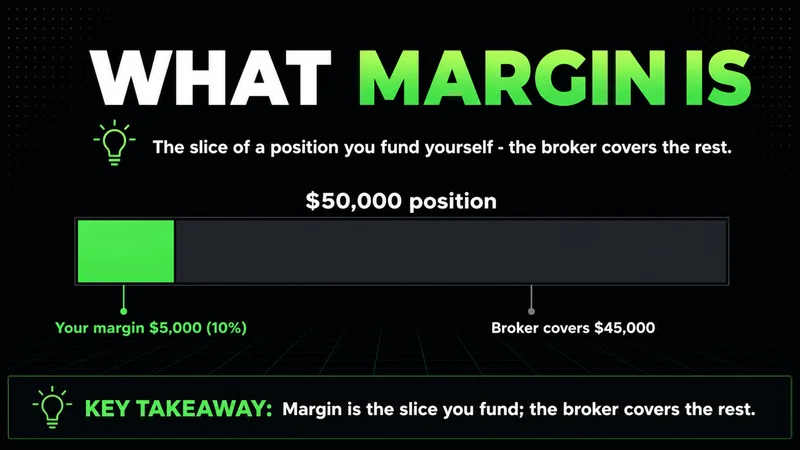
Margin meaning comes down to one idea: it is the portion of a position's full value that you fund with your own capital, while the broker effectively covers the rest. If a position is worth 50,000 dollars and the margin requirement is 10 percent, you post 5,000 dollars and the broker extends the exposure on the other 45,000.
That 5,000 dollars is not a fee. It sits in your account as collateral. If the trade works, the gains and losses are calculated on the full 50,000 of exposure, not on the 5,000 you posted. This is the core mechanic, and it is why margin feels powerful and dangerous at the same time.
Two numbers matter from the start. Initial margin is what you need to open the position. Maintenance margin is the lower amount you must keep in the account to hold it open. Drop below maintenance and the broker issues a margin call, which is a demand to add funds or reduce the position. Ignore the call and the broker can close the trade for you at the prevailing price, whether or not that price suits you.
How margin works in trading
Margin works by separating the capital you control from the capital you own. You own the deposit. You control a position many times larger. The broker is comfortable with this because the maintenance requirement and the margin call give it a mechanism to close the position before your losses exceed your collateral.
Think of it in sequence. You post initial margin and open the trade. The position's value moves with the market, and your account balance moves with it on the full exposure. As long as your equity stays above maintenance margin, nothing happens. When equity falls toward that line, the broker warns you. Below the line, the position is at risk of forced liquidation.
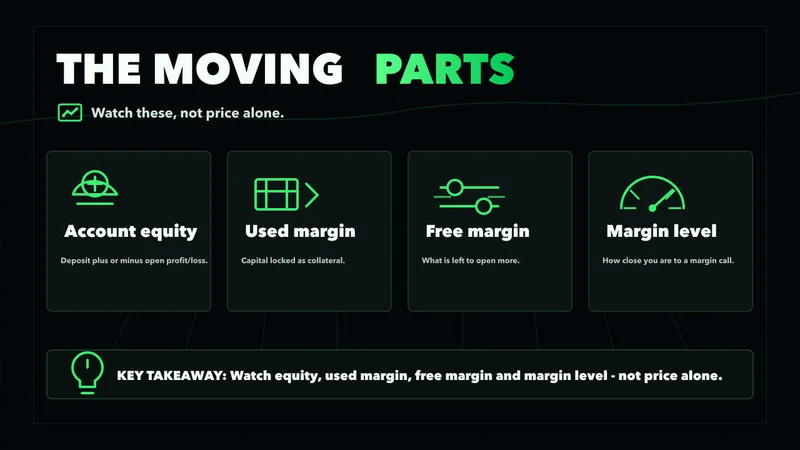
A few moving parts decide how close you are to that line at any moment, and it helps to keep all of them in view rather than watching price alone:
Account equity, which is your deposit plus or minus the open profit and loss on the full position.
Used margin, the portion of your capital locked as collateral against the positions you already hold.
Free margin, the equity left over that can absorb an adverse move or open another position.
Margin level, the ratio of equity to used margin that the broker watches and that triggers the call when it falls too far.
The part beginners underestimate is speed. Because losses are calculated on the full position, a small adverse move against a large exposure can erase a meaningful slice of a small deposit in minutes. The market does not need to crash. It only needs to move against a position that margin made larger than the account could otherwise carry.
A margin example for beginner traders
A margin example for beginner traders makes the mechanics concrete. Say you want exposure to 1,000 shares priced at 50 dollars each. The full value is 50,000 dollars. With a 50 percent initial margin requirement, you post 25,000 dollars of your own capital and the broker covers the remaining 25,000.
If the price rises to 55 dollars, the position is worth 55,000 dollars. You made 5,000 dollars on a 25,000-dollar deposit, a 20 percent return on your capital, even though the stock itself only moved 10 percent. That is the appeal, and it is real.
Now run it the other way. The price drops to 45 dollars. The position is worth 45,000 dollars, a 5,000-dollar loss on your 25,000 deposit. The stock fell 10 percent. Your capital fell 20 percent. The amplification cuts both directions with no discrimination, and the loss column is where most beginners stop paying attention too late.
Push the same example to a lower margin requirement and the picture sharpens. At a 10 percent requirement, that 50,000-dollar position needs only 5,000 dollars of your capital. The same 10 percent drop in the stock is still a 5,000-dollar loss, but now it has wiped out your entire deposit. Identical market move, identical position, ten times the damage to your account, purely because the requirement let you carry the position on less collateral. The instrument did nothing different. The margin did.
How to handle margin calculation and requirements
Margin calculation is straightforward once you know the requirement your broker and the instrument set. The margin requirement is the percentage of the full position value you must post. Multiply the position's notional value by that percentage to get the capital you need.
For a 50,000-dollar position at a 10 percent requirement, the calculation is 50,000 multiplied by 0.10, or 5,000 dollars. At a 20 percent requirement, the same position needs 10,000 dollars. The smaller the requirement, the larger the position a given deposit can control, and the more sensitive your account becomes to each tick.
Requirements are not fixed across the board. They differ by asset class, by instrument, by broker, and by market condition. The table below shows how the same 50,000-dollar position changes capital needs as the requirement moves.
Position value | Margin requirement | Capital you post | Effective leverage |
|---|---|---|---|
50,000 | 50% | 25,000 | 2x |
50,000 | 20% | 10,000 | 5x |
50,000 | 10% | 5,000 | 10x |
50,000 | 5% | 2,500 | 20x |
Notice what the right-hand column is telling you. A lower requirement is not a discount. It is more leverage, which means more risk per dollar of deposit. Brokers also raise requirements when volatility expands, so the buffer you sized in calm conditions can shrink exactly when the market turns difficult.
Maintenance margin is the calculation beginners forget until it matters. Initial margin gets you into the position; maintenance margin keeps you in it. If the maintenance requirement is 25 percent and your position is worth 50,000 dollars, your equity must stay above 12,500 dollars or the broker issues a call. Work the example: you opened the 50,000-dollar position with 25,000 dollars of your own capital, so you have a 25,000-dollar cushion above the maintenance line. The position would need to lose about 12,500 dollars, a 25 percent adverse move on the full value, before equity touches maintenance and the call arrives. The smaller your initial cushion, the sooner that line is reached, which is the entire reason low-requirement positions feel fine right up until they do not.
Margin vs leverage — the difference that matters
Margin vs leverage trips up almost every beginner because the two are bound together but are not the same thing. Margin is the deposit. Leverage is the multiple of exposure that deposit lets you control. They are two views of one relationship.
A 10 percent margin requirement is the same as 10x leverage. A 50 percent requirement is 2x leverage. When you read margin as a percentage and leverage as a ratio, you are describing the identical position from opposite ends. Lower the margin requirement and leverage rises automatically.
The practical point is this. Traders argue about leverage as if it were the risk, but leverage is just arithmetic. The risk lives in position size relative to your account and in where your invalidation sits. Margin is simply the gate that determines how much size a small account can reach. Treat the two as one decision, not two.
What you can trade on margin, and why the requirement changes
Margin is not one fixed number. The requirement attached to a position depends heavily on what you are trading, because different instruments carry different volatility and different rules. Knowing where your instrument sits tells you how much room for error a given deposit actually buys.
Stocks bought on margin in the United States generally fall under a 50 percent initial requirement, which works out to roughly 2x leverage. The requirement is set by regulation rather than by appetite.
Index and equity futures use a performance-bond model, where the exchange sets a margin per contract that is small relative to the contract's notional value. The effective leverage is far higher, and the requirement can change between sessions.
Foreign exchange typically carries the lowest requirements of the common asset classes, which is exactly why retail forex accounts blow up so often. The leverage on offer outruns most beginners' risk control.
Highly volatile or thinly traded instruments draw higher requirements, because the broker is pricing in the chance of a fast move against the collateral.
The takeaway is not to chase the lowest requirement. A 5 percent requirement on a fast instrument does not make the trade safer; it just lets you carry a larger position against the same deposit. The requirement is a measure of how much the market can move before your collateral is at risk, not an invitation to use all of it.
How margin affects trading risk
Here is where the futures and index side of trading earns its respect. Margin risk is not really about the borrowing. It is about position size that the borrowing makes possible. Most traders are overleveraged without realizing it, because they size off the margin they can post rather than the loss they can absorb.
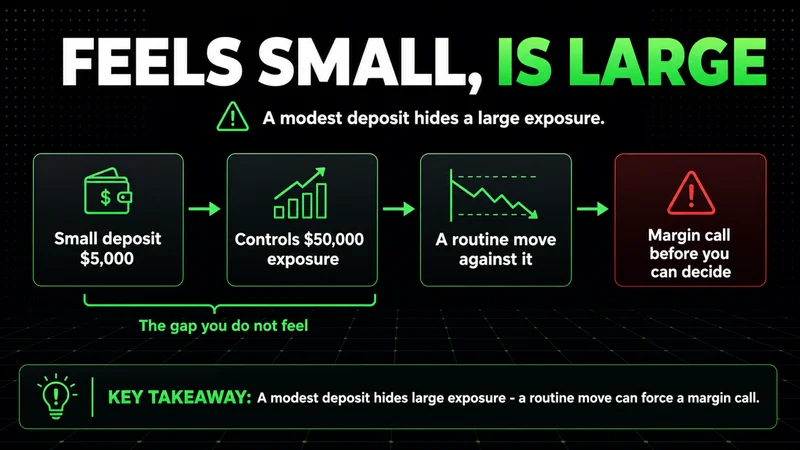
The quiet danger is the gap between feeling small and being large. You posted a modest deposit, so the trade feels modest. The exposure is anything but. On a fast instrument, a routine move against a margin-sized position can trigger a margin call before you have finished deciding whether your thesis is still valid. The account, not the chart, forces the exit.
There is a second-order effect that beginners rarely price in. When a position is sized off margin rather than off risk, the emotional weight of each tick climbs with it. A position that is too large makes patience impossible, because every adverse move threatens the account rather than a planned, survivable loss. The decision-making degrades precisely when it needs to be sharpest. If a single losing trade can affect how you size the next one, the position was already too large, and margin is usually the reason it got there.
This is the condition where the standard "margin amplifies returns" framing breaks down. In calm, liquid hours, margin behaves predictably and a stop placed at logical structure does its job. During a volatility expansion or a thin overnight session, the same position can gap straight through your intended exit, and the broker's forced liquidation lands at a worse price than your plan ever assumed. Margin does not protect you from gaps. It just makes the gap more expensive on a larger position. Size for the bad session, not the calm one.
The most common way a new account dies is not one dramatic loss. It is a sequence of margin-sized positions that each felt reasonable, sized off available margin instead of acceptable risk, compounding quietly until one ordinary move finishes the job.
Margin account rules every new trader should know
Margin account rules exist because the broker is lending you exposure and wants a clear path to protect itself. Knowing them before you trade keeps the rules from surprising you mid-position.
You must open and be approved for a margin account; a standard cash account cannot borrow.
Initial margin sets what you need to open a position, and maintenance margin sets the minimum equity to keep it open.
A margin call is a demand to restore equity, by adding funds or cutting the position, and it is not optional.
If you do not meet a margin call, the broker can liquidate your positions without further consent, at the market price available.
You pay interest on borrowed funds for as long as a leveraged position stays open, so time in the trade has a cost.
None of these rules are negotiable in the moment. They are the terms you accept when you open the account, and the worst time to read them for the first time is during a margin call.
Common margin mistakes beginners make
Common margin mistakes beginners make share one root cause: confusing the deposit with the risk. The deposit is small, so the risk feels small, and the position size drifts far past what the account can survive.
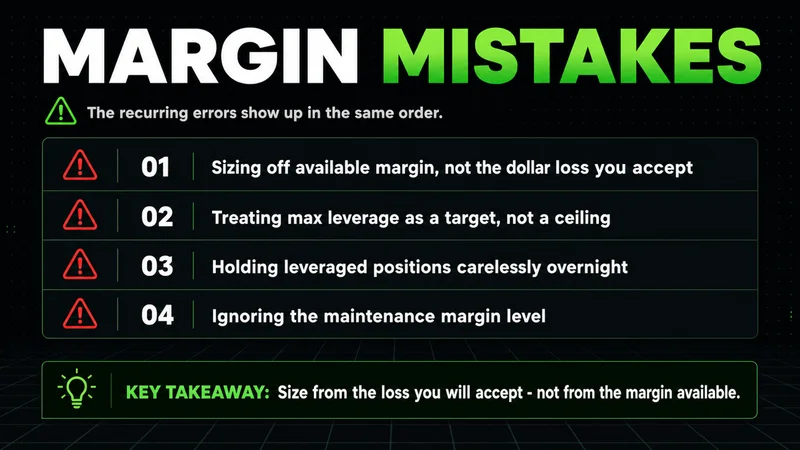
The recurring errors are predictable, and they tend to show up in the same order:
Sizing positions off available margin instead of off the dollar loss you can accept on the trade.
Treating the maximum leverage a broker allows as a target rather than a ceiling you rarely approach.
Holding leveraged positions overnight without accounting for gap risk and the interest that accrues.
Adding to a losing margin position to lower the average, which only enlarges the exposure already moving against you.
Watching profit and loss instead of margin level, so the first real warning is the margin call itself.
Each of these turns margin from a tool into a liability. They are not exotic mistakes; they are the default behavior of an account that sized off buying power. Most blown accounts do not come from a single bad call. They come from a string of these, each one survivable on its own, compounding until an ordinary move finishes the account.
The fix is not complicated, though it requires discipline. Decide the dollar amount you are willing to lose on the trade first. Work backward to a position size that respects it. Let the margin requirement tell you whether you can afford that size at all, rather than letting it tell you how large you are allowed to go.
When should traders use margin, and a checklist before you do
When should traders use margin is a fair question, and the honest answer is: rarely, deliberately, and only after the basics are automatic. Margin is appropriate when you have a defined invalidation, a position size set by risk rather than by buying power, and the experience to act on a margin call without freezing. Until then, it adds speed to mistakes you are still making.
There is also a question of whether margin is important for beginners at all, and the answer is mostly no. The skills that make margin survivable, consistent sizing, patience during low-quality conditions, and acting on a plan rather than on emotion, are exactly the skills a beginner is still building. Margin does not teach those skills. It tests them, with real money, at a speed that punishes the gaps. The traders who use margin well almost always learned to trade without it first, then added it once their risk control was reliable. Reaching for margin early usually means importing a professional tool before the process that makes it safe exists.
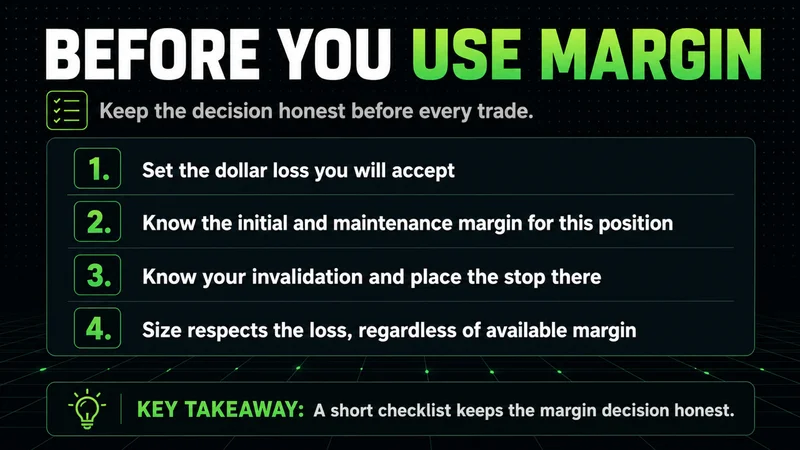
A short margin checklist for new traders keeps the decision honest before every trade:
Have I set the dollar loss I will accept, and does my size respect it regardless of available margin?
Do I know the initial and maintenance margin for this exact position?
Where is my invalidation, and is my stop placed at structure rather than at the margin-call level?
Have I accounted for gap risk, overnight exposure, and interest if I hold the position?
If a margin call hit right now, do I already know whether I add funds or cut the position?
If you cannot answer all five before entering, the trade is not ready and neither is the margin. The checklist is not bureaucracy. It is the difference between using margin and being used by it.
FAQs
What is margin in trading in simple terms? It is the collateral a broker requires you to deposit to open and hold a leveraged position. You post a fraction of the position's full value, the broker extends the rest as exposure, and gains and losses are calculated on the full amount.
What is the difference between margin and leverage? Margin is the deposit expressed as a percentage of the position; leverage is the multiple of exposure that deposit controls. A 10 percent margin requirement is the same as 10x leverage, just described from the other side.
How does margin work with a simple example? If you post 25,000 dollars at a 50 percent requirement, you control a 50,000-dollar position. A 10 percent move in the asset becomes a 20 percent move in your capital, up or down, because the result is figured on the full 50,000.
What is a margin call? It is a broker's demand to restore your account equity once it falls below the maintenance margin. You either add funds or reduce the position. If you do neither, the broker can close your positions at the market price.
How do you calculate margin requirements? Multiply the position's full notional value by the margin requirement percentage. A 50,000-dollar position at a 10 percent requirement needs 5,000 dollars of your own capital to open.
Is margin risky for beginners? It amplifies both gains and losses on the full position, so a small adverse move can cut deeply into a small deposit. The risk is not the borrowing itself but the oversized position the borrowing makes possible.
When should a trader use margin? Only after position sizing by risk, defined invalidation, and acting on margin calls have become routine. Until those are automatic, margin mostly adds speed to mistakes still being worked out.
Do you pay to use margin? Yes. You pay interest on the borrowed portion for as long as the leveraged position stays open, which means holding a margin trade longer carries an ongoing cost beyond the market risk.
Worth the read?