Overconfidence Makes Winning Streaks Fragile
Overconfidence after winning streaks often creates the next drawdown. Learn how fixed sizing, streak tracking, and process review protect gains.
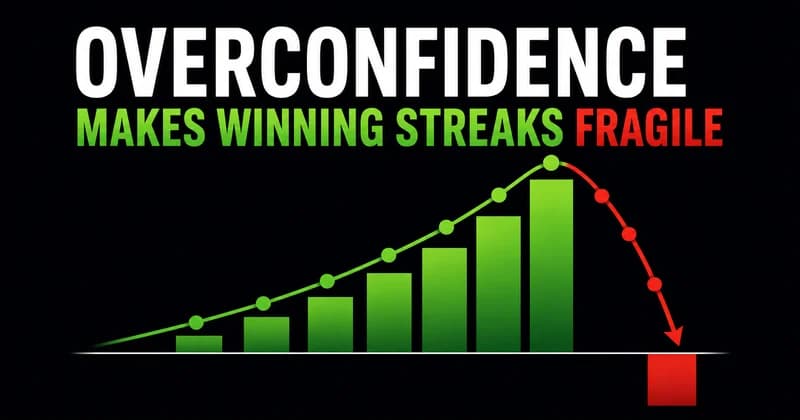
Overconfidence in trading usually appears after success, not failure. A winning streak makes the trader feel sharper than the process. Size increases, rules loosen, and the next loss lands on risk that should never have been expanded.
Winning Streaks Become Dangerous When Behavior Changes
A strong week can create a false sense of control. Five winners in a row feel meaningful because they are recent, visible, and emotionally satisfying. The trader starts to believe the market is being read better than usual.
That is where overconfidence begins. The next trade is a little larger. The entry criteria become more flexible. A new instrument suddenly looks tradable. Risk feels less important because recent outcomes have been positive.
Common signs include:
Position size increasing during a streak without a rule-based reason
Entry standards loosening because the trader feels in sync with price
Trading strategies or instruments that have not been tested
Dismissing downside because recent trades worked
Taking more setups than normal because confidence is high
The issue is not confidence itself. Traders need enough confidence to execute. The problem is confidence that comes from recent P&L instead of process quality.
Short-Term Success Is Often A Small Sample
Barber and Odean's research from 2000 is central to the source article. The dataset covered 66,465 households. In that work, the highest-activity traders finished 6.5% per year behind the market, a result tied to excess confidence and unnecessary trading.
Related work reached a similar point from another angle: men placed 45% more trades than women and gave up 1.4% in annual returns, with overconfidence identified as the main explanation. The lesson is not that activity is always bad. The lesson is that activity driven by conviction beyond the evidence is expensive.
Short streaks are especially misleading. A trader with a long-term 52% win rate across 500 trades can still win five in a row. Those five trades feel more real because they just happened, but they do not override the larger sample.
The source also notes that in a 55% system, a five-trade winning streak is not extraordinary. It may appear roughly once every 30-40 trades. Treating that normal variance as proof of special insight is how size creep begins.
Attribution Bias Inflates The Trader's Story
Overconfidence grows through attribution bias. Winning trades are credited to skill. Losing trades are explained as bad luck, market unfairness, or unusual conditions. Over time, the trader's internal story becomes cleaner than the actual record.
Recency effect supports that story. The last five winners feel more important than the last 500 trades. Internal survivorship bias adds another layer. The trader remembers the bold decisions that worked and forgets the confident decisions that failed.
Skill and luck are difficult to separate in short windows. Trading outcomes are noisy. A correct process can lose, and a poor process can win. If the trader evaluates skill only by recent P&L, the wrong behaviors get reinforced.
The Dunning-Kruger effect is especially dangerous for newer traders. Early success can create enough knowledge to take risk without enough experience to respect what risk can do. That period can be expensive because confidence is high while risk-management skill is still developing.
Size Creep Turns Normal Losses Into Drawdowns
The source explains the asymmetric effect with R-multiples. With normal sizing, five wins at +1R and one loss at -1R produce +4R net. With overconfident sizing, the same five +1R wins followed by one oversized -3R loss produce only +2R.
The strategy did not need to fail for the outcome to deteriorate. The trader changed risk exposure after the streak.
That is why overconfidence often explains the largest single-trade losses. The losing trade arrives at the exact moment when the trader feels most justified in expanding size. One poor decision then gives back a large part of the week.
The fix is to keep sizing independent of emotional state. If the plan says risk 1% per trade, the next trade uses that formula whether the last five trades won or lost. Position size should come from account size, setup rules, and predefined risk, not from the feeling of being “locked in.”
Streak Awareness Should Reduce Risk, Not Expand It
Streak tracking is useful because it shows when behavior changes. Some traders use a rule that after three or more wins, the next trade must be standard size or smaller. The point is not that the next trade is more likely to lose. The point is that the trader is more likely to mismanage it.
Expectancy recalibration helps. Keep historical stats visible. If the system wins 55% of the time, the trader should expect losses even after a strong run. A losing trade after a streak is not a betrayal. It is part of the distribution.
Process review matters more than outcome review. A winning trade taken outside the rules should be marked as poor execution. A losing trade taken inside the rules should be marked as acceptable. This separates self-worth from P&L and prevents lucky wins from training bad behavior.
External accountability can help when the urge to expand risk appears. A mentor, trading partner, or written rule set can interrupt the emotional logic that says a streak has earned bigger size.
Journal Data Exposes Overconfident Risk
Track position size variance. Compare actual risk against the rule-based risk that should have been used. Then filter by consecutive wins. If size increases after streaks, the issue is visible.
Useful reviews include:
Performance on trades after three or more consecutive wins
Average position size during streaks versus normal periods
Rule compliance after strong days or weeks
Trade frequency during profitable periods
Largest losses and whether they followed recent wins
The source recommends comparing performance after winning streaks against overall performance. This is the right question. If post-streak trades are larger, looser, or less profitable, the trader has a behavioral leak.
A boolean checklist can also help. Mark whether position-sizing rules were followed on every trade. Then filter plan-followed versus plan-broken results. The real cost of overconfidence becomes clearer when it is tied to specific broken rules, not vague memory.
Most traders do not need more confidence after a winning streak. They need more respect for variance.
The Best Protection Is Boring Consistency
Overconfidence wants each winning streak to mean something special. A professional process treats it as part of distribution. The trader can acknowledge good execution without allowing recent P&L to rewrite the risk model.
That means the same checklist, the same size formula, and the same invalidation standard after a strong week. If the next trade only looks attractive because the trader feels invincible, it is not a better setup. It is a weaker decision wearing the emotion of recent success.
FAQs
Why do winning streaks lead to large losses? Winning streaks can make traders increase size, loosen entry standards, and underestimate risk. When the next losing trade arrives, it often lands on an oversized position.
How do I know if I am overconfident? Watch for size creep, more trades than usual, new instruments outside the plan, weaker entry criteria, and dismissing downside because recent trades went well.
Should I reduce size after winning streaks? Some traders do. At minimum, size should not increase just because of recent wins. Fixed or reduced size after three or more wins can help prevent emotional risk expansion.
How should I judge skill versus luck? Use larger samples. Review 100 or more trades, compare results against expectancy, and grade each trade by process compliance rather than P&L alone.
Overconfidence is controlled by keeping risk boring. The trader does not need to predict when the streak ends. The trader needs to make sure the end of the streak does not carry more risk than the plan allows.
Worth the read?