Reversal Trading Strategy — Why Most Entries Fail
A reversal trading strategy enters as a trend exhausts and turns, but most reversal entries fail because traders act on weakness before structure breaks.

A reversal trading strategy is a method for entering as a trend exhausts and price turns the other way. The idea is simple: catch the turn early, before the crowd, and ride the new direction. In practice, most reversal entries fail for one reason. Traders act on the first sign of weakness instead of waiting for structure to actually break.
That gap between a weak candle and a confirmed turn is where accounts get hurt. A market can look exhausted for hours and keep going. Selling pressure shows up, fades, and the trend resumes. The skill in reversal trading is not spotting weakness. Weakness is everywhere. The skill is waiting for the market to prove the turn is real before you commit risk.
This piece breaks down what a reversal actually is, how to separate it from a routine pullback, how to confirm one before you enter, and the exact conditions that turn a clean-looking setup into a trap.
What a reversal trading strategy actually is
A reversal is a change in the prevailing direction of price. An uptrend that stops making higher highs and starts making lower lows has reversed. A downtrend that stops making lower lows and begins making higher highs has reversed. Everything else is noise inside the existing trend.
A market reversal comes in two forms. A bullish reversal turns a downtrend into an uptrend, where sellers lose control and buyers take over. A bearish reversal turns an uptrend into a downtrend, where the buyers driving price up run out and sellers step in. The reversal trading strategy in both cases is the same in logic: identify exhaustion in the current trend, wait for confirmation that control has changed hands, then enter in the new direction with risk defined against the level that would prove you wrong.
What it is not is a prediction. You are not calling a top or a bottom because price feels stretched. Stretched markets stay stretched. A reversal strategy is reactive, not predictive. You wait for the market to show that the prior trend has failed, and then you respond. The trader who needs to be early usually ends up being wrong.
Reversal versus pullback — the distinction that decides everything
Most losing reversal trades are not reversals at all. They are pullbacks the trader mislabeled. This single distinction decides how you size, where you place your stop, and whether you should be in the trade at all.
A pullback is a temporary move against the trend that respects structure. Price dips, holds a higher low, and continues. A reversal breaks structure. Price takes out the prior swing that the trend was built on and fails to reclaim it. The mechanical difference is whether the last protected level holds or breaks.
Here is the practical test:
- In an uptrend, a pullback holds the most recent higher low. A reversal breaks below it and stays below.
- In a downtrend, a pullback holds the most recent lower high. A reversal breaks above it and holds.
- If the broken level is reclaimed quickly, it was a pullback wearing a reversal costume.
Trading a reversal that is really a pullback means fighting the trend at the worst possible spot, right before it resumes. Most "the trend is over" entries are this exact mistake. The trend pauses, the trader reads the pause as a turn, and price continues without them. Knowing which one you are looking at is the difference between a counter-trend scalp and standing in front of momentum.
How to identify a trend reversal before you commit
Identifying a trend reversal is a sequence, not a single signal. The trend reversal strategy that survives contact with a live market reads structure first and candles second.
Start with the trend itself. Mark the swing highs and swing lows. As long as the sequence continues, the trend is intact and a reversal has not happened yet. The first real clue is a failure to continue: an uptrend that can no longer make a higher high, or a downtrend that can no longer make a lower low. That stall is not a reversal. It is permission to start watching.
The next clue is momentum fading underneath price. A bearish reversal often shows the final push to a new high happening on weaker momentum than the push before it. Buyers are still in control on the surface, but with less force each time. This divergence between price and momentum is a warning, not an entry. Plenty of divergences resolve by the trend simply continuing.
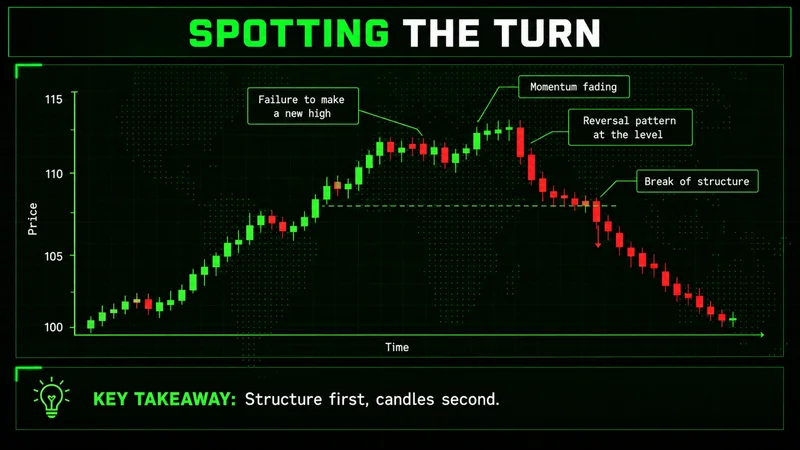
Then comes the reversal pattern at the level. Candlestick patterns matter here, but only in context. An engulfing candle, a hammer, or a rejection wick at a level where the prior structure breaks carries weight. The same candle in the middle of nowhere carries almost none. The pattern is the trigger; the broken structure is the reason.
Confirming the reversal before the entry
Reversal confirmation is the step most traders skip, and it is the one that separates a strategy from a guess. Confirmation means the market has done something that the old trend should not be able to do if it were still in control.
The cleanest confirmation is a break of structure followed by acceptance. Price breaks the level that defined the trend, then trades and holds beyond it instead of snapping back. A reversal entry taken after that hold is built on evidence. A reversal entry taken on the first touch of the level is built on hope.
The reaction after price reaches a level matters more than the level itself.
Acceptance is the word that does the work. A single candle through a level proves nothing; markets poke through levels constantly and reverse. Acceptance is price spending time beyond the broken level and building new structure there. When a downtrend breaks its last lower high and then forms a higher low above it, that higher low is the confirmation. It is also where your risk goes. The entry sits above structure that the market just built, with invalidation at the point that would put the old trend back in control.
Trading reversals at support and resistance
Support and resistance give a reversal strategy something most setups lack: a predefined level where the decision happens. Reversals do not occur at random prices. They cluster at levels where the prior move runs out of participants.
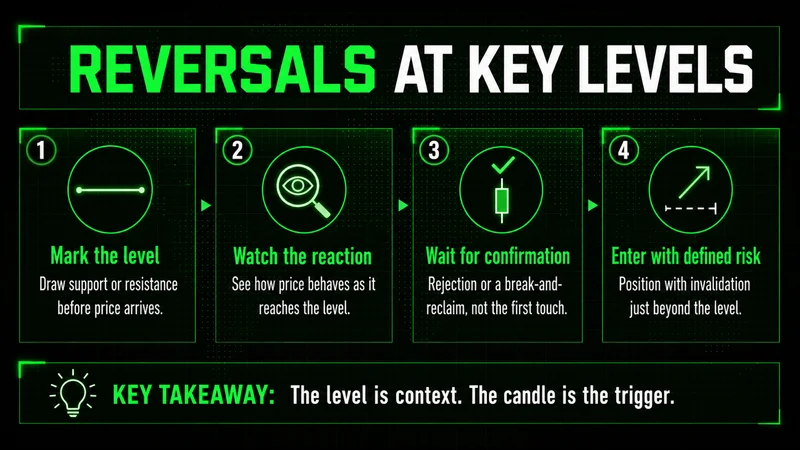
Reversal trading with support and resistance follows a clean order of operations. Identify the level before price arrives, not after. Watch how price behaves as it reaches the level, rather than assuming the level will hold. Wait for rejection or a break-and-reclaim that confirms the level is doing its job. Then enter with risk defined just beyond the level.
The level is the context. The candle is the trigger. A hammer at a support zone that has already held twice means more than the same hammer in open space. When price approaches a major level, you are not predicting the reaction. You are waiting to see whether buyers or sellers actually defend it, and positioning only after they show their hand.
When the reversal is a trap — and the level that proves it
This is where reversal trading earns its reputation for chewing up beginners. Reversal setups produce more false signals than trend-following setups, because the entire premise is betting against the direction price is currently moving. A reversal strategy works cleanly when a level breaks and holds. It inverts the moment that break gets reclaimed.
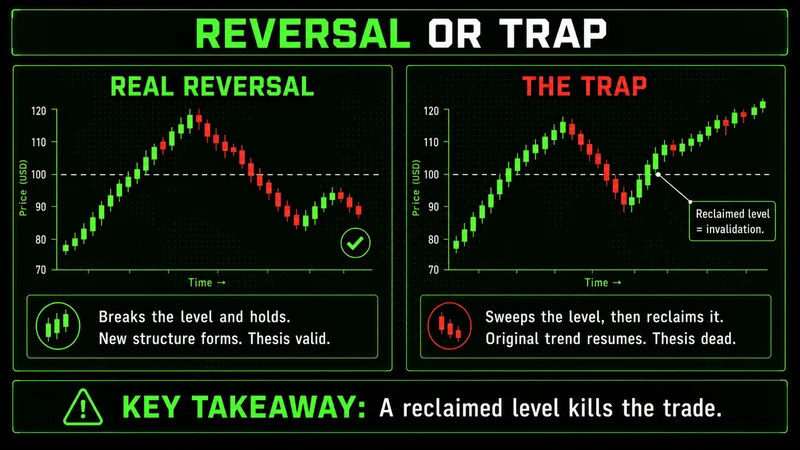
The trap looks like this. Price sweeps a key level, triggers every reversal trader watching it, then reverses back through and continues in the original trend. The candle that looked like exhaustion was the trend collecting liquidity from traders who entered early. The move that looked like a bullish reversal was sellers being offered a better price.
The level that proves it is the reclaimed level. If price breaks the structure you were trading and then trades back through it and holds, your reversal thesis is dead. That reclaim is the invalidation. It is not a place to add, average down, or argue with the chart. It is the market telling you the original trend never lost control. The discipline to exit there, take the small loss, and stand aside is what keeps a string of false reversals from becoming one large one. A reversal strategy without a hard invalidation level is not a strategy. It is a way to fight the trend until the account runs out.
Mistakes that turn a good reversal idea into a loss
The best reversal strategy for a beginner trader is a simple one executed with patience, and the common mistakes are almost always failures of patience rather than analysis.
- Entering on the first sign of weakness. One weak candle is not a reversal. Waiting for the break and the hold filters out most of the noise.
- Confusing a pullback with a reversal. If the protected level still holds, the trend is still intact, and you are fighting it.
- Trading reversals with no level. A reversal in open space has no context and no clean invalidation. Without a level, you cannot define risk.
- Ignoring the reclaim. When price reclaims the broken level, the setup is over. Holding through it turns a defined loss into an undefined one.
- Sizing for certainty. Reversals are lower-probability than continuations by nature. Position size should reflect that, not the conviction of the moment.
Most traders do not have a reversal strategy problem. They have a discipline problem. The rules above are not difficult to understand. They are difficult to follow in the moment when price is moving and the urge to act overrides the plan.
What a disciplined reversal strategy comes down to
A reversal trading strategy is a structured way to enter as one trend ends and another begins, built on a sequence rather than a single signal. You read the trend, wait for it to fail to continue, look for momentum fading and a reversal pattern at a level, and you confirm with a break of structure that holds before committing risk. Reversal confirmation and a defined invalidation are not optional extras. They are the strategy.
The edge is not in spotting the turn first. It is in refusing to act until the market proves the turn is real, and exiting without argument when the broken level gets reclaimed. Catching every reversal is impossible. Surviving the false ones while taking the real ones is the entire job. Reversals reward patience and punish the need to be early, and that order does not change with the market.
Worth the read?