Breakout Trading Strategy for Beginners — Read the Level
A breakout trading strategy for beginners pays on what follows the break, not the break itself. Read the level, the volume, and the reclaim.

A breakout trading strategy for beginners works best when you stop treating the break itself as the signal and start treating what happens after it as the decision. A breakout is simply price leaving a defined range — moving above resistance or below support. Most new traders enter the instant price crosses the line. The level breaking is the easy part. Whether price accepts the new ground is the part that actually pays, and it is the part most guides skip.
Breakouts look obvious in hindsight. On a live chart they are messy, and the cleanest-looking ones trap the most people. The goal here is not another list of patterns. It is a way of reading breakouts that respects how levels are built, why they fail, and when this entire approach should be left alone.
What a breakout trading strategy actually is
Breakout trading is a method for entering when price moves out of a range it has been respecting. The range is drawn by support below and resistance above — areas where price has repeatedly stalled or reversed. A breakout strategy waits for price to leave that range with intent, then positions in the direction of the move.
The logic is straightforward. While price stays inside the range, buyers and sellers are roughly balanced. When price clears resistance, buyers have absorbed the supply that was capping the move. When price loses support, sellers have overwhelmed the demand that was holding it up. That shift in control is what a breakout strategy tries to capture.
The mistake is treating every range exit as the same event. A break that occurs on expanding participation, after a long consolidation, in line with the broader trend, is not the same as a break that happens on a quiet afternoon because a few stops got tagged. Both cross the line. Only one reflects a real change in who controls price. The strategy is not "buy the break." It is "read whether the break means anything."
Why a level breaks: liquidity sits behind support and resistance
Most breakout guides treat support and resistance as walls that either hold or fail. They are closer to pools. Behind an obvious resistance level sit the stop-loss orders of everyone who shorted into it, plus the entry orders of breakout buyers waiting above. Behind support sits the mirror image. Those resting orders are liquidity, and liquidity is what price moves toward.
This reframes a resistance breakout and a support breakout. Price does not push through a level because the level is weak. It pushes through because the orders parked beyond it are worth reaching. When price clears resistance, the stops above fire, those forced buy orders accelerate the move, and breakout buyers pile in on top. For a few candles, the move looks unstoppable. Sometimes it keeps going because real demand was already there. Sometimes the orders beyond the level were the entire reason for the move, and once they are filled, there is nothing left to carry price higher.
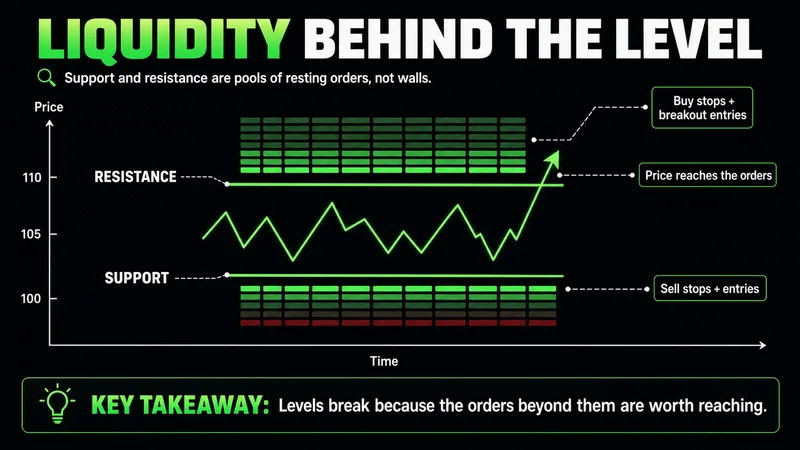
That distinction is everything. A break into thin air, where no real participation follows the initial surge, is the setup that fails. A break that holds and builds after the initial orders are absorbed is the one that continues. You cannot see the order book on most charts, but you can see the footprint it leaves: the speed of the move, whether price holds the level afterward, and whether volume confirms that fresh participants showed up rather than the same orders changing hands.
Reading the breakout entry without chasing
The breakout entry is where most beginner accounts bleed. The instinct is to enter the moment price ticks past the level, because waiting feels like missing the move. That instinct is expensive. Entering on the first tick past resistance means buying directly into the liquidity that is being consumed, with no information yet about whether anything follows.
There are two cleaner entries. The first is the close-beyond entry: wait for a candle to close decisively outside the range on your chosen timeframe, not just wick past it. A close carries more weight than a touch because it shows price held the new ground through the full period, not for a few seconds. The second is the retest entry: let price break, then wait for it to come back to the broken level and hold it as new support or resistance. The retest is the more conservative read. It costs you part of the initial move, but it replaces a guess with confirmation — you are entering only after the level has proven it flipped.
Neither entry is about precision for its own sake. Both exist to keep you from paying for liquidity that was never going to lead anywhere. A defined invalidation matters as much as the entry: if price reclaims the range after you enter, the break failed, and the trade is wrong. Knowing exactly where that line sits, before you enter, is what separates a risk-defined breakout trade from a hope-defined one.
How volume and a close confirm a breakout
Breakout confirmation is the filter between a tradeable break and a trap. The single most useful confirmation is participation: a genuine breakout tends to occur on a clear rise in volume, because a real shift in control requires real orders behind it. A volume breakout — price leaving the range while volume expands well above its recent average — suggests fresh participants are driving the move, not a thin pocket of stops getting swept.
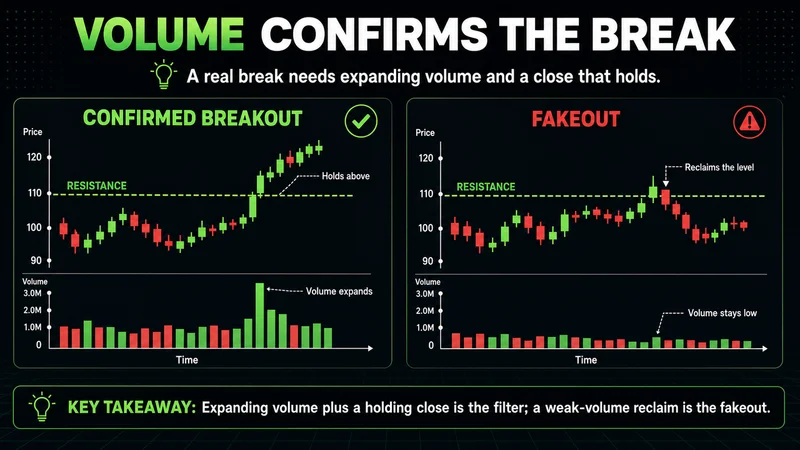
Volume alone is not enough, which is why a close adds the second layer. Price can spike on volume and still reject before the candle closes. A confirmed breakout shows both: expanding volume and a close that holds beyond the level. When you get one without the other — a close on weak volume, or a volume surge that fails to close outside the range — treat it as unconfirmed and stand aside. Confirmation is not about catching every move. It is about refusing the ones that show no evidence of follow-through. The breaks you skip for lack of confirmation are, more often than not, the ones that would have cost you.
A note on what confirmation cannot do. It lowers the odds of entering a fakeout. It does not eliminate them. Even a clean, high-volume close beyond a level can reverse if the broader conditions turn. Confirmation tilts probability in your favor; it never delivers certainty, and treating it as certainty is how confirmed-looking breaks still produce losses.
Breakout versus fakeout: the reclaim decides
The difference between a breakout and a fakeout is only clear after the fact, but one behavior tells you early: the reclaim. A fakeout is a break that fails — price clears the level, fails to find continuation, and then trades back inside the range. The moment price reclaims the broken level and holds inside, the break is invalidated. What looked like a resistance breakout becomes a failed push, and the prior range is back in control.
This is why a defined invalidation is not optional. If you entered on the break and price reclaims the level, the trade is wrong, and the size of the loss depends entirely on whether you set that line in advance. Traders who enter breaks without a reclaim level defined are the ones fakeouts hurt most, because they hold, hoping the break resumes, while price works against them.
The cleanest tell that a breakout has failed is not how far price reverses. It is how decisively it reclaims the level it just broke. A slow drift back is noise; a firm reclaim with acceptance inside the range is the market telling you the move was hollow.
Most breakouts fail not because the analysis was wrong but because the entry was emotional — price crossed a line, the trade felt urgent, and there was no plan for the reclaim. Confirmation and a defined invalidation are the two habits that turn fakeouts from account-threatening events into small, expected operating costs.
Where breakout trading stops working
No strategy works in every condition, and breakout trading has specific environments where the edge inverts. The clearest one is a range-bound, low-volatility market. When price is chopping sideways with no broader momentum, most breaks are noise — price pokes past a level, triggers a few stops, and reverts. In that regime the same setup that pays during a trend instead feeds you fakeout after fakeout, and the disciplined choice is to stop taking breaks until conditions expand.
Liquidity is the other condition that quietly breaks this approach. A breakout strategy assumes that the volume and the close mean something. Overnight, in thin pre-market hours, or in an illiquid instrument, that assumption fails. A level can break on almost no participation, the close can hold, and none of it reflects real control — there simply were not enough orders present for the signal to carry information. The same sequence that reads as a confirmed breakout during liquid cash-session hours means almost nothing on a thin overnight tape. This is the environment where beginners get hurt most: the chart looks identical to a textbook break, but the context that makes a breakout tradeable is absent.
The takeaway is not to abandon breakouts. It is to recognize that a breakout strategy is a tool for trending, liquid, expanding conditions, and a liability the moment those conditions are missing. Trading the setup without reading the regime is gambling with better vocabulary.
Common breakout mistakes that drain beginner accounts
Most beginner losses on breakouts come from a short, repeatable list of errors. Naming them is more useful than another strategy.
- Entering on the first tick past the level. This buys directly into the liquidity being consumed, before any evidence of follow-through.
- Ignoring volume. A break on weak participation is the textbook fakeout, and skipping the volume read removes the single best filter available.
- Trading breaks in a dead range. Sideways, low-volatility conditions produce noise breaks; taking them is the fastest way to bleed.
- No defined invalidation. Without a reclaim level set in advance, a fakeout turns from a small cost into a large, emotional loss.
- Oversizing the entry. Breakouts feel high-conviction, which tempts larger size; if one failed break emotionally affects your next decision, the position was too big.
- Chasing extended moves. Entering a break that has already run several candles means paying for the move others already captured, with worse risk.
None of these are analysis problems. They are discipline problems, and they are the reason most accounts struggle with a strategy that looks simple on paper.
What to take from this
A breakout trading strategy for beginners comes down to a few disciplined habits, not a pattern library. Treat support and resistance as pools of liquidity, not walls — that explains why levels break and why so many breaks fail. Wait for a close or a retest instead of the first tick. Use volume and a holding close as confirmation, and accept that confirmation lowers risk without removing it. Define the reclaim level that invalidates the trade before you enter, so a fakeout stays a small cost. And read the regime first: breakouts are a trending, liquid-market tool, not an all-conditions setup.
The practical next step is narrow. Pick one instrument, mark its obvious levels, and watch how price behaves at them across several sessions without trading — note which breaks held, which reclaimed, and what volume did each time. The pattern recognition that makes breakouts tradeable is built from screen time, not from memorizing setups. Process consistency, defined risk, and the patience to skip the breaks that show no confirmation will protect a beginner account far more than finding one more entry.
Worth the read?