Socially Responsible Investing — A Practical Primer
Socially responsible investing screens companies on ethics, environment, and governance alongside return. A practical primer on types, benefits, and risks.
Socially responsible investing is the practice of choosing investments based on ethical, environmental, and governance standards alongside expected return, not in place of it. It screens companies for the behavior an investor wants to avoid or support, then builds a portfolio around what survives that filter. The label covers a wide range of approaches, from simply excluding tobacco and weapons to actively funding clean energy and community projects. The unifying idea is straightforward: your capital expresses a position, whether you intend it to or not.
Most coverage of this topic treats values and returns as a clean trade-off, where you accept slightly lower performance in exchange for a clearer conscience. That framing is too tidy. The real decision is about which risks you are willing to hold and which ones you screen out, and those screens reshape a portfolio in ways that are easy to underestimate.
What socially responsible investing actually means
The socially responsible investing meaning comes down to a second layer of analysis on top of the usual financial one. A traditional screen asks whether a company is priced reasonably relative to its earnings and growth. A responsible screen adds a question about conduct: how the company treats the environment, its workers, its customers, and its shareholders. Both filters run before anything enters the portfolio.
This sits inside the broader ESG framework — environmental, social, and governance factors. ESG is the measurement system; socially responsible investing is one way to act on it. The distinction matters because the two terms get used interchangeably, and they are not the same thing.
Socially responsible investing vs ESG investing
The difference between socially responsible investing vs ESG investing is mostly one of intent versus information. ESG is a set of data points used to assess risk and quality. A fund can use ESG scores purely to avoid companies likely to face fines, lawsuits, or reputational damage, without any ethical mission at all. Socially responsible investing starts from values first and uses those same data points to enforce them.
In practice the line blurs. A fund marketed as responsible often relies on third-party ESG ratings, and those ratings disagree with each other more than most investors expect. The same company can land in the top quartile on one provider's scale and the bottom half on another. That inconsistency is the first thing a beginner should understand before assuming a label guarantees anything.
The main types of socially responsible investing
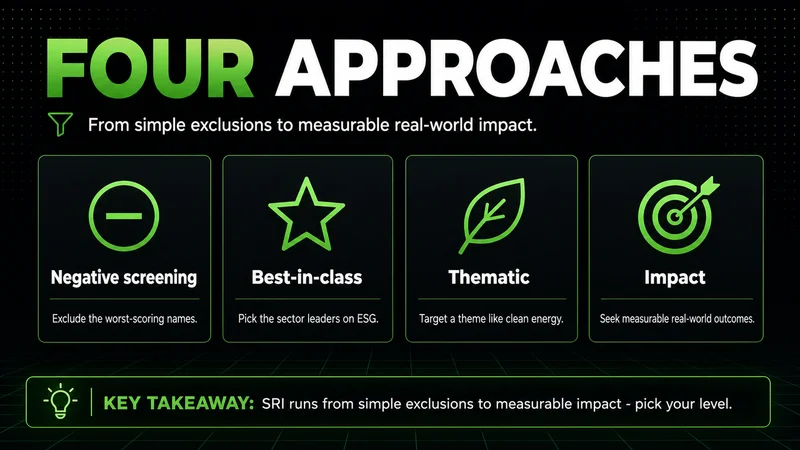
Most socially responsible investing types fall into a few recognizable approaches:
Negative screening — excluding entire sectors such as fossil fuels, tobacco, gambling, or weapons.
Positive screening — actively selecting companies that lead their peers on environmental or labor standards.
Thematic investing — concentrating capital in a specific area such as clean energy or water.
Impact investing — funding projects with a measurable social outcome, often alongside a financial return.
Shareholder advocacy — holding shares specifically to vote and pressure management on policy.
Most real portfolios blend several of these rather than committing to one.
A socially responsible investing example you can picture
A clear socially responsible investing example is a broad ESG index fund that tracks a familiar benchmark but removes the worst-scoring names in each sector. The fund still holds technology, healthcare, and financial companies, so it behaves much like the parent index. It simply trims the bottom of each group on environmental and governance measures. For an investor who wants exposure to the whole market without owning the most controversial names, that single fund does most of the work.
A more concentrated example would be a clean-energy fund holding solar, wind, and grid-storage companies. The values alignment is sharper, but so is the concentration risk, which leads directly to the part most guides skip.
The benefits and the risks, side by side
The socially responsible investing benefits are real and worth stating plainly. You hold companies whose conduct you can defend, you reduce exposure to industries facing long-term regulatory pressure, and you participate in capital flows that have grown steadily for years. Avoiding firms most exposed to environmental fines or governance scandals is, on its own, a defensible risk-management decision.
The socially responsible investing risks deserve equal weight. Screening out whole sectors changes the shape of a portfolio. Exclude energy and you may run light on a group that performs well during inflationary periods. Tilt toward clean energy and you inherit a sector that is highly sensitive to interest rates and policy shifts. This is where the approach stops being free.
Responsible screens work well while the excluded sectors are out of favor; when those same sectors lead the market, the screen becomes a drag the investor chose in advance. A clean-energy tilt can read as disciplined for years and then give back a large part of its lead in a single rate-driven repricing. The screen did not fail. It did exactly what it was built to do, which is hold a narrower slice of the market. The cost simply arrives later than the conviction does.
There is also the matter of greenwashing. A fund can carry the language of responsibility while holding names that barely clear a low bar. Reading the actual holdings, not the marketing, is the only reliable check.
Socially responsible investing for beginners — building the position
For socially responsible investing for beginners, the practical path is less about picking perfect companies and more about controlling concentration. The market rewards patience and position sizing far more than it rewards the strength of any single conviction, and a values screen does not change that math.
A workable approach treats the responsible allocation as one sleeve of a diversified portfolio rather than the whole thing. That keeps the values expression intact while preventing a single theme from dominating outcomes. How to use socially responsible investing in a portfolio is mostly a question of sizing: enough to matter, not so much that one sector decides your year.
A socially responsible investing checklist before you commit
A short socially responsible investing checklist keeps the decision honest:
Read the fund's actual holdings, not its name or brochure.
Check which ESG rating provider it relies on, and treat the score as one opinion.
Identify which sectors the screen removes, and ask how that changes your risk.
Confirm the expense ratio is competitive with a comparable conventional fund.
Size the position so a single theme cannot dominate the portfolio.
The most common mistake beginners make is buying the label and skipping the holdings. The second is overconcentrating in one theme because the conviction feels strong. Both are discipline problems, not analysis problems.
Where to go from here
Socially responsible investing is a legitimate way to align capital with values, provided the screens are understood as risk decisions rather than free preferences. Define what you want to exclude, read what you actually own, and size the allocation so a single sector cannot control the result. From there, the same principles that govern any sound portfolio apply: diversification, defined risk, and patience.
For related reading, see our primers on ESG fundamentals, index fund basics, and portfolio construction for new investors.
Worth the read?