Interest Rates Explained — What They Move and Why
Interest rates are the price of money over time. Here is what they actually mean, how they are set, and how traders read the market's reaction to them.
Interest rates are the price of money over time: what a borrower pays to use capital and what a lender earns for parting with it, expressed as a percentage of the principal. That is the textbook definition, and it is correct. It is also where most traders stop reading, which is exactly why most traders misread what interest rates do to a chart. The number matters less than what the market already expected the number to be.
A rate decision is not a fresh piece of information arriving in a vacuum. By the time a central bank moves, positioning has usually been built around an outcome for weeks. The reaction you see on the screen is the gap between what happened and what was priced. Understanding that gap is the difference between reading interest rates as an economic concept and reading them as a market participant.
What interest rates actually mean
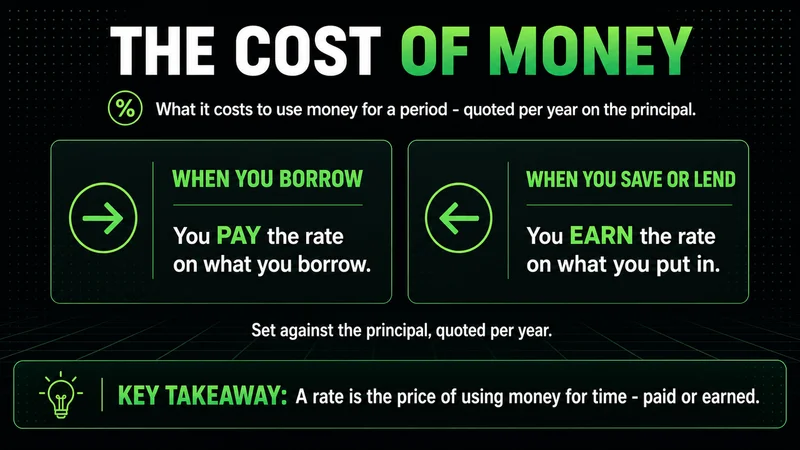
Strip away the jargon and an interest rate answers one question: how much does it cost to use money for a period of time. When you borrow, you pay it. When you save or lend, you earn it. The rate is set against the principal, the original sum, and quoted per year.
The rate that drives everything else is the policy rate, the target a central bank sets for overnight lending between banks. In the United States that is the federal funds rate. Commercial lending rates, mortgage rates, and the yield on government debt all take their cue from it, with a spread layered on top for risk and term. The interest rates meaning that matters to a trader is this layered structure, not a single headline figure.
Two distinctions are worth holding in your head:
- Nominal versus real: the real rate is the nominal rate minus inflation, and it is the real rate that tells you whether holding cash is actually growing or quietly shrinking your purchasing power.
- Fixed versus variable: a fixed rate is locked for the term, while a variable rate resets as the policy rate moves, which is why rate cycles ripple through the economy with a lag.
How interest rates are calculated and set
The interest rates calculation a borrower sees is mechanical. Simple interest is the principal multiplied by the rate and the time. Compound interest applies the rate to the principal plus accumulated interest, so it grows faster over longer horizons. That is the arithmetic.
The more important question is how the policy rate itself is set. A central bank adjusts it to manage two things: price stability and, depending on the mandate, employment. The mechanism runs through cost and demand:
- Raising rates makes borrowing more expensive, which cools spending and investment and pulls inflation down.
- Cutting rates makes borrowing cheaper, which encourages spending and investment and supports growth.
- Holding rates steady signals that current conditions are judged close to balanced.
- Forward guidance, the language around the decision, often moves markets more than the decision itself.
That last point is the one screen time teaches you. The committee statement and the press conference frequently matter more than the basis points, because they reset expectations for the next several meetings.
Why interest rates work as an economic indicator
The direction of interest rates is one of the cleanest reads on where policymakers think the economy stands. Rising rates usually signal an economy running hot enough to need restraint. Falling rates usually signal weakness that needs support. As an economic indicator, the rate path is a statement about growth and inflation risk in a single variable.
This is also where interest rates and inflation are inseparable. Central banks raise rates specifically to slow the pace of price increases, and they cut when inflation is contained and growth needs help. A trader who watches the rate decision without watching the inflation data that drives it is reading the conclusion without the argument. The two move as a pair, and the market trades the relationship between them, not either one alone.
How interest rates affect the stock market
The standard explanation is that higher rates hurt stocks. Higher rates raise the discount applied to future earnings, lower the present value of those earnings, and make bonds a more attractive alternative to equity. All of that is true on average and over time.
It is also incomplete. The effect is not uniform across the market. Financials often benefit from higher rates because lending margins widen. Long-duration growth names, the ones valued on earnings far in the future, tend to suffer most when the discount rate climbs. Defensive sectors behave differently again. So the interest rates impact on stocks is really a question about which stocks, in which regime, against what was already expected.
This is the gap most explainers leave out. A hike can land and equities can rally, because the hike was smaller than feared or the guidance turned dovish. Liquidity and positioning often matter more than the headline itself. The first move after a rate decision is frequently the least reliable one, full of stops being run and emotional reactions to a volatility spike, before structure has had time to form.
How traders use interest rates as a signal
For a discretionary futures or equities trader, the interest rates trading signal is not the rate itself. It is the reaction. The process looks like this:
- Read what is priced into the curve before the decision, so you know the bar the outcome has to clear.
- Watch the immediate reaction in the index futures, but treat the first impulse as noise, not confirmation.
- Wait for acceptance or rejection at a key level once the initial volatility settles.
- Define invalidation before sizing, because rate-event sessions expand range fast and punish loose stops.
NQ in particular rewards this patience and punishes hesitation immediately. The Nasdaq, heavy with rate-sensitive growth, can move violently in the minutes after a release, then reverse the entire move once the headline trade unwinds. Trading the reaction, not the prediction, is the only sustainable approach to these sessions.
There is a real condition where this framework breaks down. When a rate decision arrives with no surprise, fully priced and matched by guidance, the reaction can be muted to the point of meaninglessness. The session reverts to its prior structure, and traders who position for a big move on a rate day get chopped by their own expectation. The signal lives in the surprise; without one, there is no edge in the event itself.
The limitations of reading interest rates
Interest rates are a powerful read, but they are not a complete one. The biggest limitation is timing: rate changes affect the economy with long and variable lags, so the market reaction and the real-economy effect rarely line up on the same calendar. A hike today can pressure activity quarters later, long after the chart has moved on.
The second limitation is that rates never trade in isolation. Earnings, geopolitical risk, liquidity conditions, and positioning all interact with the rate path. Reading interest rates without that context is, in practice, trading with better vocabulary and no more certainty. The rate tells you something real about the cost of capital. It does not tell you what the tape will do in the next hour.
FAQs
What are interest rates in simple terms? They are the cost of using money over time, paid by a borrower and earned by a lender, quoted as a percentage of the principal per year. The policy rate set by a central bank anchors most other rates in the economy.
How is interest rates calculation done? Simple interest is principal multiplied by the rate and the time period. Compound interest applies the rate to the principal plus any accumulated interest, so it grows faster over longer horizons.
Why do interest rates matter for investors? Rates set the discount applied to future cash flows and the return available on safer assets like bonds. When rates rise, the present value of future earnings falls and bonds compete harder with stocks for capital.
Do rising interest rates always hurt stocks? No. The effect depends on the sector and on what the market already expected. Financials can benefit from higher rates, and equities can rally on a hike if the move was smaller than feared or the guidance turned supportive.
Why do markets react before rates actually change? Because positioning is built around the expected outcome in advance. By the time the decision lands, much of it is already priced, so the market trades the surprise, the gap between the result and what was expected.
Worth the read?