Top-Down vs Bottom-Up Investing — Which Lens to Lead With
Top down vs bottom up investing compared: top-down leads with the macro, bottom-up with the company, plus how to choose the right lens.
Top-down vs bottom-up investing is a question about where you start, not which one is correct. Top-down investing begins with the macro picture — the economy, interest rates, the cycle — and narrows toward sectors and then individual names. Bottom-up investing begins with the company — its earnings, balance sheet, and competitive position — and treats the broader economy as context rather than the starting decision. Both can be disciplined. Both can be reckless. The difference that matters is which lens you lead with, and whether you know when that lens stops working.
Most explainers frame this as a personality test, as if you are either a macro thinker or a stock picker for life. That framing is comfortable and mostly wrong. The lens you should lead with depends on the regime in front of you, and the cost of using the wrong one is not abstract. It shows up as a correct sector with the wrong stock, or a great company held through a regime that punishes its entire sector.
What top down vs bottom up investing actually means
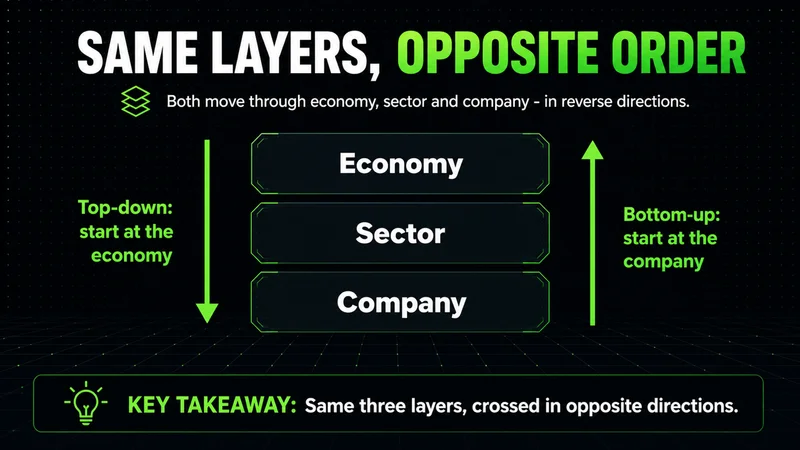
The meaning is simpler than the debate around it. Top-down vs bottom-up investing describes two directions of analysis that move through the same three layers — economy, sector, company — in opposite order.
Top-down starts at the top layer. You form a view on growth, inflation, and central bank policy, decide which sectors that environment favors, and only then choose names inside those sectors. Bottom-up starts at the bottom layer. You find a business with durable economics first, then check whether the sector and macro backdrop give it room to work.
The basics come down to one sequencing choice. Top-down treats the environment as the primary filter and the company as the final step. Bottom-up treats the company as the primary filter and the environment as a constraint you check at the end. Neither ignores the other layer. They just disagree about which one gets the first and largest vote.
How the top-down approach works
The top-down approach is a funnel. You begin wide and narrow with each step.
Form a macro view: where the economy sits in its cycle, the direction of interest rates, and the dominant policy pressure.
Map that view to sectors. A rising-rate environment treats financials differently than long-duration growth. A late-cycle slowdown favors defensives over cyclicals.
Inside the favored sectors, select the companies best positioned to benefit from the conditions you identified.
The appeal is context. A top-down investor rarely buys into a sector the macro environment is actively working against, which is a real form of risk control. The weakness is precision at the bottom of the funnel. Getting the regime right does not guarantee you pick the right company inside it. You can be correct that energy benefits from a supply shock and still own the one operator that mismanages its balance sheet through the move.
How the bottom-up approach works
Bottom-up reverses the order. The company comes first, the economy comes last.
A bottom-up investor reads the financial statements, judges pricing power and management quality, and estimates long-term earnings before forming any strong macro opinion. The belief underneath it is that strong businesses compound through cycles, and that short-term macro noise cannot consistently disrupt a company with a real competitive advantage.
This is where top-down vs bottom-up investing overlaps with fundamental analysis, and where people conflate the two. Bottom-up investing relies heavily on fundamental analysis — it is the engine for judging a single business. But fundamental analysis is a toolkit, not a direction of travel. You can run fundamental analysis inside a top-down process too, applied to the sectors your macro view already selected. The distinction is sequence: bottom-up leads with company fundamentals, top-down leads with the environment and uses fundamentals later.
The strength of bottom-up is selection quality. The weakness is regime blindness. A great company is still a holding inside a sector, and a sector is still subject to the cycle. Buy a well-run homebuilder on flawless fundamentals and the macro can still revalue the entire group when rates move against housing.
Top down vs bottom up investing vs fundamental analysis
It helps to separate three things that get blurred together.
Top-down is a starting point: economy first.
Bottom-up is a starting point: company first.
Fundamental analysis is a method: reading a business through its numbers and competitive position.
Top-down and bottom-up are answers to "where do I begin." Fundamental analysis is an answer to "how do I judge what I'm looking at." You apply the method inside either starting point. Treating fundamental analysis as a synonym for bottom-up is the most common mistake beginners make here, and it quietly leads them to ignore the macro layer entirely.
Which approach should you lead with, and when
This is the part most guides skip, because the honest answer is conditional. The importance of choosing well is not philosophical — it changes which mistakes you are exposed to.
Lead top-down when the macro environment is doing the heavy lifting. When a policy shift, a rate cycle, or a clear macro regime is the dominant force, the sector you stand in matters more than the specific name. Fighting that with pure stock selection is expensive. Lead bottom-up when the macro is muddled or range-bound and dispersion between companies is wide. When the cycle gives no clear edge, the difference between a strong business and a weak one inside the same sector becomes the thing actually worth paying for.
The market rewards reacting well to the conditions in front of you far more than predicting which conditions will arrive. The lens is a tool, not an identity. — MRPNL
That is also why most experienced allocators run a hybrid. They lead with one lens for the primary decision and use the other as a check. A bottom-up pick still gets a macro sanity test. A top-down sector call still gets a fundamental screen before any capital goes in. The two are not rivals. They are a primary filter and a second opinion.
Where each approach breaks down
Every framework has a regime where it inverts, and naming it is more useful than another list of advantages.
Top-down breaks down when sector logic and company reality diverge. You can read the cycle correctly, rotate into the favored sector, and still lose because the specific company you chose carries a problem the macro view never touched. Right sector, wrong stock is a top-down failure mode, and it is invisible until the position is already on.
Bottom-up breaks down when a macro regime overwhelms company quality. A business can have clean fundamentals and still get revalued downward because its entire sector falls out of favor when rates, policy, or liquidity shift. Great company, wrong regime is the bottom-up failure mode. The fundamentals were never wrong. They were simply outvoted by conditions the process did not weigh.
The risks are not symmetric across investors, either. A top-down investor who never opens a 10-K is exposed to single-company blowups inside a correct theme. A bottom-up investor who never checks the cycle is exposed to owning quality straight into a sector drawdown. The defense in both cases is the same discipline: define in advance what would make your starting lens the wrong one, and respect that line when conditions cross it.
A practical checklist before you commit capital
Before you size a position under either approach, the same short list keeps you honest.
Name your lens. Decide whether this decision is led top-down or bottom-up, and write down why.
Check the other layer. If you led top-down, screen the specific company. If you led bottom-up, stress-test the macro regime around it.
Define invalidation. State the condition — a regime change, a fundamental break — that would make the thesis wrong before you are in the position, not after.
Size for being wrong. The position should survive the failure mode you just named without forcing an emotional decision.
The checklist does not make either approach better. It makes the cost of using the wrong one survivable, which over a long enough horizon is the part that actually compounds.
FAQs
What is top down vs bottom up investing in simple terms? It is the order in which you analyze a potential investment. Top-down starts with the economy and works toward individual stocks. Bottom-up starts with individual companies and treats the economy as context. Same three layers — economy, sector, company — examined in opposite directions.
Can you give an example of each for investors? A top-down investor decides rising rates favor financials, then picks a specific bank inside that sector. A bottom-up investor finds a bank with strong fundamentals and a durable deposit base first, then checks whether the rate environment supports it. The first leads with the macro view. The second leads with the business.
Is bottom-up investing the same as fundamental analysis? No. Bottom-up is a starting point — company first. Fundamental analysis is a method for judging a business through its numbers and competitive position. You can use fundamental analysis inside a top-down process too. They overlap heavily but are not the same thing.
Why does choosing the right approach matter in the stock market? Because it determines which mistakes you are exposed to. Leading with the wrong lens for the regime produces predictable failures — a correct sector with the wrong stock, or a great company held through a hostile regime. Matching the lens to conditions does not remove risk, but it removes the avoidable version of it.
The bottom line on choosing your lens
Top-down vs bottom-up investing is not a contest with a winner. Top-down leads with the environment and risks picking the wrong name inside a correct theme. Bottom-up leads with the company and risks holding quality through a regime that punishes its whole sector. The practitioners who survive long enough rarely pick one lens for life. They lead with whichever one fits the conditions in front of them, use the other as a check, and define in advance what would prove the starting choice wrong. The lens is a tool. Discipline about when it fails is the edge.
Worth the read?