The Law of Supply — What It Means for Markets
The law of supply means sellers offer more when prices rise. Here is what that direct relationship means for stock prices and how traders read it.

The law of supply states that when the price of something rises, producers and sellers offer more of it, and when the price falls, they offer less. It is a direct relationship: higher price, larger quantity supplied, all else held equal. That single sentence explains why supply curves slope upward, and it is the quiet mechanism sitting underneath every price you watch print on a chart.
Most explanations stop at the textbook curve. That is where the law of supply stops being useful for anyone who actually trades. The curve describes a tendency under stable conditions. Live markets are rarely stable, and the moments that matter most are usually the ones where the tendency bends.
Law of supply meaning, stated plainly
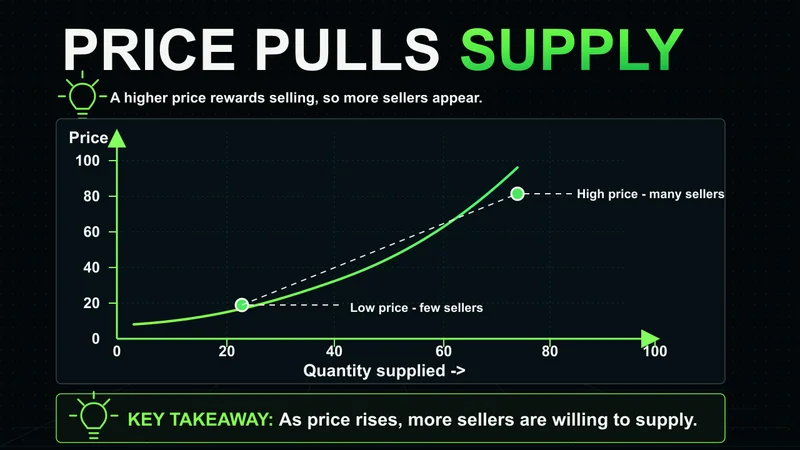
The law of supply meaning comes down to incentive. A higher price is a higher reward for producing or selling, so more sellers are willing to participate at that price. A lower price thins that crowd out. Economists hold every other variable constant to isolate this one relationship.
All else equal, the quantity supplied moves in the same direction as price.
That clause, all else equal, is doing heavy lifting. Input costs, technology, the number of sellers, taxes, and expectations are assumed fixed. When one of those moves, the entire curve shifts, which is a different event from sliding along it. Confusing the two is the most common mistake beginners make with supply.
A law of supply example you can picture
The cleanest law of supply example is a producer with spare capacity. Picture a manufacturer who can run a second shift but only bothers when the selling price justifies the overtime, the extra power, and the wear on the line.
Price per unit | Quantity supplied |
|---|---|
$10 | 200 |
$15 | 350 |
$20 | 500 |
As the price climbs, producing more becomes worth the added cost, so the quantity supplied rises with it. The same logic scales from a single factory to an entire commodity market. When oil trades higher, marginal wells that lose money at low prices come back online, and supply expands toward the new price.
How the law of supply works in the stock market
This is where the textbook idea meets order flow. In equities there is no factory deciding how many units to make. The supply is shares that current holders are willing to sell, and the price where they will let them go.
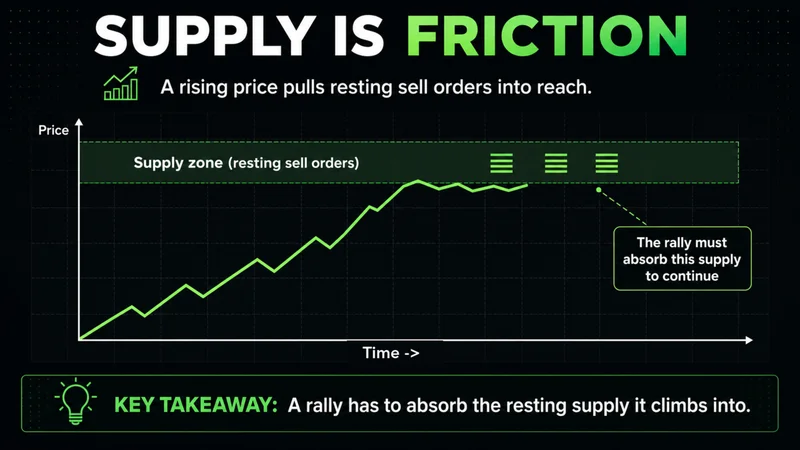
As a stock pushes higher, it pulls more resting sell orders into reach. Holders who set targets, funds trimming positions, and traders taking profits all become willing sellers at elevated prices. That added supply is the friction a rally has to absorb. When the price rises and the offers thin out anyway, that tells you something about how the law of supply affects stock prices in that moment: demand is overwhelming the willing sellers, and continuation is more likely. When price rises and a wall of supply meets it, the move stalls.
Liquidity drives markets more than opinions do. You can hold the strongest view on a name, but if size is resting just above and nobody lifts it, price does not go there. Reading where supply sits in the book matters more than the narrative attached to it.
Law of supply vs law of demand
The law of supply and the law of demand are mirror images that meet at a price. Supply rises with price; demand falls with price. Where the two cross is the equilibrium, the level where the quantity sellers will part with equals the quantity buyers will take.
Law of supply: higher price pulls in more sellers, so quantity supplied rises.
Law of demand: higher price pushes buyers away, so quantity demanded falls.
Equilibrium: the price where the two quantities match and the market clears.
For investors, the practical reading of law of supply vs law of demand is simple. Price discovery is the market searching for the level where willing buyers and willing sellers agree, and that level moves constantly as new information changes either side.
Why the law of supply matters for investors
The law of supply for investors is less about predicting a number and more about understanding pressure. When you know that higher prices generally invite more selling, you stop being surprised when a sharp rally meets resistance. You start expecting it.
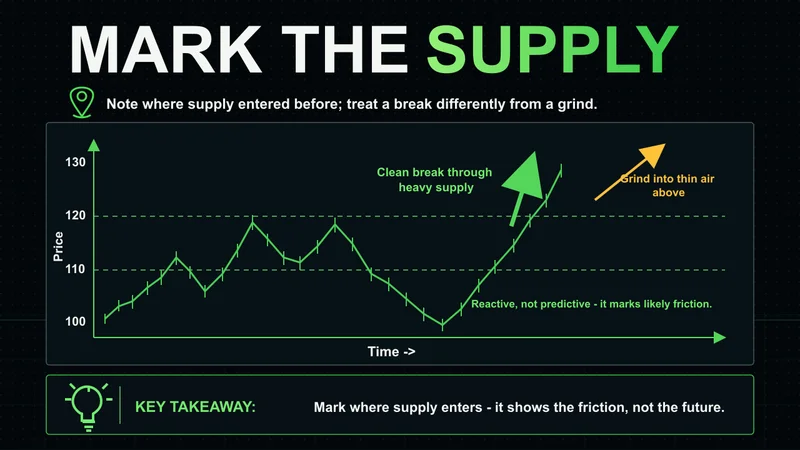
This is how traders use the law of supply in practice. They watch where supply has historically entered, mark those levels, and treat a clean break through heavy supply differently from a grind into thin air above. The framework is reactive, not predictive. It tells you where friction is likely, not where price must go.
Where the law of supply breaks down
Here is the part the textbook skips. The law of supply holds under normal conditions, and markets spend a lot of time outside normal conditions.
In a forced-liquidation event, sellers dump size into falling prices, not rising ones. A margin call does not care about incentive. The holder sells because they must, which inverts the tidy relationship between price and quantity supplied. Momentum can do the opposite: as price rises, some participants buy more aggressively rather than sell, chasing the move, so higher prices temporarily pull in demand instead of supply. In thin, illiquid conditions, a small order moves price far more than the curve suggests, because the supply simply is not there at any nearby level. The relationship reads cleanly during calm, liquid sessions. During a fast unwind or a low-volume drift, the same logic can mislead you completely.
A short checklist for reading supply
Use this law of supply checklist when you size up a move:
Identify where resting supply likely sits, such as prior highs, round numbers, and known distribution zones.
Watch how price behaves on contact: does it absorb the supply and continue, or stall and reject?
Ask whether conditions are normal or stressed, because forced selling and illiquidity invert the usual relationship.
Confirm with volume, since real supply absorption shows up as activity, not just a passing tick.
The goal is not certainty. It is knowing where the friction lives before you commit risk.
FAQs
What is the law of supply in simple terms? It is the rule that sellers offer more of a good when its price rises and less when its price falls, assuming nothing else changes. That direct relationship is why supply curves slope upward.
What is a basic law of supply example? A factory with spare capacity runs an extra shift only when the selling price covers the added cost. As the price rises, producing more becomes worthwhile, so the quantity supplied increases alongside it.
How does the law of supply affect stock prices? In equities, supply is the shares holders are willing to sell. As price rises, more resting sell orders come into reach, and that added supply is the friction a rally must absorb before it can continue higher.
Does the law of supply always hold? No. Under forced liquidation, margin calls, or thin liquidity, sellers can dump into falling prices and small orders can move price sharply. The relationship is reliable in calm, liquid conditions and unreliable in stressed ones.
Related reading
If this clarified the supply side, the natural next steps are the law of demand, how equilibrium price forms where the two meet, and how liquidity behavior shapes the way price actually moves through a market.
Worth the read?