Trade Size in Trading — What It Is and How to Set It
Trade size is the number of units you commit to a trade. Learn what trade size means, how to set it from your risk, and how it controls trading risk.
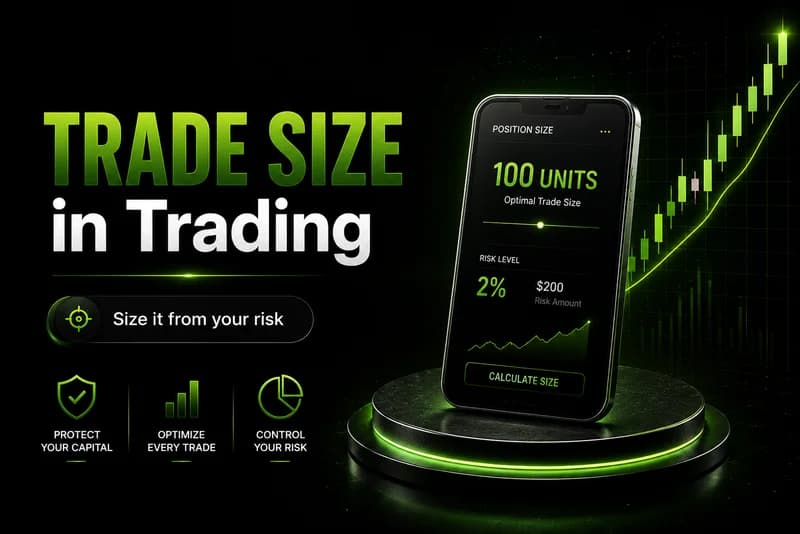
Trade size is the number of shares, contracts, or units you commit to a single trade. It is the lever that decides how much a market move is worth to your account, and it is the first thing that goes wrong when a new trader's account starts shrinking. Most people obsess over the entry. The size of the position usually decides the outcome before the entry ever fills.
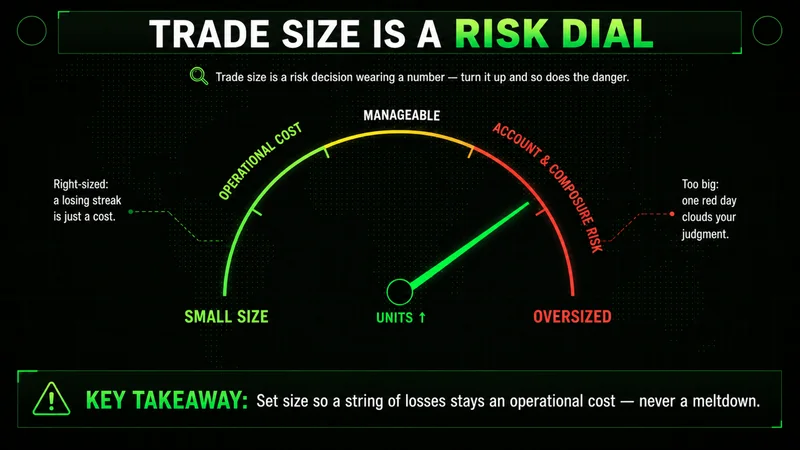
That is the part the glossaries skip. They define trade size as a quantity and move on. In live conditions, trade size is a risk decision wearing a number. Get it right and a string of losses is an operational cost. Get it wrong and one ordinary red day becomes the day you stop thinking clearly.
What trade size actually means in trading
Trade size is how much you are putting to work on one position. In equities it is a share count. In futures it is a number of contracts. In forex it is measured in lots, where a standard lot is 100,000 units, a mini lot is 10,000, and a micro lot is 1,000.
The number itself is neutral. What matters is what that number does to your account when price moves against you. Ten shares of a quiet stock and ten contracts of an index future are both "ten," and they carry nothing close to the same risk. This is why trade size only means something once you tie it to the distance between your entry and your invalidation.
A simple way to hold it: trade size is the bridge between an idea and the amount of capital that idea can lose. The chart gives you a setup. Your trade size decides what that setup costs you when it fails.
How does trade size work in trading
Trade size works by converting price movement into profit and loss. Each unit you hold scales the result of every tick. Double the size and you double the swing in both directions. That symmetry is the whole point, and it is also the trap, because larger size feels like more opportunity while it is quietly more exposure.
The professional version flips the order of operations. You do not start with how many contracts you want. You start with how much you are willing to lose if the trade is wrong, then back into the size that fits.
The sequence looks like this:
- Decide the dollar amount you are willing to risk on the trade.
- Mark the price level that proves the idea wrong — your invalidation.
- Measure the distance from entry to that level.
- Divide the risk amount by the per-unit loss at that distance.
That last number is your trade size. It is not a preference. It is the output of the risk you defined and the structure the chart handed you.
Trade size vs position size — are they the same thing
This is where the search results blur together, so here is the clean distinction. Trade size usually refers to the quantity on a single order or a single trade. Position size refers to your total exposure in an instrument, which can be built from several trades layered together. If you buy once and hold, the two are identical. If you scale in across three entries, your position size is the sum of three trade sizes.
| Trade size | Position size | |
|---|---|---|
| Scope | One order or one trade | Total exposure in the instrument |
| Built from | A single fill | One or more trades combined |
| When they differ | Scaling in or out | After the first add |
| What it controls | Risk on that specific entry | Aggregate risk you are carrying |
The reason the distinction matters is risk accounting. A trader who sizes each entry correctly can still end up dangerously oversized once three "correct" trade sizes stack into one position. Watch the aggregate, not just the order in front of you.
Why trade size is the part beginners get wrong
The setup can be sound, the read on structure can be right, and the account still bleeds because the position was too large for the stop it needed. Sizing, not strategy, is where most beginners actually lose.
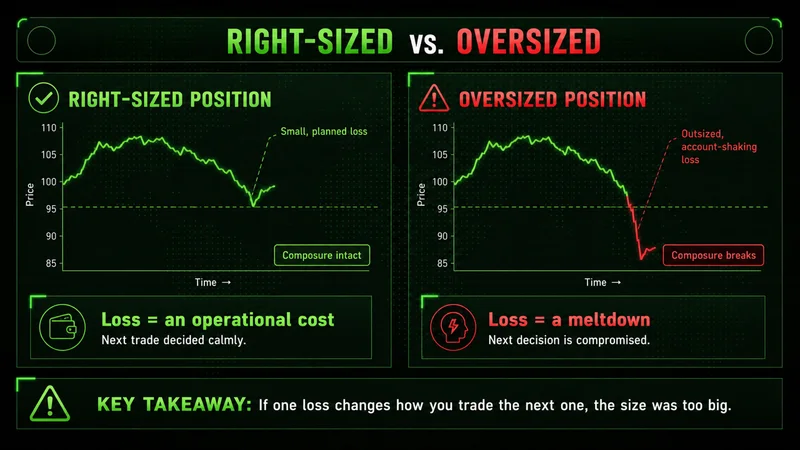
Oversizing does two things at once. It magnifies the dollar loss, and it magnifies the emotional weight of that loss. If one losing trade changes how you think about the next one, the size was too big. That is the cleanest tell there is. A position you can hold with a calm mind is a position sized correctly. A position that has you watching every tick is a position managing you.
If a single losing trade affects your decision-making on the next one, the position was too large. The number on the order ticket is also a number in your head.
How trade size affects your trading risk
The connection between size and risk is direct and unforgiving. Risk per trade is your trade size multiplied by the distance to your invalidation. Change either input and your risk changes with it.
Most professionals cap risk per trade at a small fraction of the account, commonly in the one to two percent range. The percentage is less important than the discipline of choosing one and sizing to it every time. The point of a fixed risk fraction is that no single trade can do real damage, which keeps you in the game long enough for an edge to show up.
A trade size example makes it concrete. Say you risk a set dollar amount per trade and your invalidation sits a fixed distance from entry. A tight stop lets you carry more units for the same dollar risk. A wide stop forces fewer units. The dollar risk stays constant; the size flexes to fit the structure. That is the relationship to internalize — size is the variable, risk is the constant.
This is also where the framework breaks if you are not paying attention. Fixed-fraction sizing assumes your stop will actually fill near your invalidation. In thin overnight liquidity or during a macro release on an instrument like gold, price can gap straight through the level and your real loss lands well beyond the risk you planned. The math that protects you in normal conditions quietly stops protecting you when liquidity disappears. Size smaller when the session is illiquid or news is pending, because the stop you are counting on may not be there.
When should traders adjust trade size
Trade size is not a single number you set once. It is a dial you turn with conditions.
- Turn it down in low-quality, choppy conditions where your edge is weakest.
- Turn it down ahead of scheduled news and into thin overnight sessions.
- Keep it steady in clean, high-probability environments that match your plan.
- Never turn it up to recover a loss — that is the impulse that compounds drawdowns.
The discipline that matters most is the last one. Increasing size emotionally after a loss is how an ordinary drawdown becomes an account-ending one. The market does not owe you a fast recovery, and a larger position is not a recovery plan. It is the same mistake in a bigger position.
A trade size checklist to run before every entry
Before the order goes in, run a short pre-trade routine. It takes seconds once it is a habit, and it catches the sizing errors that do the most damage.
- What dollar amount am I risking on this trade, as a fixed fraction of the account?
- Where is my invalidation, and is it based on structure rather than convenience?
- What is the per-unit loss at that distance?
- What trade size does that produce — and have I rounded down, not up?
- With existing positions added in, is my aggregate exposure still acceptable?
- Are conditions normal, or should I size smaller for liquidity or news?
If any answer is unclear, the trade is not ready. Sizing is the last gate before execution, and it is the cheapest place to catch a mistake.
FAQs
What is trade size in trading in simple terms? It is how much you commit to one trade — a share count in stocks, a number of contracts in futures, or lots in forex. It decides how much each price move is worth to your account, which makes it a risk decision more than a quantity.
What is the difference between trade size and position size? Trade size is the quantity on a single trade or order. Position size is your total exposure in an instrument, which can be built from several trades. They are identical for a single entry and diverge the moment you scale in.
How do I calculate the right trade size? Start with the dollar amount you are willing to risk, mark your invalidation level, measure the distance from entry to that level, then divide your risk amount by the per-unit loss at that distance. The result is your size.
Is trade size really that important for beginners? Yes. A sound setup with oversized risk still drains an account, while a mediocre setup with controlled size survives. Sizing decides whether a losing streak is a cost or a crisis, so it is one of the first things worth getting right.
The takeaway on trade size
Trade size is the quiet decision that controls everything downstream. It converts a chart idea into real risk, it sets the emotional weight of every loss, and it determines whether you survive the inevitable bad stretch. Define your risk first, let the structure set your invalidation, and let the size fall out of those two inputs rather than out of how confident you feel. The traders who last are not the ones who size up on conviction. They are the ones who size to survive, then let the edge do its work over time.
Worth the read?