Magnificent Seven 2026: Alphabet Takes Control
Alphabet led the Magnificent Seven split in 2026 because investors could see AI spending turning into measurable cloud growth.
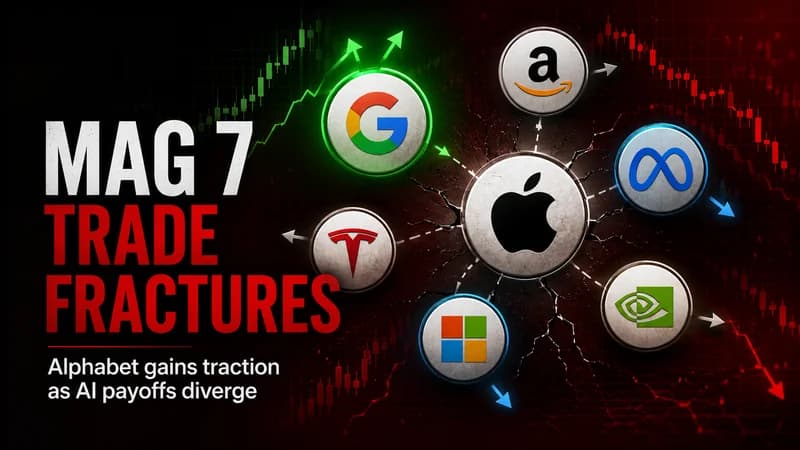
The Magnificent Seven stopped behaving like one clean technology trade in 2026. Alphabet gained acceptance because investors could see AI spending turning into cloud revenue, while Microsoft and Meta faced pressure where capital spending moved faster than visible payoff.
The Basket Trade Lost Its Structure
For roughly three years, the largest U.S. technology names moved with the same broad AI story. That structure changed in 2026. The market no longer treated every major platform company as equal just because each one was spending heavily on artificial intelligence.
The separation was clear. Alphabet was up roughly 28% year to date. Microsoft was down about 16%. Meta had moved toward the weaker end of the group. That left more than 40 percentage points between Alphabet and Microsoft inside a group many investors had treated as one exposure.
The key shift was simple: AI spending needed evidence. Capital expenditure by itself was no longer enough. Investors started rewarding companies that could connect infrastructure spending to revenue, backlog, and margin improvement.
Alphabet showed measurable cloud demand.
Microsoft carried a large AI spending plan while Azure growth cooled.
Meta raised its capital spending forecast before investors had enough proof of return.
Alphabet Had Proof Investors Could Underwrite
Alphabet became the stronger name because the numbers gave investors something concrete to work with. Last quarter, Google Cloud produced roughly $20 billion of revenue, about 63% higher than a year earlier. The contracted backlog also increased sharply, which pointed to demand already committed rather than demand only discussed in management commentary.
Margin behavior mattered as well. Google Cloud operating margin expanded, moving the segment further away from the old cash-drain perception and closer to a profit contributor. That changes how the market reads AI infrastructure spending. When revenue, backlog, and margin move together, the investment looks disciplined rather than open-ended.
Management also framed capital spending around return. That gave investors a clearer path from AI investment to business output. The market does not need perfect certainty, but it does need a structure it can evaluate.
The important shift was not that AI spending got punished. Spending without enough measurable confirmation got punished.
Microsoft Faced A Payoff Timing Problem
Microsoft's issue was not that investors ignored its AI position. The issue was timing and attribution. For 2026, its AI capex plan sat near $190 billion, while Azure growth slowed into the high-20s percent range.
That contrast created pressure. The infrastructure cost was visible immediately. Revenue tied to products such as Copilot was harder for investors to isolate. In a market less patient with broad AI promises, that mismatch helped explain why Microsoft lagged.
This is where the trade becomes more specific. A strong company can still be a weak stock when positioning, expectations, and payoff timing are misaligned. The market was not rejecting Microsoft's long-term relevance. It was questioning whether the current spending pace had enough near-term confirmation.
Meta Had The Same Concern With More Capex Pressure
Meta carried a similar problem, but the spending signal was sharper. For 2026, the company moved expected capex into a $125 billion to $145 billion range. That increase came while investors were still looking for clearer evidence that AI investment was converting into return.
The ad business remained strong, which matters. But strength in the core business did not remove the market's concern about AI capital intensity. A downgrade followed, and the stock came under pressure as analysts questioned whether spending was running ahead of the payoff.
The broader lesson across Microsoft and Meta is that size alone did not protect the stocks. In 2026, investors wanted proof of execution quality, not just large budgets and familiar AI language.
Position Sizing Matters More Than The Old Label
The old Magnificent Seven label can create false comfort. If a portfolio is concentrated in one or two names, the investor is not holding diversified big-tech exposure. They are holding a specific view on one company's AI return timeline.
That distinction matters when the group stops moving together. Trimming a leader after a strong move can make sense if the position has become too large. Adding to a laggard only makes sense when the investor accepts the payoff timeline and the risk. Chasing Alphabet only because it is already up roughly 28% is poor process.
Fractional shares can help smaller portfolios manage that exposure with precision. The practical goal is not to own every name blindly. It is to size each position according to risk, evidence, and conviction.
The Takeaway Is Discipline, Not Prediction
The Magnificent Seven split into separate stories in 2026. Alphabet led because cloud growth, backlog, expanding margin, and management's return framework gave investors measurable confirmation. Microsoft and Meta lagged because AI spending was easier to see than the payoff.
The better response is not to assume the current winner will keep leading. It is to stop treating the group as one trade, define exposure deliberately, and let evidence guide position sizing instead of relying on the old basket narrative.
FAQs
Why did Magnificent Seven stocks split in 2026? Investors began judging each company on whether AI capital spending was producing visible revenue, margin improvement, or committed demand.
Why did Alphabet outperform Microsoft and Meta? Alphabet showed about 63% year-over-year Google Cloud revenue growth, a larger contracted backlog, expanding cloud margin, and a clearer return framework.
Why did Microsoft lag despite its AI position? Microsoft's 2026 AI capex plan was near $190 billion as Azure growth slowed into the high-20s percent range, which made the payoff harder to underwrite.
Why was Meta under pressure? Meta put 2026 capex guidance in a $125 billion to $145 billion band. Investors still wanted clearer proof that AI spending was converting into return.
How should investors think about rebalancing big tech? The cleaner process is deliberate sizing across different AI payoff timelines, not treating every Magnificent Seven stock as the same exposure.
Worth the read?