Sector Analysis — A Practical Framework for Investors
Sector analysis is how you judge whether a part of the economy supports a stock before you buy it. A practical framework, the metrics, and a checklist.

Sector analysis is the process of studying a group of related companies to judge how that part of the economy is positioned before you commit capital to any single name inside it. It answers one question first: is this sector working with you or against you right now? Most stock decisions are made without that context, and that is usually where the trouble starts. A strong company in a weakening sector still fights the tape.
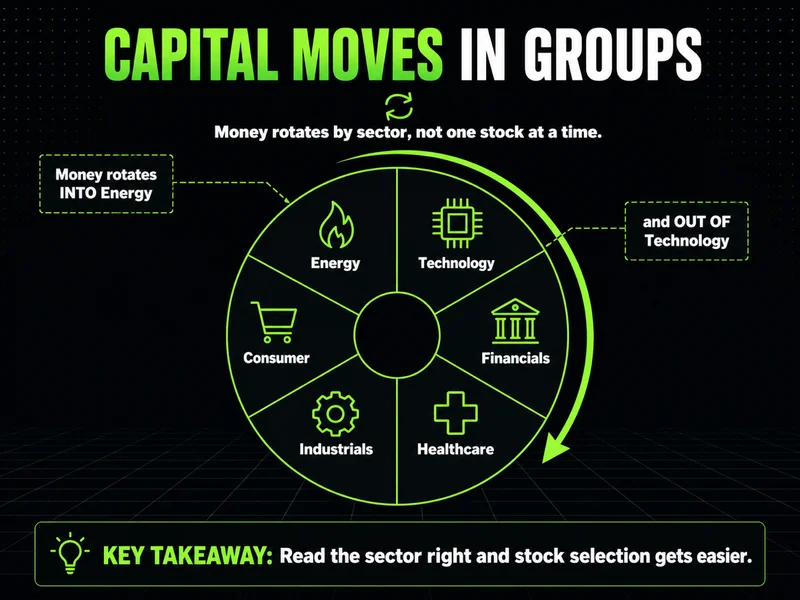
The reason it matters is simple. Capital moves in groups. When money rotates toward energy or out of technology, it rarely moves one stock at a time. It moves the sector. Read the sector correctly and individual selection becomes easier; ignore it and you are picking names in the dark.
What sector analysis actually measures
Sector analysis meaning, stripped down, is an assessment of the conditions and outlook for a slice of the market, such as technology, energy, financials, healthcare, or consumer staples. You are measuring relative strength, the macro backdrop, and how a sector tends to behave at this point in the economic cycle.
Sectors split broadly into cyclical and defensive groups. Cyclical sectors, like industrials, materials, and consumer discretionary, tend to lead when growth is expanding. Defensive sectors, like utilities, staples, and parts of healthcare, tend to hold up better when conditions tighten. The point is not to predict which one wins. It is to know which environment you are in, so your positioning matches the context rather than fighting it. You are not forecasting the index; you are ranking parts of it against each other.
Sector analysis versus industry analysis
The terms get used interchangeably, but they describe different levels of detail. Sector analysis looks at a broad segment of the economy. Industry analysis goes one layer deeper, into the business lines inside that sector.
Technology is a sector. Semiconductors, enterprise software, and consumer hardware are industries within it. The sector can be strong while one industry inside it is under pressure. The sector tells you where capital is flowing; the industry tells you the competitive structure it is flowing into. For most investors the sequence runs top down: sector first, then industry, then the individual company.
A framework for working through a sector
A usable sector analysis framework does not need to be elaborate. It needs to be repeatable. Run the same steps every time so your read stays consistent across different parts of the market.
Define the sector and confirm which index or group of companies represents it.
Place it in the economic cycle. Is it cyclical or defensive, and does the current macro backdrop favor it?
Measure relative strength against the broad market over several timeframes, not just the last week.
Identify the dominant drivers, such as interest rates for financials or commodity prices for energy.
Note the risks that would invalidate the read, including regulation, input costs, and shifting demand.
The top-down approach assesses the economy first and works toward the sector. The sector-rotation approach tracks how leadership shifts between cyclical and defensive groups as the cycle turns. Both are valid. What matters is that you react to what the sector is doing, not to what you expect it to do.
The metrics that carry weight
Not every number deserves attention. A few sector analysis metrics do most of the work; overloading the read with the rest tends to create false confidence rather than clarity.
Relative strength versus the broad market, which shows whether capital is favoring the sector.
Aggregate valuation, such as the sector's blended price-to-earnings level against its own history.
Earnings revision trends across the sector's larger constituents.
Sensitivity to the macro driver that governs the group, like rates, energy prices, or the consumer.
Breadth, meaning how many names in the sector participate rather than one or two carrying it.
Breadth is the one most people skip. A sector index can rise while most of its members go nowhere. That is a narrow, fragile move, and it usually does not survive the first real test.
How sector analysis fits into fundamental analysis
Sector analysis in fundamental analysis is the layer that sits above the company. Fundamental work on a single stock tells you whether the business is sound. Sector work tells you whether the environment around it is supportive or hostile.
The two are meant to stack. A high-quality company in a sector facing structural decline is a harder hold than its balance sheet suggests. Reading them together is what separates a complete thesis from a partial one.
Trading without context is gambling with better vocabulary. A clean balance sheet in a sector the market is abandoning is still a position fighting the flow of capital.
This is why the sequence matters. Study the sector, then the industry, then the company. Skipping the top layer means analyzing the business in isolation, as if the rest of the market does not exist.
Where most beginners get sector analysis wrong
The common sector analysis mistakes are rarely about math. They are about confusing a narrative with a position.
Treating sector analysis as a prediction engine rather than a read on current conditions.
Chasing the strongest sector after it has already run, with no defined level that would say the move is over.
Ignoring breadth and trusting an index move that only a few large names are driving.
Forcing a static framework onto a sector whose dominant driver has changed.
Here is the honest limit. Sector analysis works only while the relationships you are leaning on hold. A defensive sector is defensive until a rate shock or a credit event redraws the map, and then the same group that was a shelter becomes a source of risk. The read that was correct on Friday can be wrong by Monday if the macro driver flips. Treat the framework as context that expires, not as a forecast you can hold indefinitely.
A practical sector analysis checklist you can run
A short sector analysis checklist keeps the process disciplined. As a worked example, imagine an investor weighing energy against utilities heading into a period of rising rates and firm commodity prices.
Ask, in order: Which economic phase favors this sector? Is its relative strength improving or fading against the market? Is the move broad or narrow? What single driver governs the group, and which way is it pointing? And finally, what condition would tell me the read is wrong? In that case, rising rates pressure rate-sensitive utilities while firm commodity prices support energy, and the invalidation is a sharp reversal in those same drivers.
That last question is the one that protects capital. A read without a defined invalidation is just an opinion. With it, sector analysis becomes a tool for managing risk rather than a story told after the fact.
FAQs
What is sector analysis in simple terms? It is the study of a related group of companies, such as a technology or energy sector, to judge how that part of the economy is positioned. It tells you whether the environment around a stock supports it before you analyze the company itself.
How do you do sector analysis step by step? Define the sector, place it in the economic cycle, measure its relative strength against the broad market, identify the single driver that governs it, and note the condition that would invalidate the read. Running the same steps every time keeps the process consistent.
What is the difference between sector analysis and industry analysis? Sector analysis studies a broad segment of the economy; industry analysis goes a layer deeper into specific business lines within it. Technology is a sector; semiconductors and software are industries inside it. Most investors read the sector first.
Why does sector analysis matter in fundamental analysis? Fundamental analysis tells you whether a business is sound; sector analysis tells you whether the environment around it is supportive. A strong company in a weakening sector fights the flow of capital, so the two layers belong together.
What metrics matter most in sector analysis? Relative strength against the market, aggregate valuation versus the sector's own history, earnings revision trends, sensitivity to the sector's main macro driver, and breadth. Breadth is the most overlooked, because a narrow move carried by a few names is fragile.
What are common sector analysis mistakes beginners make? Treating it as a prediction rather than a read on current conditions, chasing a sector after it has already run, ignoring breadth, and holding a framework after the sector's main driver has changed. Each one substitutes a narrative for a defined position.
How does sector analysis help stock analysis? It supplies the context a single-stock study cannot see. Knowing whether a sector has tailwinds or headwinds changes how much weight you put on a company's fundamentals, and it helps you avoid strong names trapped in weak sectors.
Worth the read?