Ask in Trading — The Price Most Beginners Overlook
The ask price is the lowest price a seller will accept. For buyers using market orders, the ask determines your fill. Here is how it works and why it matters.
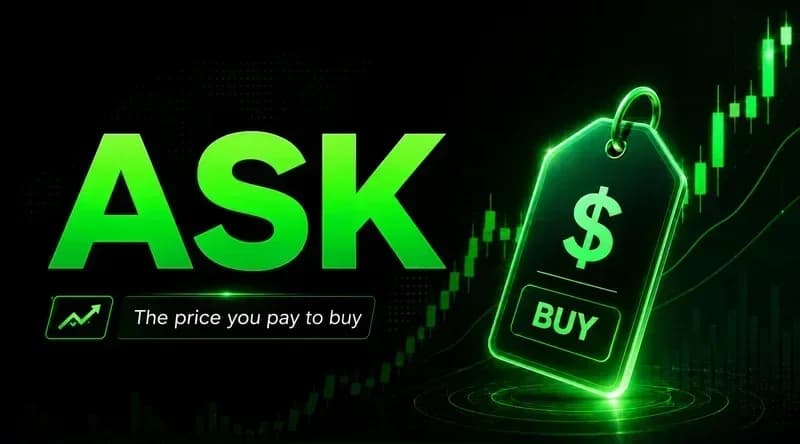
Most new traders fixate on charts, indicators, and setups while ignoring the single number that determines whether their order fills: the ask. The ask price is the lowest price a seller is currently willing to accept for an asset. If you are buying with a market order, the ask is the price you will get.
What the ask price actually means
Every asset on an exchange displays two prices. The bid is the highest price a buyer will pay. The ask is the lowest price a seller will accept. Together they form the bid-ask spread, which is the cost of immediate execution.
The ask is not a suggestion. It represents a real order sitting on the book, placed by someone willing to sell at that level right now. When a market buy order comes in, it consumes that resting sell order. The next ask then shifts to whatever the next seller has posted.
In liquid markets like the S&P 500 or Nasdaq futures, the ask updates hundreds of times per second. In thinner markets — small-cap equities, certain options chains, or low-volume altcoins — the ask may sit far from the last traded price, which creates execution risk.
How to read the ask on an order book
An order book displays bids on one side and asks on the other. The top of the ask side is the best available price for buyers.
Level | Bid Price | Bid Size | Ask Price | Ask Size |
|---|---|---|---|---|
1 | 150.00 | 200 | 150.05 | 150 |
2 | 149.95 | 300 | 150.10 | 100 |
3 | 149.90 | 500 | 150.15 | 250 |
In this example, 150.05 is the ask. A market buy for 150 shares fills at 150.05. If you need 300 shares, the first 150 fill at 150.05 and the rest fill at 150.10. This is walking the book, and it is where slippage begins.
Ask vs. bid — the difference that costs you money
The spread between the bid and the ask is a real cost. On a stock priced at $150 with a $0.05 spread, you lose $0.05 per share the moment you enter a long position and immediately exit. That may sound small, but for active traders running hundreds of orders per week, spread costs compound.
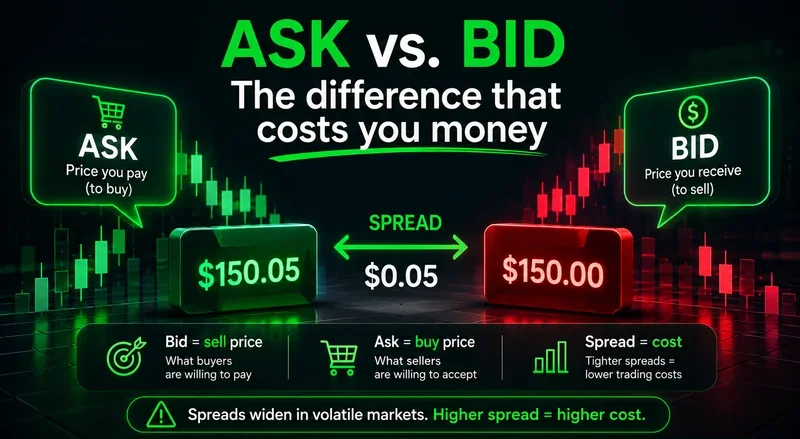
Key differences between bid and ask:
Bid — the price you receive when selling. It is what buyers are willing to pay right now.
Ask — the price you pay when buying. It is what sellers are willing to accept right now.
Spread — the gap between them. Tighter spreads mean lower execution costs and better liquidity.
In fast-moving markets, the spread can widen sharply. During a volatility spike, a spread that is normally $0.02 can expand to $0.50 or more.
How the ask affects execution quality
Execution quality is not just about getting filled. It is about getting filled at a price that makes sense relative to the market's current state.
When the ask is thin — meaning small order sizes at each level — a market buy order will eat through multiple price levels. The average fill price drifts higher than the displayed ask. This is slippage, and it is the silent cost most beginners do not account for.
Two scenarios show the difference:
Liquid market — the ask at level 1 shows 500 contracts. You buy 50 contracts. You fill entirely at the displayed ask. No slippage.
Illiquid market — the ask at level 1 shows 10 contracts. You buy 50 contracts. You eat through multiple levels. The average fill price is meaningfully worse.
"Execution quality matters more than finding secret setups. Most edges disappear when discipline disappears." — MRPNL
This distinction matters for every order type. Limit orders protect against paying above your target, but they risk not filling if the ask moves away. Market orders guarantee a fill but give up price control. The ask is the reference point both order types measure against.
What most traders get wrong about the ask
The most common mistake is treating the ask as a static number. It shifts constantly as orders are placed, canceled, and filled. Watching the ask move in real time tells you more about immediate supply and demand than most lagging indicators.
Another frequent error is ignoring the ask during pre-market or after-hours sessions. Spreads widen outside regular trading hours, and the ask can sit several percent above the last close. Traders placing market orders in those windows often pay more than expected.
When relying on the ask price breaks down
The ask becomes unreliable during extreme volatility events — earnings releases, Federal Reserve announcements, or flash crashes. During these moments, order books thin out as market makers pull their quotes. The displayed ask may represent a single small order far from fair value. In those conditions, the ask is less a reflection of supply and more a signal that liquidity has temporarily disappeared.
Professional traders adjust by widening their acceptable fill range or switching to limit orders with defined slippage tolerance. The ask cannot be taken at face value when the book is hollow.
FAQs
What is the ask price in simple terms? The ask price is the lowest price at which someone is willing to sell an asset. When you place a market buy order, you pay the ask.
How is the ask different from the bid? The bid is what buyers will pay; the ask is what sellers want. The gap between them is the bid-ask spread, which represents your cost of immediate execution.
Why does the ask price change so fast? The ask updates every time an order is placed, filled, or canceled on the sell side of the book. In liquid markets, this happens hundreds of times per second.
Can I buy below the ask price? Yes, using a limit order set below the current ask. However, the order will not fill unless the ask drops to your limit price. There is no guarantee that happens.
The ask is where execution starts
Every trade begins with a price. For buyers, that price is the ask. Understanding how it moves, what it costs, and when it becomes unreliable separates traders who execute with precision from those who pay more than they need to.
Worth the read?