Day Trading — What It Is and How It Actually Works
Day trading means opening and closing positions inside one session. What it is, how it works, the real risks, and the checklist that keeps the process honest.

Day trading is the practice of opening and closing positions within the same session, so no market exposure is carried overnight. That part is simple. What most new traders get backward is the purpose: the point is not catching fast moves. It is closing risk before the market can act on it while you cannot respond.
Most day trading losses have little to do with strategy selection. They come from trade frequency, position size, and decisions made under pressure. This guide covers what day trading involves, how it differs from swing trading, where the risk concentrates, and the checklist that keeps the process honest.
What day trading means and how it works
The day trading meaning is narrow by design: buy and sell the same instrument within one session, and finish the day flat. The instruments vary — stocks, ETFs, index futures, currencies, options — but the constraint is constant.
How does day trading work in practice? The session starts before the open. The trader marks the levels that matter — the prior day's high and low, the overnight range, areas where liquidity is likely resting — and defines which setups are tradable. During the session, the job is waiting for price to reach those areas, reading the reaction, and executing with defined invalidation. A day trading strategy can lean on momentum, breakouts, range rotation, or scalping; the workflow underneath is the same: plan, wait, execute, manage, flat by the close.
Margin makes the math sharper in both directions. Intraday buying power is typically several times account equity, so a small adverse move on an oversized position can erase weeks of careful work. Leverage amplifies whatever process already exists.
Day trading vs swing trading — the real difference is overnight risk
The comparison usually gets framed as fast versus slow. The difference that matters is what each approach is exposed to when the trader is not watching.
| Day trading | Swing trading | |
|---|---|---|
| Holding period | Minutes to hours, flat by close | Days to weeks |
| Overnight gap risk | None | Full exposure to gaps and news |
| Decision speed | Fast, under pressure | Slower, more deliberation time |
| Screen time | The full session | Periodic check-ins |
| Cost profile | More trades, more fees and slippage | Fewer transactions |
| Margin treatment | Intraday buying power, pattern day trader rules | Standard margin |
Day trading vs swing trading is not a question of which is better, but of which risks a trader is equipped to carry. The day trader accepts execution pressure and transaction costs in exchange for sleeping flat. The swing trader accepts gap risk in exchange for time to think. A trader who cannot watch the screen for full sessions has already answered the question.
A day trading example for new traders
A clean day trading example, the kind that repeats in index futures: price grinds toward the prior session high in the first hour. Resting orders cluster above a level like that — stops from shorts, breakout entries waiting for confirmation. Price sweeps through the high, fills that liquidity, and stalls. No acceptance above the level. Sellers step in, and the next bars close back inside the prior range.
That failure is the trade. The short entry comes on the rejection, with invalidation above the swept high — if price reclaims and holds that level, the idea is wrong and the position is closed at a small, planned loss. If the rejection holds, the position is managed toward the next area of interest and closed before the session ends.
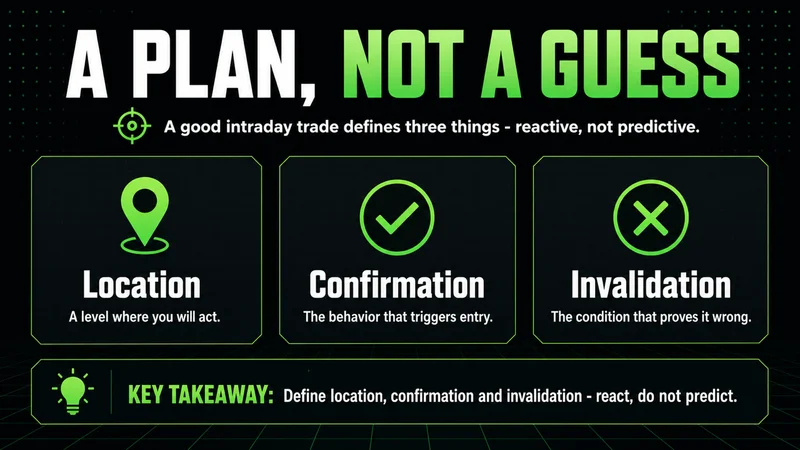
Notice what the example does not contain: prediction. It defined a location, a confirming behavior, and the condition that would prove it wrong. Reactive, not predictive.
The main risks of day trading
The risks of day trading are well documented, and regulators are blunt: most nonprofessional traders who attempt it are not profitable over the long term. The reasons concentrate in a few places:
- Leverage. Intraday margin amplifies losses at the same rate as gains.
- Transaction costs. Commissions, fees, and spread costs scale with frequency. A strategy that wins on paper can lose after costs.
- Volatility without context. Short-term price movement is noisy. Without a structural read, there is no edge in it to extract — only activity.
- Emotional compounding. Losses arrive quickly intraday, and the time to react is short. Decision quality degrades exactly when it matters most.
The last item is the one the statistics undercount. A trader takes two planned stops, feels the session slipping, and doubles size on the third trade to recover it. That third trade is where accounts break.
Small losses are operational costs. Large losses are usually emotional decisions.
When a single planned stop starts steering the next decision, the sizing was wrong from the start. That pattern explains more blown accounts than flawed strategy does.
Day trading rules and the mistakes that compound quietly
In U.S. margin accounts, the main constraint is the pattern day trader rule. Execute four or more day trades within five business days — when those trades exceed 6% of total account activity — and the account is flagged and must maintain minimum equity of $25,000 to continue day trading. FINRA sets the framework; brokers often layer their own requirements on top. Futures accounts sit outside this rule, but exchange margin imposes its own discipline.
The rules that matter more are the ones nobody enforces for you. The common day trading mistakes are not exotic:
- Sizing positions so large that a normal stop feels like an event.
- Moving a stop because the trade "needs more room."
- Averaging into a losing position.
- Trading the first minutes after a news release, before structure has formed.
- Forcing trades in quiet conditions because the session feels unproductive.
- Ending every red day with a recovery attempt instead of a shutdown.
Each one feels minor in the moment. Rule-breaking compounds quietly before it becomes obvious. Most account failures are a sequence of small concessions, not one bad trade.
When should traders use day trading — and when it stops working
Day trading fits a specific set of conditions: liquid instruments, sessions with real participation, and a trader who can give the market full attention with a tested process and capital they can afford to risk. When those hold, the intraday approach converts short-term volatility into defined-risk opportunities with no overnight exposure.
It is equally important to name when it does not work. The same breakout sequence that pays cleanly in a trending, high-participation morning produces a string of small stops in low-volatility midday chop — the structure looks identical on the chart, but there is no participation behind it to carry the move. Macro-driven sessions invert the problem: structure can read cleanly for hours and then invalidate within minutes when the headline hits. In both regimes, the correct play is usually to stand aside. Flat is a position. Frequency is a cost, not an edge — the fewer, better-selected trades tend to carry the month.
A day trading checklist for new traders
A day trading checklist is the mechanism that keeps decisions consistent when the session gets fast. Before and during every session:
- Define risk per trade before the open — a common guideline is 1% to 2% of capital — and size positions from that number, not from conviction.
- Set a maximum daily loss. When it hits, the session is over.
- Mark key levels before the bell: prior high and low, overnight range, open price.
- Write down which setups are tradable today. If a trade is not on the list, it does not get taken.
- Demand confirmation at levels — acceptance or rejection — instead of anticipating the move.
- Close everything before the session ends. A day trade carried overnight is a different trade, taken without a plan.
- Journal every execution, including the trades skipped.
The checklist will not make a session profitable. It makes losses planned, small, and survivable — which gives any edge time to show up.
FAQs
What is day trading in simple terms? Day trading means buying and selling the same financial instrument within one trading session, so every position is closed before the market closes. The goal is to profit from intraday price movement with no overnight exposure.
Is day trading good for beginners? Generally, no — it is the most demanding starting point in trading. Decisions are fast, costs are high, and mistakes compound quickly. Beginners are better served learning structure and risk management on slower timeframes or in a simulator first.
How much money do I need to start day trading? In a U.S. margin account, a pattern day trader must maintain at least $25,000 in equity. Cash and futures accounts are not bound by that rule, but the account still has to absorb a normal string of losses without forcing oversized positions.
Is day trading profitable? It can be, but the base rate is poor — most nonprofessional day traders lose money over time. The traders who last treat it as a performance profession: defined risk, controlled frequency, and a process that survives losing streaks.
How many hours a day does day trading take? More than the session itself: preparation before the open, full attention during the hours traded, and review afterward. Many professionals trade only the first one to two hours and stand aside for the rest.
Worth the read?