Financial Markets — A Trader's Guide for Beginners
Financial markets are venues where assets trade and price is set by supply and demand. A practical beginner's guide to how they work and which to trade.
Financial markets are the places where buyers and sellers exchange assets like stocks, bonds, currencies, and commodities, and where the price of each asset is set by supply and demand in real time. That is the textbook answer. The part most beginners miss is that a market is not a neutral playing field. It is a record of where money is positioned, and price moves when that positioning shifts.
Most guides treat financial markets as a list of definitions to memorize. You do not trade a definition. You trade the behavior of other participants, and that behavior is what this guide focuses on.
What are financial markets in trading?
A financial market is any venue, physical or electronic, where financial instruments are bought and sold at an agreed price. That price is the only thing that matters to your account. It reflects what participants will pay right now, not what an asset is worth in theory.
Markets exist to do a few specific things:
- Move capital from people who have it to businesses and governments that need it.
- Let holders of an asset sell it again, which is what we call liquidity.
- Transfer risk from one participant to another at a price both accept.
- Set a continuous, public price through ongoing trading.
When you place a trade, you step into that last function. You take one side of a price that someone else takes the other side of, and one of you is positioned better than the other.
How financial markets work day to day
Price is set by order flow. Buyers post bids, sellers post offers, and trades happen where the two meet. When buyers are more aggressive, price rises until enough sellers appear to absorb the demand. When that absorption fails to hold, price moves on.
This is why reading a market is closer to reading behavior than reading news. A headline can be bullish while price falls, because positioning going into it was already crowded on the long side. Liquidity drives markets more than opinions do.
Markets also split into two layers. The primary market is where an asset is first issued, such as a company selling new shares. The secondary market is where everyone else trades it afterward. Almost all of your trading happens in the secondary market, where price discovery is continuous and structure forms.
The main types of financial markets, with examples
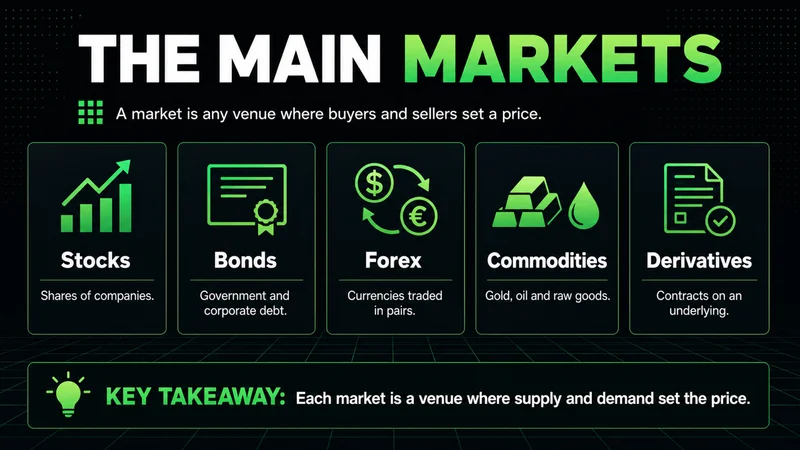
Markets are usually grouped by what trades in them. For a beginner, four matter most.
- Stock market. Shares of ownership in public companies. Examples include the S&P 500 index and individual equities. Prices respond to earnings, positioning, and broad risk sentiment.
- Bond market. Debt issued by governments and companies. Bonds set the cost of borrowing and often move ahead of stocks during stress.
- Commodities market. Physical goods like gold, oil, and agricultural products, traded directly and through futures. Gold respects structure for long stretches, then invalidates a clean setup within minutes once macro volatility expands.
- Foreign exchange (forex) market. Currencies traded in pairs, such as EUR/USD. It is the largest and most liquid market and trades nearly around the clock.
There is also the derivatives market, where futures and options derive their value from an underlying asset. Index futures like NQ and ES sit here, where much professional, risk-defined trading takes place.
Financial markets versus asset classes explained
These two terms get used interchangeably, and they should not be. A financial market is the venue where trading happens. An asset class is the category of thing traded.
The stock market is a market. Equities are the asset class that trades there. The same holds across the board: the bond market trades fixed income, the forex market trades currencies. One venue can list several instruments, and one asset class can trade across several venues. Keeping the venue separate from the instrument keeps your analysis clean, because liquidity and session behavior belong to the venue, while fundamentals belong to the asset.
How to choose financial markets for a trading plan
The taxonomy above is where most beginner guides stop. The harder question is which market fits you, and that is a decision about liquidity, volatility, and the hours you can sit at the screen.
Work through it in order:
- Match the market's active session to the hours you can actually trade. A market you watch only part time will punish you on the moves you miss.
- Match the volatility to your risk tolerance. Index futures move fast and punish hesitation; a broad bond fund moves slowly. Neither is better; they demand different temperaments.
- Confirm the market is liquid enough to enter and exit at the price you see. Thin markets fill you worse, and that cost compounds.
- Pick one market and stay there long enough to build pattern recognition. Spreading attention across five markets early usually means learning none of them.
The market rewards patience far more than activity. One venue learned well beats five sampled at once.
The main risks of trading financial markets
Every market carries the same core risk: price can move against your position, and leverage can make that move larger than your account can absorb. Most beginners are overleveraged without realizing it. If one losing trade affects your next decision, the position was too large.
The structural read that works in calm conditions is also conditional. A clean sequence of higher highs and higher lows reads reliably during regular cash-session hours on a liquid market. Overnight, on thin liquidity, that same sequence can mean almost nothing, because a few orders can push price through a level with no real participation behind it. Knowing when your read does not apply matters as much as the read itself.
Protecting capital is the first objective. Define your invalidation before you enter, size so a single loss is survivable, and treat small losses as the cost of staying in the game.
FAQs
What are financial markets in simple terms? They are venues where people buy and sell assets like stocks, bonds, currencies, and commodities, with price set continuously by supply and demand. Each trade has a buyer and a seller taking opposite views of that price.
Are financial markets good for beginner traders? They can be, if the beginner treats them as a process to learn rather than a source of fast money. Starting with one liquid market and a defined risk per trade beats spreading attention across several.
What is the difference between financial markets and asset classes? A financial market is the venue where trading happens; an asset class is the type of instrument traded. The stock market is a venue, and equities are the asset class within it.
How do financial markets actually work? Buyers post bids and sellers post offers, and trades occur where the two meet. Price rises when buyers are more aggressive and falls when sellers are, so reading order flow matters more than reading headlines.
What are examples of financial markets for beginner traders? The stock, bond, commodities, and foreign exchange markets are the four most common starting points. Index futures sit in the derivatives market and are common among more experienced traders.
What account requirements do financial markets have? Most require a brokerage account, identity verification, and a funded balance, with minimums that vary by broker and instrument. Leveraged products like futures carry margin requirements you should understand before funding.
Where to go from here
If this is your starting point, keep the next steps narrow. Pick one market that matches your hours and risk tolerance. Learn how its liquidity behaves across sessions. Practice defining invalidation and sizing before every trade, so capital preservation becomes a habit. The taxonomy of markets is easy to memorize, but the edge comes from understanding the behavior inside one of them well enough to act with discipline.
Worth the read?