Forex — What It Is and How It Actually Works
Forex is the market where one currency is traded against another in pairs. Here is what forex actually is, how it works, and the risks beginners miss.
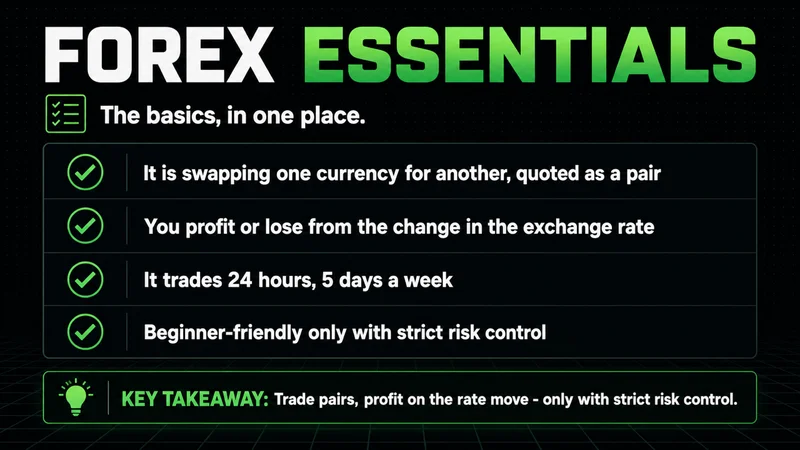
Forex is the market where one currency is exchanged for another, traded in pairs like EUR/USD, with daily turnover above $7 trillion. It is the largest and most liquid market in the world, it runs 24 hours a day for five days a week, and it has no central exchange. Most of what beginners read about forex explains the mechanics correctly and the reality poorly. The mechanics are simple. Surviving them is not.
The pitch is always the same: deep liquidity, low barriers to entry, a market open around the clock. All of that is true. None of it tells you why most retail accounts lose money. The structure of forex is what makes it accessible, and the same structure is what makes it unforgiving when execution is sloppy.
What forex actually is
Forex, short for foreign exchange, is the global market for trading national currencies against each other. The forex meaning is literal: you are exchanging one currency for another and trying to profit from the change in their relative value. When you buy EUR/USD, you are buying euros and selling dollars in a single transaction. There is no certificate, no share of a company, no underlying asset beyond the currencies themselves.
Price moves because the relationship between two currencies moves. Interest rate differentials, capital flows, central bank policy, and positioning all push the exchange rate up or down. You are never trading a currency in isolation. You are always trading one against another, which is why context matters more here than in almost any other market.
The participants are worth understanding, because they explain why the market behaves as it does. Large banks transact the bulk of the volume, settling trade flows and hedging exposure for corporations and governments. Hedge funds and asset managers take directional positions. Central banks influence value through policy and, occasionally, direct intervention. Retail traders sit at the end of this chain, trading through brokers, on the same prices but with none of the size. Recognizing where you stand in that order is the start of trading with realistic expectations rather than imagined ones.
How the forex market works
The forex market is decentralized. There is no single building where trades clear. Instead, a network of banks, brokers, funds, and individual traders transacts electronically, over the counter, across every major financial center. As one session closes another opens, which is how forex stays open 24 hours a day through the trading week.
That continuous structure is the part beginners underestimate. A stock has a clear open and close, a settled price you can anchor to overnight. Forex does not stop. The level you fell asleep watching can be unrecognizable by the time you wake up, because liquidity rotated to a different region and the participants changed entirely. Understanding how forex works in financial markets means accepting that the market keeps moving whether you are watching or not.
Liquidity drives this market more than opinions do. Positioning and order flow often matter more than the headline that supposedly caused the move. The most actively traded pairs absorb enormous size with little slippage during peak hours, and the same pairs can gap and thin out when the major centers are closed.
The trading day rolls through four major sessions, each with its own character:
- Sydney — the quiet open, thin liquidity, modest ranges.
- Tokyo — Asian flows and yen pairs become active.
- London — the largest session, deepest liquidity, the bulk of daily volume.
- New York — overlaps London for several hours, the window where the most decisive moves tend to print.
Liquidity is deepest where London and New York overlap, which is when spreads tighten and price tends to move with conviction. The quieter handoffs, such as the late New York close into the Sydney open, are when ranges go thin and a small order can push price further than the move deserves. Knowing which session you are trading is not a detail. It is the difference between a fill at a fair price and a fill that slips against you before the position is even working.
This is also why the same setup is not equal at all hours. A clean break of structure during the London or New York session, backed by real participation, carries weight. The identical pattern overnight, on thin liquidity, often means almost nothing, because the volume confirming it is not there. The chart looks the same. The context behind it does not.
Currency pairs, pips, and what a quote really tells you
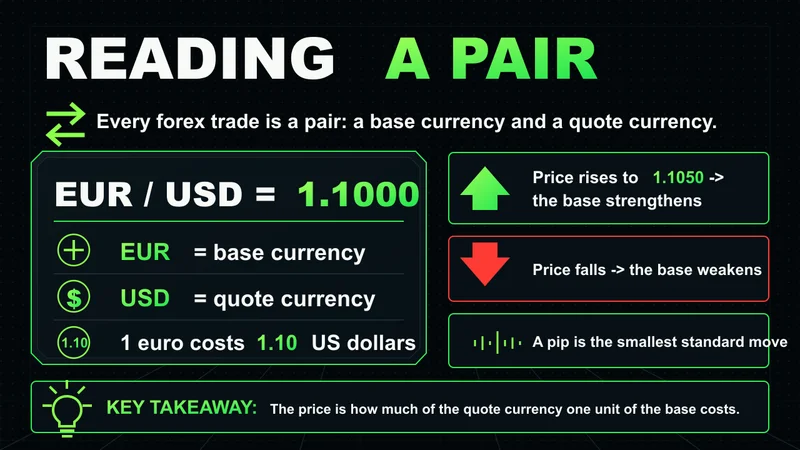
Every forex trade is a pair. The first currency is the base, the second is the quote. A EUR/USD price of 1.1000 means one euro costs 1.10 U.S. dollars. If the price rises to 1.1050, the euro strengthened against the dollar. If it falls, the dollar strengthened. These are the kind of forex examples that beginner traders actually need: not abstract definitions, but the direct reading of a quote.
Pairs are grouped into three tiers:
- Majors — the most traded pairs, all involving the U.S. dollar, such as EUR/USD, USD/JPY, and GBP/USD. Tight spreads, deep liquidity.
- Minors — pairs without the dollar, such as EUR/GBP or EUR/JPY. Still liquid, slightly wider spreads.
- Exotics — a major currency against a smaller economy's currency. Wider spreads, thinner liquidity, sharper moves.
The tier you trade decides your cost and your risk profile before you place a single order:
| Pair type | Examples | Liquidity | Typical spread | Best for |
|---|---|---|---|---|
| Majors | EUR/USD, USD/JPY, GBP/USD | Deepest | Tightest | Beginners and consistent execution |
| Minors | EUR/GBP, EUR/JPY, GBP/JPY | Strong | Slightly wider | Experienced traders adding variety |
| Exotics | USD/TRY, USD/ZAR, EUR/SEK | Thin | Widest | Specific macro views, not learning |
Movement is measured in pips. For most pairs a pip is the fourth decimal place, 0.0001; for yen pairs it is the second decimal, 0.01. The spread, the gap between the bid and the ask, is your cost of entry on every trade. On a major pair it might be a fraction of a pip. On an exotic it can be many times that, which quietly erodes a strategy that looked fine on paper.
Lot size is the other half of the math. A standard lot is 100,000 units of the base currency, a mini lot is 10,000, and a micro lot is 1,000. The lot size sets how much each pip is worth, which is how a small move in the exchange rate becomes a meaningful change in your account balance. Beginners who trade large lots relative to their account discover this quickly, and rarely in a pleasant way. The size of the position, not the direction of the trade, is usually what decides whether a normal loss is survivable.
Forex vs stocks: the difference that matters for execution
Most forex vs stocks explainers stop at the obvious: stocks are shares in a company, forex is currency against currency. That distinction is real but shallow. The difference that affects your execution is structural.
Stocks trade on centralized exchanges with fixed hours and reported volume you can trust. Forex is over the counter and continuous, so the volume you see depends on your broker's feed rather than a single exchange tape. Stocks can be moved by a single earnings report or a single company's news. A currency pair reflects two entire economies, so it tends to trend on macro forces and grind through ranges between them.
Leverage is the sharpest contrast. Equity accounts are typically capped at modest leverage. Retail forex routinely offers far more, and that access is marketed as opportunity. It is also the fastest way to turn a normal drawdown into a margin call. The forex vs stocks decision is less about which is better and more about which structure matches your discipline. If unlimited screen time and high leverage tempt you into overtrading, the 24-hour market will find that weakness quickly.
There is also a difference in what you are actually analyzing. A stock trader can study one company, its earnings, its sector, and its competitors, and build a focused view. A forex trader is always weighing two economies against each other, so the relevant inputs are interest rate paths, inflation prints, employment data, and central bank tone from both sides of the pair. Forex explained for beginners often skips this, but it is the reason a currency pair can trend for weeks on a single shift in rate expectations. The fundamentals are macro, slow-moving, and relative. The price action that expresses them is fast.
What you need to open a forex account
The forex account requirements are light, which is part of the problem. The barrier to entry is low enough that most people start before their process is ready. At a minimum you need a regulated broker, a funded account, a platform, and a verified identity.
- A broker regulated in your jurisdiction, with transparent spreads and execution.
- A starting balance you can afford to lose entirely without it affecting your decisions.
- A trading platform with charting, order types, and reliable order routing.
- Identity verification to meet the broker's compliance rules.
Margin is the deposit that supports a leveraged position. A pair might require only a small percentage of the notional value to hold, which is exactly why position sizing has to be deliberate rather than maximal. The account minimum a broker advertises is not the same as the account size that lets you trade with a clear head.
Choosing the broker matters more than choosing the deposit size. Regulation is the first filter: a broker overseen by a recognized authority is held to standards on client fund segregation and execution that an offshore shop is not. After that, look at how the broker makes money. Tighter spreads with a transparent commission usually beat a wide, opaque spread, because the cost you cannot see is the cost that erodes a small account fastest. The platform should feel boring and reliable, not feature-stuffed. You want it to disappear so you can focus on the decision in front of you.
Forex trading basics, step by step
Forex trading basics are easy to list and hard to follow under pressure. The sequence below is the process, not a shortcut.
- Learn to read a quote, a spread, and a pip until it is automatic.
- Open a demo account and practice on live prices without risking capital.
- Define your risk per trade before you look for a single setup.
- Build a simple plan: what you trade, when you trade it, and what invalidates the idea.
- Take entries only when structure, liquidity, and your plan agree.
- Manage the position with a defined stop and a reason to exit.
- Journal every trade and review the process, not just the result.
The market rewards patience far more than activity. Most new traders believe they need more setups. They need fewer trades and better risk control.
Forex trading basics step by step is not a promise of profit. It is a way to make sure your losses are small and operational instead of large and emotional. Confidence should come from following the process, not from a recent green day.
The demo stage is where most beginners cut corners. They treat paper trading as a formality and rush to fund a live account, then act surprised when real money changes their behavior. Demo trading is not about proving you can be profitable in a risk-free environment. It is about building the mechanical habits, placing orders, setting stops, and sizing positions, until they require no thought. When real capital is on the line, you want the mechanics handled automatically so your attention is on the decision, not the buttons.
A simple plan beats a complicated one almost every time. Clear structure, defined risk, and disciplined management outperform a chart buried under indicators searching for a certainty that does not exist. Indicators are tools, not decision-makers. The trader who knows exactly what invalidates the idea before entering has an edge over the one chasing confirmation from five overlapping signals.
The risks beginners underestimate
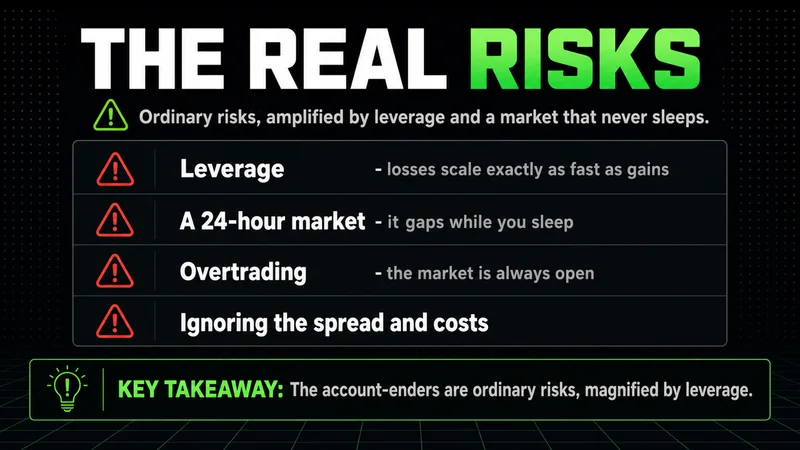
The main risks of forex trading are not exotic. They are the ordinary ones, amplified by leverage and a market that never sleeps. The ones that actually end accounts cluster into a short list:
- Leverage risk — losses scale exactly as fast as gains, and a position sized for the upside becomes a margin call when the pair turns.
- Liquidity risk — thin overnight sessions can run a stop further than the move warrants.
- Volatility risk — economic releases and central bank decisions can gap price through your level.
- Behavioral risk — the 24-hour market rewards overtrading, revenge trading, and trading while tired.
Leverage magnifies losses exactly as fast as it magnifies gains. A position sized for the upside becomes a margin call when the pair moves against you, and forex pairs move against you often.
The round-the-clock structure is its own risk. A stop set during a liquid session can be run through on thin overnight liquidity, when a few orders move price further than they would at peak hours. The clean technical read you had during the London or New York session can mean almost nothing when liquidity rotates to a quieter region. That is the honest answer to where this breaks down: structure holds while the major centers are active, and the same structure can fail on thin liquidity outside them.
Most account blowups happen gradually before they happen suddenly. Rule-breaking compounds quietly during a drawdown until the loss is no longer operational. The risk that ends accounts is rarely a single bad trade. It is oversized positions taken during emotional sessions, repeated until the math turns final.
Most traders do not have a strategy problem. They have a discipline problem. Breaking the rules during a drawdown destroys more accounts than poor analysis ever does. The plan held up fine until a few losses in a row made it feel inadequate, and the trader abandoned the process at the exact moment it mattered most. A losing day does not require immediate recovery, but the urge to make it back is what turns a manageable red day into a real problem.
There is one more risk that rarely makes the standard lists: fatigue. A market open around the clock invites you to trade around the clock, and tired execution is poor execution. Stepping away from the screen is sometimes the highest-quality decision available. Knowing when not to trade is part of the job, not an absence of it.
Protecting capital is the first objective. Whether forex is good for beginner traders depends entirely on whether the beginner treats it as a process to be managed or a fast outcome to be chased.
FAQs
What are forex in trading, in simple terms? Forex is the exchange of one currency for another, always quoted as a pair such as EUR/USD. You profit, or lose, from the change in the exchange rate between the two currencies.
Is forex good for beginner traders? It can be, but only with strict risk control. The low barrier to entry and high leverage make it easy to start and easy to lose money fast, so the process matters more than the market choice.
How does forex work in financial markets? It runs as a decentralized, over-the-counter network of banks, brokers, and traders transacting electronically across global sessions, which keeps it open 24 hours a day for five days a week.
What are the main risks of forex trading? Leverage that magnifies losses, thin overnight liquidity that can run stops, and the emotional overtrading the 24-hour market encourages. Most damage comes from poor sizing during volatile sessions, not from a single trade.
How do I choose forex pairs for a trading plan? Start with major pairs for their tight spreads and deep liquidity, match the pair's active hours to your own schedule, and avoid exotics until your process is consistent.
The bottom line
Forex is the largest, most liquid, and most continuously open market available, and that accessibility is exactly what makes it dangerous for an unprepared trader. The mechanics, currency pairs, pips, spreads, and leverage, can be learned in a weekend. The discipline to trade them with defined risk takes far longer.
If you are building a forex checklist for new traders, keep it short and behavioral: trade major pairs, define risk before entry, size so a single loss never affects your judgment, and review the process instead of the score. The market does not reward effort or conviction. It rewards survival, and survival is built on capital preservation, not prediction.
Worth the read?