Leverage and Margin Trading, Explained for Beginners
Leverage and margin trading explained for beginners usually skips the part that matters most: the math that decides how fast a position can fail. Leverage is borrowed exposure. Margin is the collateral the broker holds against that exposure. The two only feel different until the market moves against the position, at which point they collapse into the same question: does the account still have enough equity to keep the trade open?
Most beginners do not blow accounts because they were wrong. They blow accounts because they were the right size on the wrong account.
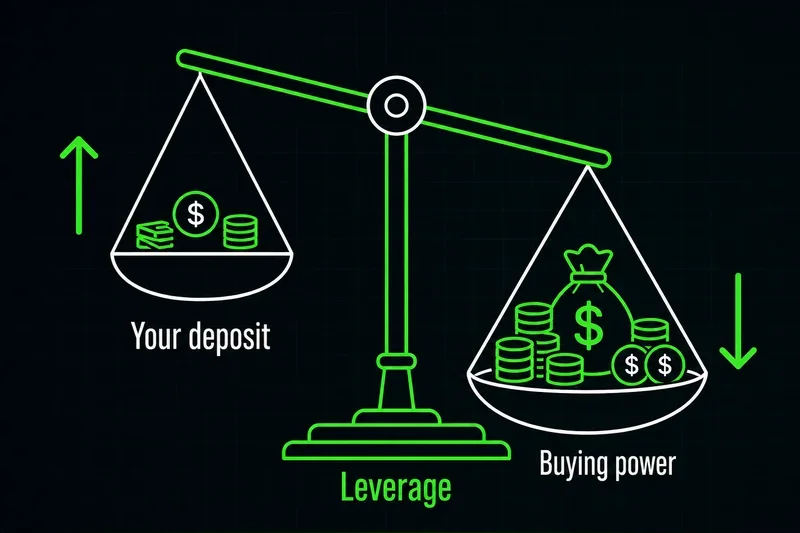
What leverage and margin actually are
Leverage is a ratio. It tells you how much notional exposure the broker lets you control for every dollar of your own capital. A 10:1 ratio means $1,000 of capital controls $10,000 of position. The broker is not gifting you the other $9,000 — it is letting you act as if you have it, with your $1,000 sitting as collateral.
Margin is that collateral. The broker holds it, and if the position loses value, the broker can demand more or close the trade. Leveraged trading is just the act of taking that ratio above 1:1. Every futures contract, every CFD, every margin-enabled stock account works this way. Only the numbers change.
The relationship between leverage and the margin requirement is mechanical: a 20:1 ratio implies a 5% margin requirement. A 50:1 ratio implies 2%. The smaller the percentage you have to post, the faster a small adverse move consumes it.
How a margin account works in practice
When you open a leveraged position, two numbers get carved out of your balance. The first is the initial margin — the collateral the broker requires up front to open the trade. The second is the maintenance margin — the minimum equity you must keep in the account for the position to stay open.
If the trade moves in your favor, the unrealized profit adds to your equity and your available margin grows. If it moves against you, your equity drops. The position is fine while equity stays above the maintenance margin threshold. Once it drops below, the broker is no longer your patient counterparty.
The sequence usually looks like this:
Equity holds above maintenance margin — the position runs.
Equity touches maintenance margin — a margin call may be issued, asking for more funds.
Equity falls below the broker's liquidation threshold — the position is closed at market, regardless of price.
Liquidation is not a warning. It is the broker protecting itself, not protecting you.
How margin call math actually works
This is the part most beginner guides skip. A worked example makes the risk concrete.
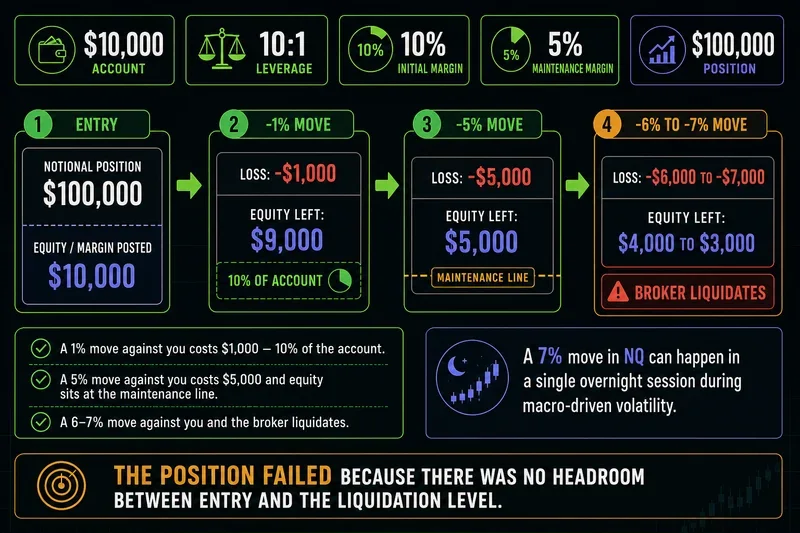
Assume a $10,000 account, 10:1 leverage, and an instrument requiring 10% initial margin and 5% maintenance margin. You open a $100,000 notional position. Initial margin posted: $10,000. A 1% move against you costs $1,000 — 10% of the account. A 5% move costs $5,000 and equity now sits at the maintenance line. A 6–7% move and the broker liquidates.
A 7% move in a major index futures contract is not a black-swan event. NQ can do that in a single overnight session during macro-driven volatility. The position did not fail because the trader was wrong. It failed because there was no headroom between entry and the liquidation level.
This is also where the framework can invert. In thin liquidity sessions — Asian hours, holiday tape, around major economic releases — slippage can carry price past the maintenance level before any human reaction is possible. The same 5% maintenance buffer that feels safe in normal cash hours can be cleared in seconds when the book is empty. The math doesn't change. The fill quality does.
What is initial margin and what is maintenance margin
Initial margin is the deposit the broker requires to open a position. It is set by the exchange for futures, by the broker for CFDs and margin stock accounts, and by regulators in some jurisdictions. Think of it as the price of entry.
Maintenance margin is lower than initial margin. It is the minimum equity the position must maintain to stay open. The gap between the two is your working room. When the trade is profitable, that room grows. When it loses, the room shrinks toward zero.
The key beginner mistake is treating the initial margin as the risk. It isn't. The risk is the full notional exposure of the position. Posting $1,000 to control $10,000 means a 10% move wipes the deposit. The broker is exposed to none of that loss — you are.
What is a margin call in trading
A margin call is the broker's request for more collateral when equity drops below the maintenance threshold. It can arrive as an email, a platform notification, or — in fast markets — as an automatic position close with no warning at all.
Three things tend to follow a margin call:
The account is asked to deposit more funds to restore the buffer.
The position is partially closed by the broker to reduce exposure.
The position is fully liquidated at market.
Which one happens depends on the broker's policy, the market's speed, and how far below the maintenance line the account has fallen. In modern retail brokerage, the third outcome is the most common, because automated systems do not wait for a human to wire funds.
How to avoid margin calls — sizing instead of guessing
The practical answer is not "use less leverage." It is to size positions from risk per trade, not from available margin. The 1–2% rule applies: risk no more than 1–2% of account equity on any single trade, measured by the distance from entry to your invalidation level — not by the size of the deposit.
What that looks like in practice:
Pick the stop-loss level from market structure, not from how much you want to risk.
Calculate the dollar risk per contract or per share at that stop.
Divide acceptable account risk (1–2%) by per-unit risk to get position size.
Confirm the resulting position fits within available margin — usually it does, with room to spare.
Most overleveraged accounts skip step one and size from how much margin the broker will let them post. That inverts the entire process. Risk should define size. Available margin is a constraint, not a target.
Recording each sizing decision belongs in a trading journal and performance metrics process, where you can see whether the rule is actually being followed across a sample of trades. The behavior also differs across instruments — index futures, CFDs, and margin-enabled equities each carry their own requirements and overnight rules. The trading instruments overview covers those mechanics.
FAQs
What is leverage in trading? Leverage is the ratio between the notional value of a position and the trader's own capital backing it. A 20:1 ratio means $1 of capital controls $20 of exposure. The broker holds the rest as exposure to your account, not as a gift.
What is margin in trading? Margin is the collateral the broker requires to open and maintain a leveraged position. Initial margin is the deposit needed to open the trade; maintenance margin is the minimum equity needed to keep it open.
What is the difference between margin and leverage? Leverage is the ratio of exposure to capital. Margin is the deposit that makes that ratio possible. One is the lever; the other is the deposit it pivots on.
How does liquidation work in trading? When account equity falls below the broker's liquidation threshold, the position is closed at market without further consent. The closing price is whatever the order book offers in that moment, which can be worse than the displayed level in thin conditions.
How do I avoid a margin call as a beginner? Size positions from risk per trade — 1 to 2% of account equity, measured to a structural invalidation level — rather than from how much margin the broker will let you post. Keep meaningful headroom between current equity and the maintenance threshold so normal volatility does not trigger a close.
The shorter version
Leverage is borrowed exposure. Margin is the collateral that makes it possible. The risk lives in the full notional position, not in the deposit. Initial margin opens the trade, maintenance margin keeps it open, and the gap between equity and the maintenance line is your working room. Size from invalidation distance and account-percent risk, and most margin calls become arithmetic problems the broker never has to solve.
Worth the read?