Limit Order Explained — Price Control, Not Certainty
A limit order fills only at your price or better, trading price control for the chance it never fills. Here is how a limit order really works.

A limit order is an instruction to buy or sell only at a chosen price or better, never worse. A buy limit fills at your price or lower; a sell limit fills at your price or higher. That is the whole limit order meaning in one line: you trade price control for the possibility that the order never fills at all. Most beginners learn the first half and ignore the second, and that gap is where the trouble starts.
The order sits in the order book as a resting bid or offer until the market reaches it. If price never trades through your level, nothing happens. You keep your price discipline, and you keep your unfilled order. Speed is the cost. A limit order is built for traders who care more about where they get in than how fast.
How a limit order works in the order book
When you place a limit order, you set two things: a side and a price. The exchange holds the order until the market is willing to transact at that price or better. A buy limit at 100 will not pay 101; it waits for 100 or below. A sell limit at 100 will not accept 99; it waits for 100 or above.
Execution follows a clear queue. The matching engine works on price first, then time. Better-priced orders fill before worse-priced ones, and at the same price the one that arrived earlier fills first. Two traders can post the same limit and only one gets filled because the other was late to the level.
This is also why the fill price on a limit order is bounded but not always the level you typed. If the market gaps past your buy limit, you can fill at a better price than you asked for. The limit caps the worst case, not the best.
Limit order vs market order: speed versus price
The cleanest way to understand a limit order is to set it against a market order. A market order takes whatever price is available right now. It prioritizes certainty of execution over price. A limit order does the reverse: it prioritizes price over certainty of execution.
Aspect | Limit order | Market order |
|---|---|---|
What you control | The price | The timing |
Fills guaranteed | No | Effectively yes, if there is liquidity |
Fill price | Your level or better | Whatever the book offers |
Best used when | Price matters more than speed | Getting in or out now matters most |
Neither is better in the abstract. A market order is the right tool when you need out of a position and the exact price is secondary. A limit order is the right tool when you have a level in mind and you are willing to wait, or to not trade at all if the level never comes.
A limit order example you can picture
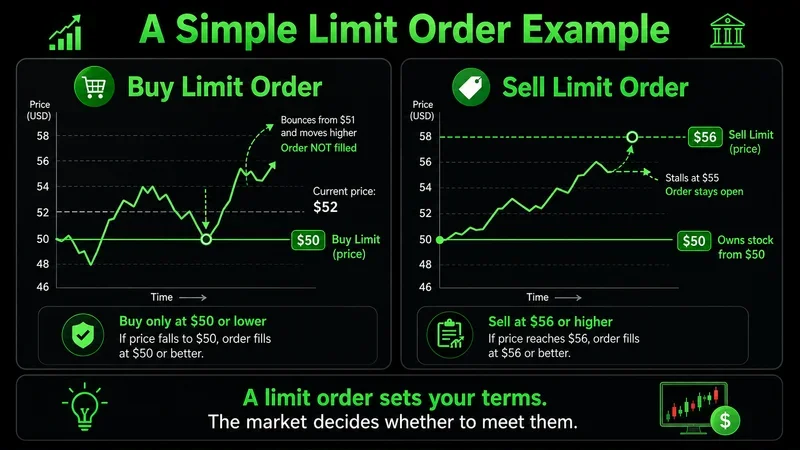
Say a stock is trading at 52. You think it is fair value closer to 50, and you only want to own it there. You place a buy limit at 50. The order rests. If the stock drifts down and trades at 50 or below, you get filled at 50 or better. If it bounces from 51 and runs higher, you never buy it, and you never overpay either.
Now flip it. You own the stock at 50 and want to sell into strength at 56. You place a sell limit at 56. If price reaches 56, you exit at 56 or higher. If it stalls at 55 and rolls over, the order stays open and you keep the position. That is a limit order example a beginner can hold onto: the order defines your terms, and the market decides whether to meet them.
When traders should use a limit order
The practical use case for a limit order is any situation where the entry or exit price is part of the plan, not an afterthought. A few conditions where it earns its place:
You are buying into a defined support level and want to be filled there or not at all.
You are scaling out of a winner at preset targets rather than guessing the top.
You are trading a wide or thin market where a market order could fill far from the last print.
You are working around a known catalyst and want to avoid chasing the first emotional move.
That last point is worth sitting with. The first move after major news is often not the cleanest opportunity. A resting limit at a level you defined before the volatility keeps you from buying the spike and selling the flush. The order enforces the patience that most accounts lose in the moment.
How a limit order affects your trading risk
A limit order is a risk tool, but it manages a specific risk: price risk on the fill. It does not manage the risk of being wrong about direction, and it does not guarantee you a seat in the trade. Used well, it keeps your cost basis honest and stops you from paying up in a panic.
There is a misconception worth correcting here. Many beginners believe a limit order protects them from slippage in every case. It protects the fill price, yes. It does not protect the outcome. If price slices through your buy limit and never looks back, your fill was clean and your trade is already underwater. Price control is not the same as being right. The order does its job and the position can still lose.
Where limit orders quietly break down
This is the part the textbook explanations skip. A limit order assumes the market will pause at your level long enough to fill you. In fast conditions, it often does not. When price gaps through a level on a news print or a thin overnight session, your resting limit can be skipped entirely. The market trades on both sides of your number without your order ever transacting, because there was no liquidity at your exact price when the move blew through.
That is the real failure mode, and it differs from simply not getting filled in a quiet market. You watched the trade work, the level traded, and you were still left behind. On instruments like index futures, where volatility expands fast, this happens more than beginners expect. A limit gives you price control while the market is orderly. The moment liquidity thins out, that same control can leave you on the sidelines of a move you read correctly.
Common limit order mistakes beginners make
Most limit order problems are not about the tool. They are about how it is used. The recurring ones:
Setting the limit too far from price, so it never fills and the trade idea expires.
Treating an unfilled limit as a free option and forgetting it is still live.
Assuming a fill means the trade is good, when the fill only means the price was met.
Using a limit to exit a losing position when speed mattered and a market order was the honest choice.
The through-line is simple. A limit order rewards traders who have a plan and punishes traders who use it to avoid making a decision. If you are placing a limit because you cannot commit to a level, the order is hiding the problem, not solving it.
FAQs
What is a limit order in trading, in simple terms? It is an instruction to buy or sell only at a set price or better. A buy limit fills at your price or lower; a sell limit fills at your price or higher. If the market never reaches your price, the order does not fill.
Does a limit order guarantee my fill price? It guarantees you will not fill worse than your price, and you may fill better if the market gaps in your favor. It does not guarantee the order fills at all. If price never trades through your level, nothing happens.
When should I use a limit order instead of a market order? Use a limit order when the entry or exit price is part of your plan and you can accept not trading if the level never comes. Use a market order when getting in or out now matters more than the exact price.
Why did my limit order not fill even though the price was reached? In fast or thin markets, price can trade through your level without enough volume resting at your exact price to fill you. The level printed, but the liquidity was not there when the move passed, so your order was skipped.
The takeaway on limit orders
A limit order buys you price control and charges you certainty of execution. It fills at your level or better, or it does not fill, and in fast conditions it can be skipped even when the price you wanted prints on the screen. Treat it as a tool for traders who already have a level and a plan, not as a way to avoid the decision. Used that way, it keeps your cost basis disciplined; used as a substitute for a plan, it just delays the problem.
Worth the read?