Liquidity in Trading — What It Means and Why It Matters
Liquidity in trading is how easily you can buy or sell an asset without moving its price. Here is what it means and why it decides your real cost.
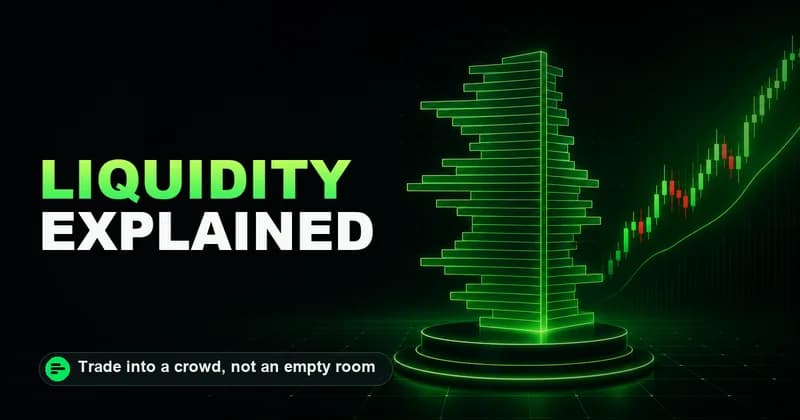
Liquidity is how easily you can buy or sell an asset without moving its price against you. In a liquid market there are enough buyers and sellers on both sides that your order fills near the price you see, almost instantly. In a thin market, the same order can push price several ticks before it completes. That gap between the price you expected and the price you got is where most beginners quietly lose money, and they rarely connect it back to liquidity.
Most traders study entries and ignore the conditions that decide whether an entry can even be executed cleanly. Liquidity is one of those conditions. It does not predict direction. It decides how much it costs you to be right or wrong.
What liquidity actually means when you are in a trade
The textbook liquidity meaning is simple: a liquid asset can be converted to cash quickly, at a fair price, with low transaction cost. Cash itself is the most liquid thing you can hold. A house is one of the least liquid, because selling it takes weeks and the price is negotiable.
In trading, liquidity shows up in three places you can actually see. The bid-ask spread tells you the cost of crossing from buyer to seller. Volume tells you how many contracts or shares are changing hands. Order-book depth tells you how much size is resting at each price. When all three are healthy, your order disappears into the flow. When they are thin, your order becomes the move.
This matters because price is not a single number. It is a stack of resting orders. Liquidity is how deep that stack is. A market can look calm on the chart and still be hollow underneath, which is the part a candlestick never shows you.
A simple liquidity example most beginners can picture
Here is a liquidity example you can hold in your head. Imagine you want to sell 100 shares of a large index name like an S&P 500 component. There are thousands of buyers waiting within a penny of the last price, so your sale fills instantly and the price barely flinches. That is deep liquidity.
Now imagine you hold 100 shares of a tiny micro-cap that trades a few thousand shares a day. There may be one buyer at the current price and the next buyer 4% lower. To sell, you either wait or accept the lower price. Your own order drags the market down. That is thin liquidity, and the loss is real even though the chart only shows one red candle.
The asset did not change between those two cases. The depth of willing participants did. That is the whole concept.
How to read liquidity without an order-flow degree
Liquidity trading basics do not require a Bloomberg terminal. You can read most of what matters from three things already on your screen.
- Spread. A tight bid-ask spread means buyers and sellers agree on value and there is competition to fill you. A wide spread means the opposite. Major forex pairs and index futures run razor-thin spreads; exotic pairs and small-caps do not.
- Volume. Rising volume into a level confirms that real participants are transacting there. Volume that dries up tells you the move may be running on momentum alone, with no one underneath to catch it.
- Depth. If your platform shows the order book or a depth-of-market ladder, look at how much size sits within a few ticks of price. Thin ladders fill violently.
None of these are precise. They are a read, not a reading. The goal is to know whether you are trading into a crowd or into an empty room before you commit size.
Liquidity vs volatility — the two things beginners keep confusing
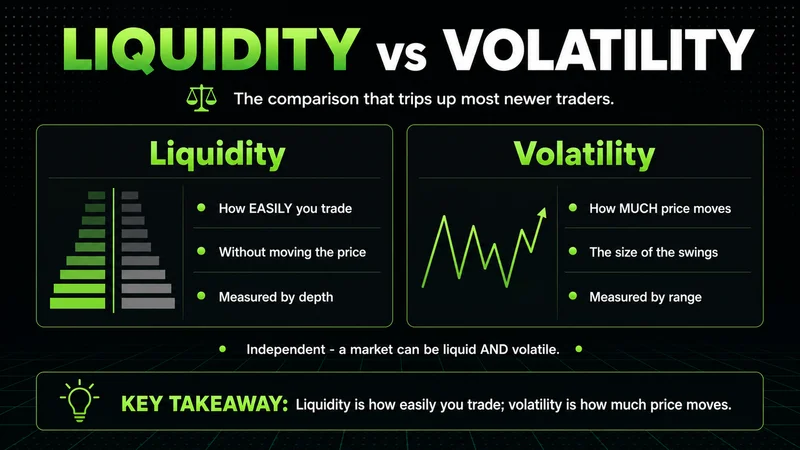
Liquidity vs volatility is the comparison that trips up most newer traders, because the two often move together and feel like the same thing. They are not.
Volatility is how much price moves. Liquidity is how easily it can be traded while it moves. A market can be highly liquid and highly volatile at the same time, which is exactly what index futures do around major data. Price travels fast, but there is still enough depth to get filled.
The dangerous combination is high volatility with low liquidity. Price is swinging hard and there is almost no one to trade against. Spreads blow out, stops fill far from where they were placed, and a position that looked risk-defined on the chart turns out not to be. Understanding liquidity vs volatility explained this way keeps you from assuming a fast market is also a tradable one.
Where liquidity quietly breaks
This is the part the glossary definitions leave out. Liquidity is not a fixed property of an asset. It is a condition that changes by the hour, and it breaks at the worst possible moments.
Structure reads cleanly during regular cash-session hours, when participation is highest. Overnight on thin liquidity, the same chart means almost nothing. The bids that were stacked under price during the day are gone, so a small order can travel a long way. The first move after a major news print is the same trap. Volatility spikes, but the depth that normally absorbs orders has stepped aside, so spreads gap and fills get ugly.
A tight spread on a quiet screen can also be an illusion. It looks liquid until you send real size, and then the book is hollow behind the top level. The displayed price was real; the depth behind it was not.
The displayed price tells you where the last trade happened. It does not promise that your trade can happen there too.
This is why liquidity risks are mostly timing risks. The same setup that is clean at 10 a.m. can be untradeable at 2 a.m., and nothing on the price chart will warn you.
The liquidity mistakes that cost beginners the most
Most liquidity mistakes come from assuming liquidity is always there. A few show up repeatedly.
- Trading thin instruments with size meant for liquid ones. A position size that is invisible in index futures will move a small-cap or an exotic pair against you on entry and again on exit.
- Placing stops in thin zones. A stop resting where there is no resting liquidity does not get filled at your level. It gets filled at the next available price, which can be far worse.
- Trading the open or the news spike for the volatility while ignoring the liquidity. The first move after major news is often not the cleanest opportunity. Many traders lose reacting to the spike instead of waiting for depth to return.
- Confusing a tight spread for deep liquidity. Spread is the top of the book. Depth is everything behind it. They are not the same.
Most traders do not have a strategy problem here. They have a context problem. The entry was fine; the conditions were not.
When should a trader actually use liquidity in a decision?
Liquidity belongs in the decision before the entry, not after it. As a practical liquidity strategy, treat it as a filter rather than a signal.
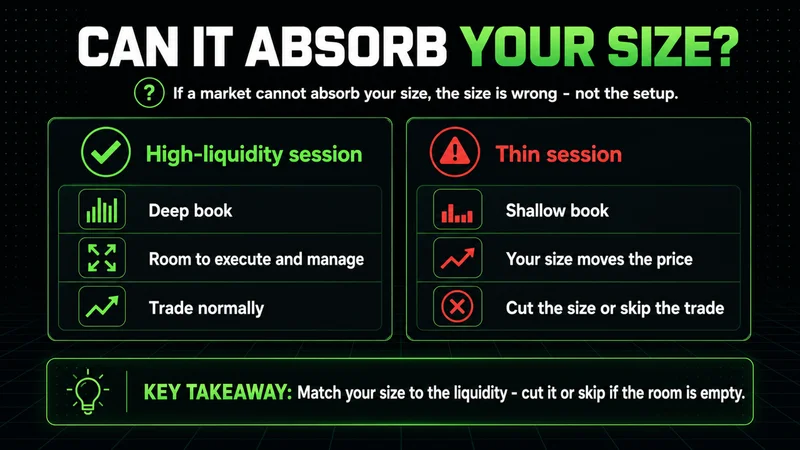
Before you size a trade, ask whether the instrument and the session can absorb the size you intend to use. If the answer is no, the setup is not invalid, but your size is. Cut the size or skip the trade. During high-liquidity hours in major markets, you have room to execute and manage normally. During thin sessions, illiquid names, or the minutes around a news release, the same idea carries hidden execution cost that the chart will never show you. Is liquidity important for beginners? It is arguably more important for them than for anyone else, because beginners trade the thin, cheap-looking instruments where the cost of poor liquidity is highest.
A short liquidity checklist before you click buy
A liquidity checklist for new traders does not need to be complicated. Run these four questions before you commit:
- Is the spread tight relative to this instrument's normal range?
- Is volume present and steady at the level I am trading?
- Is there real depth behind the top of the book, or just the top?
- Is this a session and an asset that can absorb my position size cleanly?
If the answers are yes, execute and manage the trade on its own merits. If any answer is no, the issue is not your direction. It is your conditions, and the fix is smaller size or no trade at all. Liquidity does not tell you where price is going. It tells you what it will cost you to be there.
FAQs
What is liquidity in trading in simple terms? It is how easily you can buy or sell an asset without moving its price. High liquidity means plenty of buyers and sellers, so orders fill quickly near the quoted price. Low liquidity means few participants, so your own order can push the price against you.
Is high liquidity always better than low liquidity? For most traders, yes, because it lowers transaction cost and execution risk. High liquidity gives tighter spreads and cleaner fills. The main trade-off is that the most liquid markets are also the most competitive, so edges there are thin and have to be earned through execution quality.
How does liquidity affect trading risk? It changes how much your entries and exits actually cost and whether your stops fill where you placed them. In thin conditions, spreads widen and stops slip to worse prices, so a position that looked risk-defined on the chart can lose more than planned. Liquidity is a core part of managing real, not theoretical, risk.
Worth the read?