The Biggest Stock Markets — What Size Buys You
The biggest stock markets are ranked by market capitalization, led by the U.S. Here is what that size actually buys a trader, and what it does not.
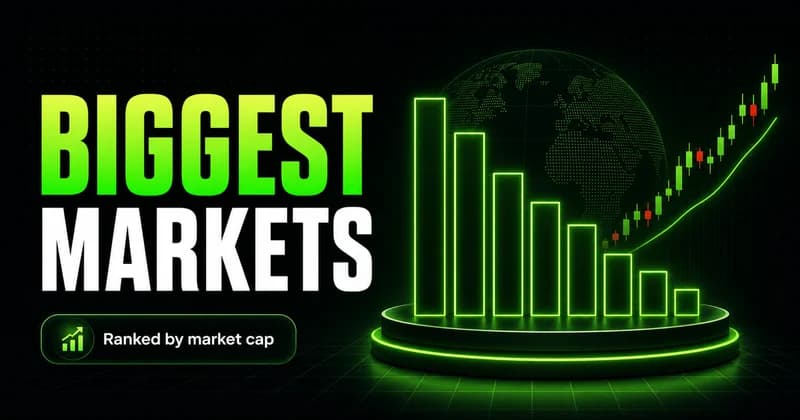
The biggest stock markets are the exchanges with the largest total market capitalization, the combined value of every company listed on them. As of early 2026, the United States holds that position by a wide margin, with the Nasdaq and the New York Stock Exchange together listing companies worth more than the next several markets combined. Size, here, is a measure of how much capital sits in one place. It is not a measure of how well that capital performs.
That distinction matters more than most rankings admit. A larger market gives you deeper liquidity and tighter spreads. It does not give you better returns, lower risk, or a cleaner read on price. Traders who confuse the two end up sizing into the wrong assumption.
What the biggest stock markets actually measure
When a list ranks the biggest stock markets, it is almost always ranking by domestic market capitalization, the total value of shares listed on a given exchange. The figure moves daily as prices, exchange rates, listings, and delistings change. A market can climb the ranking on a strong currency alone, with no underlying company doing anything different.
There is a second measure that often gets blurred into the first: trading volume, the dollar value of shares actually changing hands. A market can be large by capitalization yet thin in daily turnover, or smaller in size but heavily traded. For execution, volume is the number that tells you whether you can get in and out without moving price against yourself.
Keep the two separate. Capitalization tells you how much value is parked on an exchange. Volume tells you how much of it is in motion right now.
A short history of how these markets got so large
The scale of today's biggest stock markets is recent. The New York Stock Exchange traces back to an agreement signed under a buttonwood tree in 1792, but exchanges stayed regional and relatively small for most of their history. Capitalization compounded over the last few decades, driven by index inclusion, the growth of passive flows, and a handful of very large technology companies whose weight now anchors entire indices.
This is worth holding in mind. A market's current size is the product of a specific path, not a permanent feature. Rankings that looked settled twenty years ago have reordered. The ones today will reorder again.
The biggest stock markets ranked by market capitalization
The table below reflects approximate domestic market capitalization for the leading exchanges in early 2026. Treat the figures as a snapshot. They shift with every session, and the order near the bottom of the list changes more often than the top.
Rank | Exchange | Region | Approx. market cap |
|---|---|---|---|
1 | Nasdaq | United States | ~$35T |
2 | New York Stock Exchange | United States | ~$31T |
3 | Shanghai Stock Exchange | China | ~$10T |
4 | Euronext | Europe | ~$7T |
5 | Japan Exchange Group | Japan | ~$7T |
6 | Shenzhen Stock Exchange | China | ~$6T |
7 | Hong Kong Exchanges | Hong Kong | ~$6T |
8 | National Stock Exchange of India | India | ~$5T |
Two things stand out:
The top two are both American, and both dwarf everything below them.
The gap between second and third place is larger than the entire capitalization of most other exchanges on the planet.
That concentration is the single most important fact about the global equity landscape right now.
How the biggest stock markets differ from the New York Stock Exchange
The phrasing trips people up, so it is worth being precise. The New York Stock Exchange is one of the biggest stock markets, not a separate thing being compared against them. The Nasdaq and the NYSE are the two largest exchanges in the world, and they sit in the same country. The real distinction is between the two of them.
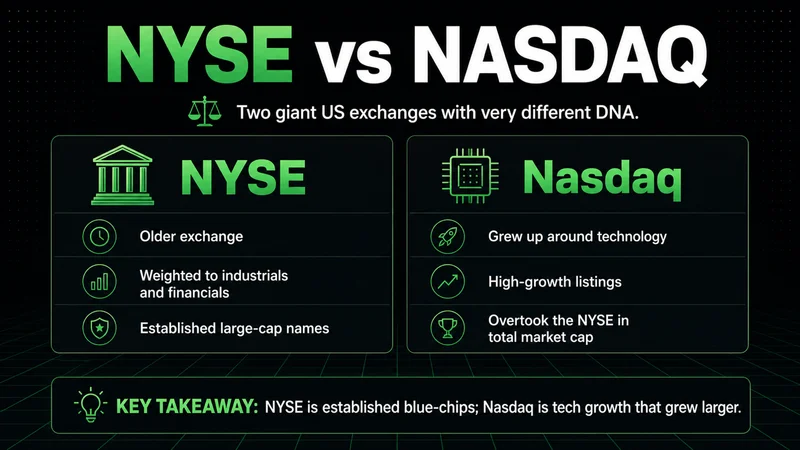
The NYSE is older and historically weighted toward established industrials, financials, and large-cap names. The Nasdaq grew up around technology and high-growth listings, which is part of why it overtook the NYSE in total capitalization as those companies expanded. For a trader, the practical difference is in the character of the order flow, not the building. A Nasdaq-heavy index like the one underlying NQ futures behaves with more volatility and faster momentum than a broader S&P 500 measure traded through ES. Same country, very different temperament.
What size means for an investor versus a trader
For a long-term investor, the size of a market is mostly a proxy for access and stability. The biggest stock markets for investors offer thousands of listings, deep secondary markets, and the regulatory infrastructure that makes a position easy to hold for years. That is a real advantage, and it is why so much global capital concentrates in U.S. equities.
For a trader, size matters in a narrower, more immediate way. Depth is what lets you execute. In the largest markets, the spread on a liquid name is tight and the book is thick enough that a normal-sized order fills without slippage. That liquidity is the edge you are actually buying when you trade the biggest names on the biggest exchanges.
The market rewards patience far more than activity, and that is doubly true here. A deep market gives you room to wait for a clean setup instead of forcing trades into a thin book. Most traders read "large and liquid" as permission to trade more. The more useful read is that liquidity lowers the cost of doing nothing until conditions are worth participating in.
When market size stops helping you
Depth is conditional. The liquidity that makes a large market easy to trade in normal conditions is not guaranteed in every session. During a macro shock, a major data release, or the first minutes after unexpected news, spreads on even the most liquid instruments widen and the book thins out fast. The same size that protected your execution an hour earlier offers almost no protection during the volatility spike.
This is where the assumption breaks. A trader who has only ever sized positions in calm, deep conditions can carry that confidence straight into a moment where the depth has evaporated. The first move after major news is rarely the cleanest opportunity, and in those windows the market's headline size tells you nothing about whether your stop will fill where you expect. Capital preservation in a large market still depends on defined risk, not on the comfort of the capitalization number.
Risks hiding inside the biggest stock markets
The biggest stock markets carry risks that their size can disguise. Two stand out before you put on any position:
Concentration. When a handful of mega-cap companies make up a large share of an index, the index is far less diversified than its breadth suggests, and a move in those few names drives the whole tape.
Currency. For anyone trading a foreign market, capitalization measured in dollars can rise or fall on the exchange rate alone, separate from any business performance.
The deeper risk is interpretive. A market being the largest does not make its listings the best value or its direction more predictable. Size buys liquidity. It does not buy a forecast. Treating the ranking as a quality signal is how traders end up overexposed to a market they never actually analyzed.
A short checklist before you trade a large market
Use the size of a market as context, not as a conclusion. Before putting risk on, run through a few questions:
Is the market deep in this specific instrument, or only on paper across the whole exchange?
Is current volume confirming the move, or is price drifting on thin participation?
Does a currency exposure sit underneath the trade that I have not accounted for?
Have I defined my invalidation, independent of how large or liquid the market is?
Are conditions actually high-probability right now, or am I treating size as a reason to be active?
None of these are answered by the ranking. They are answered by reading the order flow and the context in front of you.
FAQs
What are the biggest stock markets in the world? Measured by domestic market capitalization, the largest are the Nasdaq and the New York Stock Exchange, both in the United States, followed by exchanges in China, Europe, Japan, and India. The U.S. leads by a wide margin, with its two main exchanges worth more than the next several combined.
Is the biggest stock market the best one to trade? Not automatically. The biggest markets offer the deepest liquidity, which lowers execution cost, but size says nothing about returns, valuation, or how predictable price will be. Liquidity is an execution advantage, not a forecasting edge.
What is the difference between market capitalization and trading volume? Capitalization is the total value of all listed shares, a measure of how much value sits on an exchange. Volume is the value of shares actually traded in a period, a measure of how much is in motion. Volume, not capitalization, tells you whether you can execute without moving price.
Why is the New York Stock Exchange counted separately from the Nasdaq? They are two distinct exchanges in the same country, each with its own listings and order flow. The NYSE skews toward established large-cap and industrial names, while the Nasdaq is weighted toward technology and high-growth companies, which is why it now leads in total capitalization.
The bottom line on the biggest stock markets
The biggest stock markets are large because capital has concentrated there over decades, and that concentration gives you liquidity, access, and stability. None of it gives you an edge by itself. Size tells you how easy a market is to trade, not whether the trade is worth taking. Read the depth, confirm the volume, account for currency, and define your risk before the ranking ever enters the decision. The exchange's capitalization is the backdrop. Your execution is still the job.
Worth the read?