Position Sizing Formula — Sizing a Trade by Risk
The position sizing formula is one division: account risk divided by stop distance. Here is how to size every trade by risk, with a worked example.

The position sizing formula tells you how many shares or contracts to trade so that a single loss costs only what you decided to risk in advance. In its simplest form it is one division: dollars you are willing to lose, divided by the distance from your entry to your stop. That number is your size. Everything else is commentary.
Most traders learn it backward. They pick a size first, usually the largest one the account allows, and then look for a stop that justifies it. The formula reverses that order. Risk comes first, the stop defines the math, and size is the output, never the input. That single reversal is the difference between a process that protects an account and one that quietly drains it.
What the position sizing formula actually means
Position sizing is the decision about how much of your capital is exposed on one trade. The position sizing formula is the rule that turns a chosen risk amount into a concrete number of units. It is not a prediction tool and it does not improve your entries. It controls one thing: how much damage a wrong idea can do.
The meaning matters because size is the variable that ends accounts. A trader can be right on direction and structure and still lose everything by sizing emotionally. The formula exists to remove that emotion from the one place it is most expensive.
Think of it as the gap between two unrelated questions. Where the trade is going is an analysis question. How much you stand to lose if you are wrong is a sizing question. The formula keeps the second question from being answered by hope.
The position sizing formula, broken down
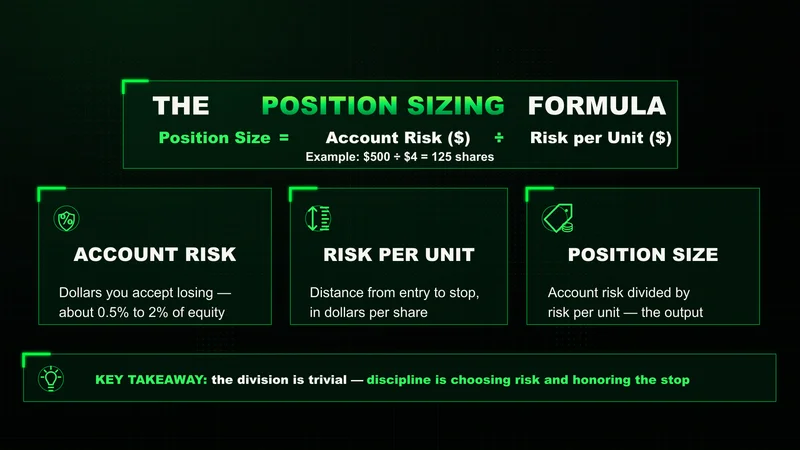
The calculation has three inputs and one output.
- Account risk — the dollar amount you accept losing on this trade. Most disciplined traders keep this between 0.5% and 2% of account equity.
- Risk per unit — the distance between your entry price and your stop-loss, measured in dollars per share or per contract.
- Position size — account risk divided by risk per unit.
Written out, it reads: position size equals account risk in dollars, divided by the distance between the entry price and the stop price.
For a long trade you subtract the stop from the entry; for a short trade you subtract the entry from the stop. The sign does not matter because the distance is what you are measuring. The result is the number of units that keeps your loss capped at the account risk you chose.
Knowing how to calculate the position sizing formula is less about the arithmetic and more about discipline around the inputs. The division is trivial. Choosing a risk percentage and then honoring the stop that defines it is the part that separates traders who survive from those who do not.
Walking the formula through a real trade
An example makes the mechanics concrete. Say the account holds 50,000 dollars and the chosen risk is 1%, so the account risk is 500 dollars. The setup is a long entry at 100 dollars with a stop at 96 dollars. The risk per share is 4 dollars.
Position size is 500 divided by 4, which is 125 shares. If the stop is hit, the loss is 125 shares times 4 dollars, or 500 dollars, exactly the risk that was defined before the trade.
Now change one input. Keep the same account and risk but widen the stop to 90 dollars, a 10-dollar distance. The size drops to 50 shares. The dollar risk stays at 500. This is the part most traders miss: a wider stop does not mean more risk, it means a smaller position. The formula holds the loss constant and lets size float.
The table below shows how size moves as the stop distance changes, holding the account at 50,000 dollars and risk at 1%.
| Entry | Stop | Risk per share | Account risk | Position size |
|---|---|---|---|---|
| 100 | 98 | 2 | 500 | 250 shares |
| 100 | 96 | 4 | 500 | 125 shares |
| 100 | 90 | 10 | 500 | 50 shares |
| 100 | 80 | 20 | 500 | 25 shares |
The dollar loss is identical in every row. Only the share count changes. That is the formula doing its job.
Position sizing formula vs. risk per trade explained
These two ideas get used interchangeably, and they are not the same. Risk per trade is a policy: the percentage of equity you are willing to lose on any single position. The position sizing formula is the mechanism that enforces that policy across trades with different stop distances.
Risk per trade answers how much. The formula answers how many. A trader who fixes risk per trade at 1% but ignores the formula will take wildly inconsistent losses, because a fixed share count produces a different dollar loss every time the stop distance changes. Trade the same 100 shares on a 2-dollar stop and again on an 8-dollar stop, and the second loss is four times the first even though the position looks identical. Pairing a fixed risk percentage with the formula is what makes losses uniform. That uniformity is what lets a losing streak stay survivable instead of compounding into a drawdown that breaks the account.
Where the position sizing formula breaks down
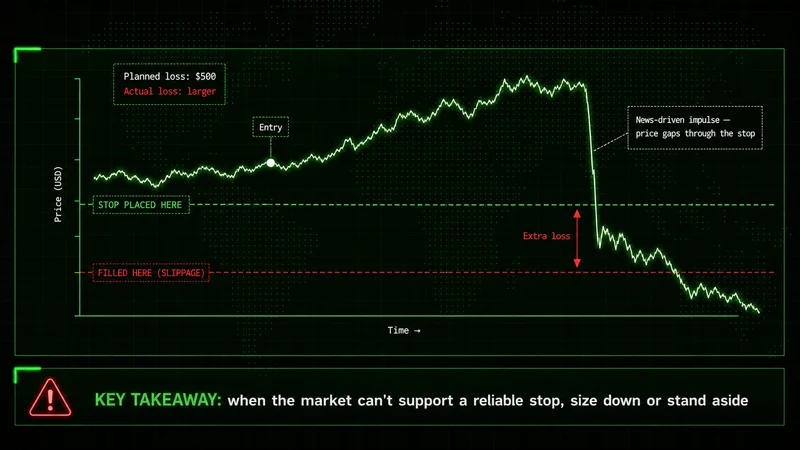
The formula assumes one thing that fast markets do not always provide: a stable, honest stop level. It works cleanly when structure gives you a clear invalidation point that price respects. In high-volatility futures like NQ or GC during a macro-driven session, that assumption can fail within minutes.
Gold trades technically for hours and then invalidates an entire move in a single news-driven impulse. When that happens, the stop you sized against does not fill where you placed it. Slippage turns a 500-dollar planned loss into something larger, and the formula's math quietly stops protecting you. The number was correct; the market did not honor the inputs.
This only works while the stop distance is something the market will actually trade through in an orderly way. Outside that condition, on thin overnight liquidity or into a scheduled release, the same calculation gives you false precision. The right response is not a better formula. It is smaller size, or no position at all, when conditions cannot support a reliable stop.
Common position sizing formula mistakes beginners make
The arithmetic is rarely where traders go wrong. The errors are behavioral, and they repeat.
- Sizing first, justifying later. Picking a comfortable share count and then drawing a stop to fit it inverts the formula and removes its only purpose.
- Moving the stop instead of accepting the loss. Widening a stop mid-trade to avoid being stopped out silently doubles or triples the risk the formula was holding constant.
- Ignoring slippage on wide-distance trades. Treating the planned loss as the certain loss in fast markets leads to repeated overruns.
- Increasing size after a loss to recover. This is the most expensive mistake, and it is rarely a math error. Most traders are overleveraged without realizing it; if one losing trade affects the next decision, the position was already too large.
That last point is worth sitting with. The formula cannot save a trader who overrides it the moment a loss stings. Sizing discipline is tested after the loss, not before it.
A position sizing formula template for trading review
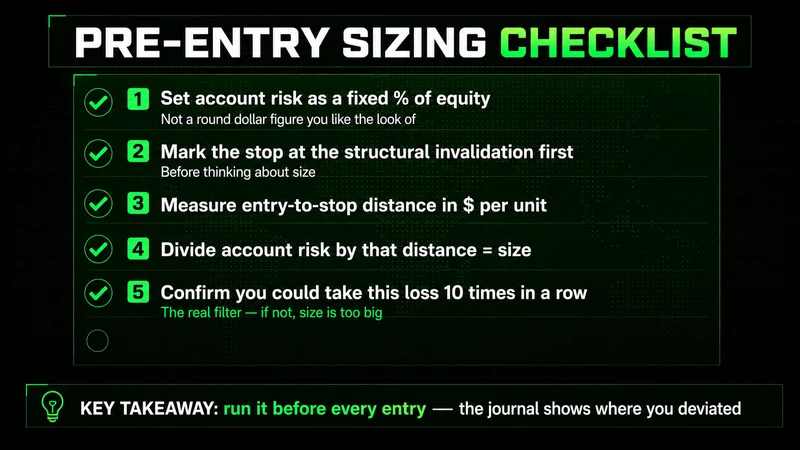
You do not need software to apply this. A short checklist, run before every entry, enforces the formula better than any calculator because it forces the inputs in the right order.
- Set account risk as a fixed percentage of current equity, not a round dollar figure you like the look of.
- Mark the stop at the structural invalidation level first, before thinking about size.
- Measure the distance from entry to stop in dollars per unit.
- Divide account risk by that distance to get the size.
- Confirm the worst-case loss is one you can take ten times in a row without it changing how you trade.
The fifth step is the real filter. If the answer is no, the size is too big regardless of what the formula produced. Run this template as part of every trading review and the sizing errors surface quickly, because the journal shows where you deviated from your own numbers.
How to improve your position sizing formula over time
The base formula does not change, but how you apply it should mature with your data. Early on, a flat percentage risk per trade is the right tool. It is simple, it is hard to misuse, and it keeps you in the game long enough to gather a sample.
Once you have a meaningful record, refinement becomes possible. You might lower risk in conditions your journal flags as low-quality and reserve full size for the setups that have earned it. Some traders scale risk to volatility, widening stops and cutting size when ranges expand. These are adjustments to the inputs, not replacements for the formula.
The improvement that matters most is consistency, not sophistication. A trader who applies a plain percentage-risk formula on every trade, without exception, will outperform one who runs a complex model but abandons it under pressure. Sizing is a discipline problem long before it is an optimization problem.
The bottom line on the position sizing formula
The position sizing formula is one division: account risk divided by the distance to your stop. The math is simple on purpose. Its value comes entirely from the order of operations — risk first, stop second, size last — and from the discipline to honor that order when a trade goes against you.
Get the inputs right and the formula keeps every loss the size you chose. Override it after a bad trade, or apply it where the market cannot support a reliable stop, and the number becomes meaningless. Protecting capital is the first objective, and consistent sizing is the most direct tool for doing it. Size for survival first, and let the analysis earn its keep on top of that.
Worth the read?