Risk Management Orders — How They Protect Your Trades
Risk management orders decide the cost of being wrong before the trade does, using stop-loss, stop-limit, and take-profit levels you set in advance.

Risk management orders are the instructions you place in advance to close or limit a position when price moves against you, so the size of a loss is decided before the trade rather than during it. They are not entries. They are the part of the plan that defines where you are wrong and how much that costs. Most traders spend their attention on getting in. The orders that actually protect capital sit on the other side of the trade, and they are the ones beginners tend to treat as an afterthought.
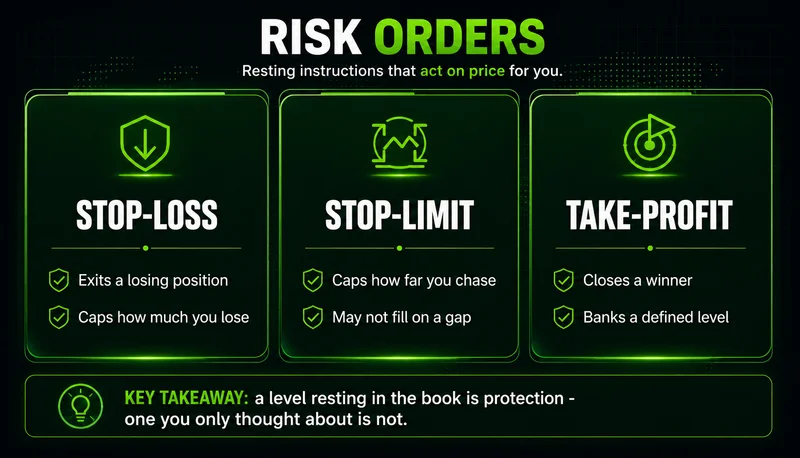
A risk management order is any resting instruction whose job is to control downside or secure an outcome: a stop-loss that exits a losing position, a stop-limit that caps how far you will chase the fill, a take-profit that closes a winner at a defined level. Each one converts a vague intention into a concrete level the platform will act on without you. That distinction matters more than it sounds. A level you have only thought about is not protection. A level resting in the order book is.
What risk management orders actually mean
The meaning of risk management orders is simple once you separate intent from execution. An entry order expresses where you want to be in the market. A risk management order expresses what happens when the trade either fails or works. The first is about opportunity. The second is about survival.
This is where most failed trades begin. Poor positioning and the absence of a predefined exit usually decide the outcome long before price does anything dramatic. When you place a stop before entering, you are forcing one decision while you are still calm. When you skip it and plan to "watch the chart," you are leaving that decision for the exact moment your judgment is worst.
Risk-defined trading is the whole point. You accept that any single trade can be wrong, and you decide in advance how wrong you are willing to be. The order is the mechanism that holds you to it.
Risk management orders vs entry orders
An entry order and a risk management order do different jobs, and confusing them is a common beginner mistake.
An entry order gets you into a position: a market order fills immediately at the current price, a limit order waits for a specific price, a buy-stop triggers entry on a breakout. Its concern is participation.
A risk management order governs the position once you hold it. The stop-loss defines your invalidation, the level where the reason for the trade no longer holds. The take-profit defines where you are willing to bank the move rather than give it back. Together they frame the trade before you commit capital, which is the only honest way to know your risk-to-reward.
The cleaner way to think about it: the entry is a guess about direction. The risk management orders are the rules that keep a wrong guess from becoming an account problem.
How risk management orders work
A stop-loss rests below your entry on a long position and above it on a short. When price reaches that level, the stop converts to a market order and your position is closed. A take-profit works the same way in reverse, closing the position when price reaches your target.
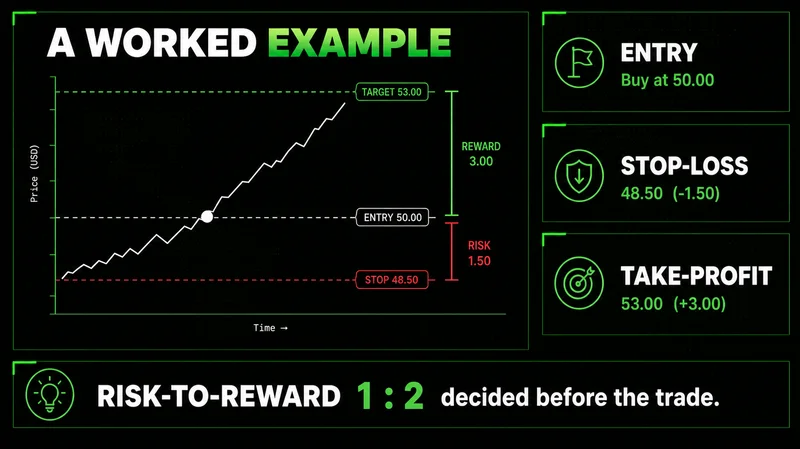
Consider a simple risk management orders example. You buy a stock at 50.00. Your analysis says the idea is invalid below 48.50, so you place a stop-loss there, defining a 1.50 risk per share. You see resistance near 53.00, so you place a take-profit there for a 3.00 reward. That is a risk-to-reward of roughly 1:2, decided before you ever held the position. Whether the trade wins or loses, you knew both outcomes in advance.
The order does the work so you do not have to sit and decide under pressure. That is the operational value: it removes the moment of hesitation where most discretionary mistakes happen.
Execution and fill price: where the protection gets tested
Here is the part the broker guides tend to soften. A stop-loss does not guarantee your fill price. It guarantees a trigger. When price reaches your level, the stop becomes a market order, and a market order takes whatever liquidity is available.
In normal conditions the difference is small. In fast or thin conditions it is not. This is slippage risk, and it is the gap between where your stop triggered and where it actually filled. A stop-limit order addresses one side of this by refusing to fill beyond a price you set, but it introduces the opposite problem: if price gaps straight through your limit, the order does not fill at all and you stay in the losing trade.
This is the honest limitation. Structure reads cleanly during regular cash hours when liquidity is deep. Overnight, over a weekend, or through a scheduled news release, the same protective order can fill far from its trigger, because price moves between levels without trading at every one in between. Gold respects structure for hours and then invalidates the entire move within minutes during macro-driven conditions, and a stop placed for the quiet tape behaves very differently in that window. A risk management order limits your exposure. It does not freeze the market at your chosen price.
Knowing this changes how you place them. You size the position for the realistic fill, not the ideal one, and you treat overnight risk on illiquid instruments as a separate decision rather than assuming the stop will behave the way it does midday.
When to use risk management orders
The honest answer is on every position that can move while you are not watching it, which is almost all of them. But the use case is not uniform.
A defined stop earns its place when:
The position is large enough that a single adverse move would affect your decision-making on the next trade.
You cannot watch the screen continuously, including overnight and weekend exposure.
Volatility is elevated and the speed of a move could exceed your reaction time.
The instrument is prone to gaps around scheduled events.
The market rewards patience far more than activity, and risk management orders are how that patience gets enforced. They let you step away from low-quality conditions instead of babysitting a position you should not be in.
There is one nuance worth stating. A protective order is not a substitute for position sizing. If a single losing trade emotionally affects your next decision, the size was too large no matter where the stop sat. The order controls the exit. Sizing controls whether that exit hurts.
Common risk management orders mistakes beginners make
The recurring errors are predictable, and they cluster around emotion rather than analysis.
Placing the stop too tight, at a level normal noise will hit, then getting stopped out of an idea that was actually fine.
Placing the stop at a round number everyone else uses, where liquidity sits and price is likely to be drawn before reversing.
Moving the stop further away once price approaches it, which converts a defined loss into an undefined one.
Trading with no stop at all and relying on "I'll close it manually," which fails precisely when the move is fast.
Setting the take-profit by hope rather than by a real level, so winners get cut early and losers run.
Most traders do not have a strategy problem. They have a discipline problem, and the protective order is where that shows up first. Breaking the rule you set while calm is the quiet start of most account damage.
A mediocre entry with proper risk control survives. A perfect entry with poor sizing eventually destroys the account.
The order is only as good as your willingness to leave it alone once it is placed.
A risk management orders checklist for new traders
Before you commit to a position, confirm each of these. It takes seconds and it is the difference between risk-defined trading and improvising:
Entry level identified, with a specific reason for it.
Invalidation level identified, the price where the idea is wrong.
Stop-loss resting at that invalidation, not a level chosen for comfort.
Take-profit set at a real structural level, giving a risk-to-reward you would accept repeatedly.
Position sized so the distance to the stop equals a loss you can take without flinching.
Awareness of any scheduled event or overnight window that could cause a gap.
If any line is blank, the trade is not ready. That is not caution for its own sake. It is the recognition that protecting capital is the first objective, and consistency is built by surviving difficult periods rather than maximizing the good ones.
FAQs
What is risk management orders in trading? Risk management orders are resting instructions that limit downside or secure an outcome on a position, mainly stop-loss, stop-limit, and take-profit orders. They define where you exit a losing or winning trade before you enter, so the size of the result is decided in advance rather than under pressure.
How does risk management orders work? When price reaches the level you set, the order activates automatically. A stop-loss triggers an exit on a losing position and a take-profit closes a winner at your target. The platform executes the instruction without you needing to watch the screen.
Are risk management orders important for beginners? Yes, because they enforce a decision while you are calm rather than during a fast move when judgment is worst. For newer traders, a predefined stop is often the single habit that keeps a normal losing trade from turning into account damage.
Do risk management orders guarantee my exit price? No. A stop-loss guarantees a trigger, not a fill price. In fast, thin, or gapping conditions the actual fill can be worse than your level, which is the slippage risk you size the position to absorb.
What is the difference between risk management orders and entry orders? Entry orders get you into a position and concern participation. Risk management orders govern the position once you hold it and concern survival, defining your invalidation and your target before capital is committed.
Key points to remember
Risk management orders are the instructions that decide the cost of being wrong before the trade proves you wrong. They are separate from entries, and treating them as an afterthought is where most beginner damage starts.
A stop-loss defines invalidation, a take-profit defines where you bank the move, and a stop-limit caps how far you chase a fill. None of them freeze the market at your chosen price, so you size the position for a realistic fill and treat overnight and event risk as their own decisions. Set the level while you are calm, place it at real structure rather than comfort, and leave it alone once it rests. The order protects capital only when the discipline behind it holds.
Worth the read?